
On 11 December 1827 at about 8 am, a prisoner named John Stones was working at the Moreton Bay settlement making bricks, when a fellow convict William Johnson approached him with the startling announcement “Morris Morgan has threatened to knock my brains out many times, and I hit him with an axe.”
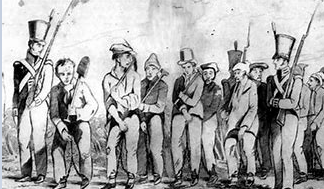
Morris Morgan was a 30-year-old Welshman, a solid 5 feet 5 with a florid complexion, brown hair and hazel eyes. Transported for life in 1819, he had reoffended in Sydney in November 1826 and was serving a 3-year sentence at Moreton Bay. Described as a quiet man, not given to quarrelling with other prisoners, he had been cutting wood in the next paddock with Johnson when he was struck from the side. Stones said that he was close enough to the wood-cutters to have heard if there was any quarrel between Morgan and Johnson.
William Johnson was one of six prisoners transported on the Earle St Vincent in 1826. The group was sentenced to go directly to the penal colony of last resort, Norfolk Island, for their sentences because of their “notorious bad characters”. The ship landed at Hobart Town, with a view to head to Norfolk Island, but the Colonial Secretary made an order that they should instead serve their original sentences at Moreton Bay. Johnson was 25, a sailor with a sallow complexion, dark brown hair and grey eyes.
John Stones asked Johnson if he had killed the man. Johnson replied, “go up, and see”. Stones went up to find Morris lying on his back barely alive, with two noticeable wounds, one to the right side of the head and one to the neck below. Dr. Cowper was sent for and came the short distance from his house to attend to Morris, who died shortly after his arrival. The wounds were too severe to be survived – the spinal cord was nearly severed; an artery had been cut and the vertebrae had been broken.
Johnson did not flee the area, although there was ample opportunity to do so, and was taken into custody for the murder. He was then sent to Sydney to take his trial. Moreton Bay had no sittings of the Supreme Court until 1850, and the Commandant had no jurisdiction in the matter.
At the trial on Friday March 21, 1828 before Justice Dowling, the prisoners John Stones and Edward Mullens attended to give their evidence, as did Dr. Cowper, as a government official. William Johnson did not have his witnesses produced for his defence. He told the Court that he had summoned them two months ago, but they had not been produced. Justice Dowling told him that it was too late to stand the matter down – had Johnson advised the Court of this issue at the beginning of proceedings, something could have been done. Now, it was just too late.
Johnson’s counsel implied that subpoenaing prisoners as witnesses for the defence of a fellow prisoner was difficult, because the authorities did not appear to have a process for producing them. Justice Dowling wasn’t having any of that, and summed up at length for the jury, who retired briefly and gave a guilty verdict.
Justice Dowling gave a stirring sentencing speech, quoted at length in the press, imploring Johnson to make his peace with his maker, whom he was shortly to meet.
On Monday, 24 March 1828, Johnson and two other prisoners were executed by hanging. One of the other prisoners had a shocking experience, the gibbet snapped and flung him, alive but semi-conscious into one of the coffins, which had been thoughtfully placed below for convenience. He waited while the other two were cut down and taken away and was then re-hung. William Johnson had been ordered to be anatomised after death. It was considered the most final punishment, because cutting up the body meant that it could not rise again, whole, on Judgement Day.
Johnson’s complaint of not having his defence witnesses produced would be repeated on several occasions in later trials, with similarly tragic results.
Sources:
The Sydney Gazette and New South Wales Advertiser, Friday 21 March, Monday 24 March 1828.
The Australian, Wednesday 26 March 1828
Chronological Register, Moreton Bay 1824-1839
Picture: bubblepedia.blogspot.com
 Moreton Bay and More