
The first three of today’s mug shots show what can happen when the law interacts with poverty and alcoholism. There was no capacity in the 19th century court or prison system for social workers, or drug and alcohol counsellors. The gaol instead was filled with mentally ill, poor, or addicted prisoners.
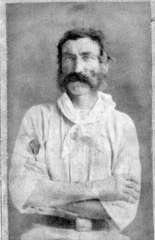
In 1876, William Kelly, of Ireland sits for his prison photograph. No particulars, beyond his native place were recorded. On the opposite page, where one would usually find particulars of offences, is a scrawled note in pencil: “about 20 convictions for drunkenness”. He folds his arms across his body, and although dirty and unkempt, he retains a rakish, slightly defiant air.

The same year, a respectable-looking young man, Charles Rix, 27, is imprisoned for Habitual Drunkenness offences committed at Allora, a picturesque small town on the Darling Downs. Born in England, he came to Australia as a small child, and worked as a farmer.
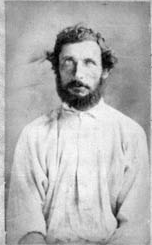
John McGrath, a 30-year-old Irishman received 1 month’s imprisonment in winter 1876 for vagrancy. He appears wild and unkempt. His fixed, glazed stare may just be a result of having to concentrate on a spot in the middle distance in order to keep still for the photograph. Luckily, like Charles Rix, one visit to Brisbane Gaol was enough for McGrath.
John Byrne
This case shows the possibilities for law enforcement with access to identifying photographs of offenders. In this matter, the presiding Judge did not feel that the physical description in the Police Gazette at the time was enough to identify a criminal without evidence of the gaoler.
However, the relatively quick and widespread dissemination of printed material like the Police Gazette, and the existence of the electric telegraph meant that law enforcement was changing.
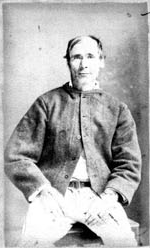
HORSE STEALING:
John Byrne, alias John Nore, alias John Thompson, alias John Marsden, was charged with having on March 31 stolen two horses, the property of William Scott. A second count charged prisoner with having feloniously received the property. Prisoner pleaded not guilty; he was not defended.
The particulars of the case were very recently reported in this journal. Mr Scott, a drover, had the two horses in question whilst camped off the Maryborough Road near Gympie on March 31; he missed them the next day, and they were afterwards recovered by the Police in the possession of prisoner on the other side of Nanango on April 18; prisoner did not give a satisfactory account of his possession of the horses. The horses were produced and positively identified by Scott as his property.
Prisoner did not cross-examine any of the witnesses, neither did he address the jury. His Honour briefly summed up. Prisoner was informed that he could still call evidence for his defence if he wished; he did not do so, however. The jury then found prisoner guilty on the first count.
Prisoner had nothing to say why the sentence of the Court should not be passed upon him. Inspector Lloyd gave evidence that the Police ‘Gazette’ showed that a man answering prisoner’s description had been convicted before. He only knew him by this description. His Honour said without the evidence of the gaoler he could not accept the ‘Gazette’ as proof of the conviction. – His Honour said the offence of horse-stealing was a serious one, and the sentence of the Court was that the prisoner should be kept in penal servitude for four years.
Gympie Times and Mary River Mining Gazette (Qld.: 1868 – 1919), Wednesday 8 July 1874, page 3
John Byrne’s history is in the sparse notes on his prison card. A miner by trade, he had been born at sea, and was 53 on his 1874 admission to Brisbane Gaol. “At Sea” became your native place for life it seems. He stood 5 feet 4, had brown hair and eyes. He was able to read and write and came to Australia in 1865.
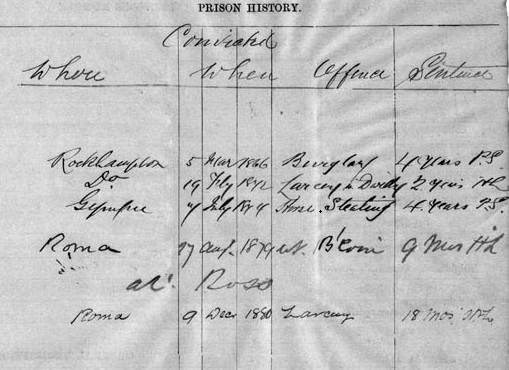
The 4 years in Brisbane Gaol from 1874 to 1878 did not deter him from re-offending, though. His offences of dishonesty spanned 1866 to 1880, his final term being 18 months for Larceny at Roma.
SOURCES:
| Queensland State Archives Series ID 3693, Photographic Records, Descriptions and Criminal Histories of Prisoners – (Males and Females) [HM Gaol, Brisbane, later HM Prison (Boggo Road), Brisbane] |
 Moreton Bay and More