
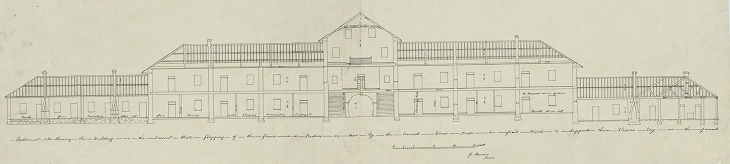
“Be Quick”
Sometime between 3 and 4 in the morning of 19 February 1830, in the Prisoners’ Barracks at Moreton Bay, a voice whispered, “be quick”.
It was a bright moonlit night, nearing dawn. Some of the prisoners were awake, others oblivious. The Barracks were quite full – almost 100 men – and prisoners bunked in together to save space. Some men were in irons, others were in “French Irons”, which made a high-pitched jingling sound when they moved.
February nights in Brisbane are oppressively warm, but a window with wooden bars let air in. The moon and a fire burning outside illuminated the barracks.
George Williams stirred in his shared bunk; Mark King’s knees were in his back. King slept with his legs up because of a painful boil on the right knee. Young asked King to move his legs. He didn’t get a response, so he straightened King’s legs himself.
Richard Young answered a call of nature in “the tub” and returned to the bunk he shared with Mark King, Henry Muggleton and ‘Fire Eater’ Williams. He noticed a man on his knees with his back turned away. He was sure it was Henry Muggleton. As Young reached his part of the bunk, he heard a whisper “be quick”, accompanied by the jingle of French Irons. Young was positive that the whisper came from Thomas Walsh.
Just then George Williams, lying next to Mark King, heard a blow being struck and turned to see Henry Muggleton hitting Mark King on the head with an axe, quickly and repeatedly. Williams was too afraid to stop Muggleton, who then threw the axe away and crawled into bed alongside his victim. Richard Young cried “Murder” to attract the attention of the sentry outside the window.
Felix McCoey, sleeping in a bunk at the feet of Muggleton and King, woke to hear the cry of “Murder, murder!” and the sound of the axe striking on bones and cracking them. He took note of Muggleton’s actions but feared “a clip” if he drew attention to himself.
The hue and cry brought Soldiers and Parker the Overseer, and Richard Young told Parker to search the man lying in bed with the bloodied victim. Parker turned the blanket over – Muggleton was seen to have blood on his sleeve and on his breast. The axe was found in the gang-way where it had been thrown.
Mark King lay moaning and semi-conscious, and Surgeon Dr Henry Cowper had him removed to the Convict Hospital. King would die three days later.
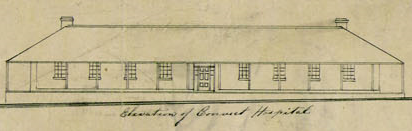
Later on the morning of the murder, Dr Cowper made his way from the hospital to see Overseer Parker, and saw Muggleton and three other men in irons, chained to trees. Young Patrick Cuffe and Thomas Walsh were chained to the first tree, looking very pale. Muggleton and a William Brown were chained to another. Muggleton had strings tied around his legs to make them swell, and Cowper noticed ulcers on them. Brown then told Cowper that all four men had conspired to murder Mark King.
Later, in the cells, Brown would repeat this confession to Cowper, who he had called for specially. However, when the men were taken before the settlement’s Commandant, Captain Logan, Muggleton swore that he alone had murdered King, and the other three knew nothing of it.
On 21 February 1830, Felix McCoey helped carry King to his grave in the old convict cemetery on the eastern side of what is now the Hershell Street/North Quay intersection.
After reviewing the confessions, all four prisoners were sent to Sydney to take their trial for the murder of Mark King. Henry Muggleton was convicted and sentenced to death. Cuffe, Brown and Walsh were found not guilty of murder, and then subsequently not guilty as accessories after the fact.
Who were these men? And why did they kill another inmate?
Henry Muggleton had a history of violence. A Londoner, aged 21 when he arrived at Moreton Bay, he already had a life sentence for Cutting and Maiming at 17, and he reoffended at Wallis Plains, receiving 3 further years attempting the lives of 2 men. Although his description at Moreton Bay was pale, with dark brown hair and hazel eyes, the Sydney Monitor, at his trial described him thus: “Muggleton, a man of colour, is of determined appearance and is stout built.”
Patrick Cuffe, a teenager from Kilkenny, had been transported for 7 years for Larceny at 16. At Penrith General Sessions, he received 3 years at Moreton Bay for repeatedly absconding.
William Brown, a 30-year-old sailor from Liverpool was transported for 7 years, then reoffended by “repeatedly stowing away”, which earned him 2 years at Moreton Bay.
Thomas Walsh (Welch in the Chronological Register) was a 20-year-old carpenter from Bristol, transported for life for picking pockets, and was serving 3 years at Moreton Bay for robbery.
The victim was Mark King, 22, of Birmingham. He stood 5 feet 7, pale with brown hair and dark grey eyes. He was transported in 1825 for 14 years, and reoffended in 1828, and was at the time of his murder doing 3 years for robbery. Felix McCoey remembered him as a very young-looking man, of about 20 or 21. None of the witnesses noticed any friction between the prisoners and their victim in the days prior to the killing.
Initial reports of the crime indicated a motive of an escape plan that the killer or killers did not want made known. Evidence at the trial touched on whether the axe was intended to be used to cut the slats of the convict barracks.
The four accused had been seen with their heads together on the day before the murder, and Patrick Cuffe was the owner of the axe. Henry Muggleton was violent, and Cuffe and Brown were frequent absconders. Walsh probably didn’t have a lot to lose. Mark King may have overheard something, or had just been in the way.
Ultimately, Muggleton saved the lives of his co-accused by taking the whole blame for the killing. He also took the real motive for the murder to his grave. The sentence was death by hanging and his corpse to be anatomised. This was the practice at the time – it allowed surgeons to study anatomy on human bodies and further punished the offender with the prospect of not being able to rise with an intact body on Judgement Day.
Sources:
- Sydney Gazette and New South Wales Advertiser (NSW : 1803 – 1842), Tuesday 30 March 1830, page 2.
- Sydney Monitor (NSW : 1828 – 1838), Wednesday 2 June 1830, page 2.
- Sydney Gazette and New South Wales Advertiser (NSW : 1803 – 1842), Saturday 29 May 1830, page 4.
- Chronological Register of Prisoners, 1824-1839.
- Alphabetical List of Prisoners, 1824-1839.
- Queensland State Archives Agency ID2753, Commandant’s Office, Moreton Bay.
 Moreton Bay and More