
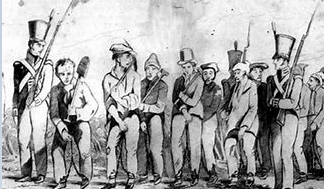
In late January 1828, Samuel Myers, overseer, Michael Malone and Francis Reynolds were guarding a field of maize on the South Bank of the Brisbane River. There had been problems with the local indigenous people raiding the crops there for six months. In the last bad incident, an indigenous man had been killed, and a soldier speared in the leg. Guarding the crops was at once boring and unnerving. Sometimes nothing happened, and all you got was a day of sunburn. That was a good day.
Agriculture was important to Moreton Bay. The settlement was set up to be self-supporting, and loss of crops meant less to eat, unless supplies could be got from Sydney for the Commissariat. Some men watched cattle, others guarded the crops.
Overseer Samuel Myers, 36, was a short, swarthy sort of fellow from London – he’d been out in the Colonies half his life, having been transported in the famous year of 1812, when Bonaparte made the mistake of trying to invade Russia. Myers had volunteered for Moreton Bay, could you believe it, thinking a couple of years as an overseer might set him up – better rations and accommodation, plus a real bonus if you were a man looking to be emancipated. Mind you, there were quotas of work to be got out of these poor wretches, and a man had to be hard with some of them.
Wexford-born Michael Malone was one of the convicts under Myers. He was an unlucky bastard. He’d come out for seven years back in ’20 and was near to the end of his sentence when he was tried for attempting to commit a felony. Didn’t even get the job done and he was caught. His sentence was light – only 18 months, and he’d 6 of them done.
Young Francis Reynolds of Dublin was another of his charges. He might not look much – pitted with the pox as he was – but he’d absconded last autumn and managed 5 months out in the bush. He never said, but he must have had mates out there. He didn’t look the type to survive in the wilderness.
They scanned the area intently. The aborigines here were not like the ones in Sydney, who were more used to the whites. These fellows had no experience of white men, because the settlement was only a couple of years old.
The indigenous people watching in return, wanted their old life back. They wanted to hunt and fish and live on their lands, observing their traditions. The white men with their buildings, strange garb and stranger animals, were spreading out over their land. Ignoring the richness of the land, they planted for food near the river and drove the wildlife away. Hunger was a problem. Having white men there, clearing the forest and putting buildings over the sacred lands of their ancestors was sacrilege. Still, they hadn’t been there long. Maybe they could be made to go away.
The attack came quickly, and at the end of it, Samuel Myers and Michael Malone lay dead. Francis Reynolds survived and raised Hell, and the soldiers came. There were a group of indigenous men involved in the attack, but Francis Reynolds was sure he could identify one. Sure enough, the soldiers went out armed, and found a man that Francis Reynolds said was the killer.
The naked indigenous man, identified as Binghe Multo (or Bhinge Multo, or Milti) was put in a stone box with bars between him and the sun, and there he remained for the rest of summer, then autumn, then winter. The white men gave him food, and a blanket, but he wasn’t allowed outside. When the weather began to get warm, he was put on a boat. He couldn’t speak their language, they couldn’t speak his. He had no idea what was in store but was sure it wasn’t going to be good.
OFFICIAL CORRESPONDENCE:
28 January 1828: Captain Logan to the Colonial Secretary, Alexander McLeay, advising of the fatal attack. “Reynolds identified a native who has been detained”.
03 April 1828: Captain Logan to the Colonial Secretary, enclosing a copy of Francis Reynolds’ statement.
07 April 1828: Courthouse Chambers to Colonial Secretary, requests affidavit of Francis Reynolds and others regarding the cause of death of Myers and Malone. Sufficient case in statement for native black to be tried. Also requires evidence of a medical man regarding cause of death.
01 May 1828: From Captain Logan to Colonial Secretary, forwarding affidavits of Francis Reynolds and Thomas Smyth regarding the murder of Myers and Malone.
03 June 1828: From Captain Logan to Colonial Secretary, regarding depositions and native.
25 August 1828: Bhinge Multo per Isabella Schooner to Sydney for trial. (noted in Spicer’s Diary).
Captain Logan travelled to Sydney on the new Government schooner Letitia Bingham and arrived on 07 September 1828. Bhinge Multo on the Isabella Schooner arrived on the following Saturday.
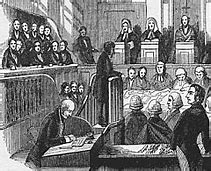
On 26 September 1828, the trial of Bhinge Multo commenced at the Supreme Court in Sydney. Imagine being Bhinge Multo – shunted into a large building full of white men dressed as crows, with white woolly hair, like old men. Perhaps they were old men. One man arguing all morning with the man in the raised seat. White people staring at you. So many of them. Craning their necks, whispering. Then you go back to the room you were in before, not knowing if you will ever see your country or people again.
The newspaper report of the trial – R. v. Binge Mhulto (1828) Sel Cas (Dowling) 1; [1828] NSWSupC 82, contains some inexcusable language, but I am reproducing it because it demonstrates that the Attorney-General was quite content to put a person on trial at the Supreme Court without any form of support, defense or interpreter. It also demonstrates that Justice Dowling was not prepared to allow the Court to ignore the situation of the defendant, or the “dry form of the law”.
Australian (Sydney, NSW : 1824 – 1848), Friday 26 September 1828, page 3
CASE OF THE ” NIGER.”
An aboriginal native of Moreton Bay was placed in the dock on Friday, for the purpose of being tried on an indictment charging him with the wilful murder of a European. Before the information being gone into or the prisoner called to plead, the learned Judge Mr. Dowling enquired whether or not the black was at all conversant with the English language, to which the Attorney-General replied in the negative.
Judge Dowling—Then how do you propose Mr. Attorney-General to try this man? The prisoner, according to the principles of the British Constitution, is entitled to be tried by a jury composed one-half of his own countrymen. But waiving even this as a matter of consideration; by what means do you intend Mr. Attorney-General to convey to this man’s mind whom you purpose to try for a capital felony, the nature and particulars of the charge?
The Attorney-General — May it please your Honour. I consider, that in the trial of this aboriginal native, it is not incumbent in me to provide either of the requisitions to which your Honour refers. Constituted as this Colony is, in respect of the aboriginal population, it is, I apprehend, to be considered on terms of relationship and good feeling between this class of people and Europeans. I hold that the aboriginals of this Colony are amenable to the British Laws for any acts they may be found guilty of, in the same proportion as Europeans, convicted of offences against them might be punished by our Courts.
With respect to the formation of a Jury composed one-half of Europeans and the other half of aboriginals; this, in the present untutored and savage state of the natives, is next to impossibility to effect. Hence, then, the absolute necessity of departing from the rule of law, which your Honour has adverted to, but which I admit is strictly in unison with the spirit of the British Constitution. But in the present unfettered state of the black community, I apprehend your Honour will see the necessity of foregoing this rule in the instance before the Court.
The Judge—The material question, for the consideration of the Court is—does the prisoner stand in such a situation as that he may be made to understand what is passing to his prejudice on the trial?
The Attorney-General—I believe your Honour he does not; and it may perhaps be necessary for me to explain to your Honour, why I have not taken the precaution of having persons in attendance who are conversant with the dialect of the Moreton Bay blacks, and who might have been used as interpreters on the occasion. The reason was this. Some months ago, a black native was tried for murder. On that occasion, I obtained the attendance of Mr. Threlkeld, a gentleman connected with the Wesleyan Mission, who understood tolerably well the native language of the person then on trial. I also procured the Chief Boongaree, who was employed in Court to assist Mr. Threlkeld in interpreting and propounding questions to the black. The latter however, for reasons best known to the man himself, refused to make answer to any of the questions put to him. The black was convicted, and subsequently executed in the usual, course of legal proceedings.
The Judge—Mr. Attorney-General, this man is a savage. He stands before the Court in the same light as a dumb man—as void of all intellect. You purpose examining witnesses in support of a charge, and that of capital felony, which affects his life. The man knows nothing of what is being said against him. He is incapable of making any defence. Non constat. If this man were made sensible of the nature of the charge you are here prepared to prove against him, he might set up such a satisfactory defence as to prove that he had been placed in such a situation, as that the retaliation on his part, which affected a European’s death, was justifiable in law.
The Attorney-General—I will just observe to your Honour, that the case as affects the prisoner, is one so clear and satisfactory in its character, as that it would be morally impossible, by any evidence which might be offered on the prisoner’s side, to shake that testimony. I can have no wish, your Honour, beyond the promotion of the ends of public justice—but I must say that in the present instance public justice would be sacrificed, if the dry form of law were to be rigidly adhered to, in instances where the aboriginals of the Colony are parties who have to appear before the Court. Your Honour is not perhaps aware of the fact, that with the black natives here, they do not make it a practice to revenge any insult that may have been offered them, upon the actual aggressor, but that they do so upon the very first European they meet with.
The Judge—The public justice of the country cannot be in any way defeated by the delay of this trial. The aboriginal inhabitants of the Colony are most certainly amenable to all the consequences of punishment which the English law affixes—but if these wretched people are to be held liable to punishment, the same as a European, surely those miserable outcasts are entitled to all the privileges and protection which the British law affords to its own immediate subjects. Looking at this case, in any point of view, I am clearly of opinion, that if I were to try this savage, in his utterly defenceless situation, I should be at once departing from the spirit and letter of the British law. As such I will not try this man. Let him be remanded.
The Attorney-General has it in his power to provide interpreters from the district the man came from (Moreton Bay), against the next Criminal Court Sessions The Attorney-General said he would be prepared to proceed on the trial of the prisoner next Session; and the man, who appeared before the Court almost in a state of nature, having an old blanket merely wrapped round his person, was then released from the dock, and ordered to be returned to gaol, with express instructions by the learned Judge to the Sheriff, that whilst there, the man should meet with humane treatment.
Captain Logan, the committing Magistrate from Moreton Bay, was in Sydney, and the Attorney-General was directed to approach him on the matter of an interpreter from Moreton Bay. One can theorise that this was not a priority for the Commandant, or that no interpreter existed at Moreton Bay.
Bhinge Multo was not tried for the murders of Myers and Malone. He disappears from the European record almost immediately, save for one more piece of official correspondence, this time in a letter from the Supreme Court to the Colonial Secretary, recommending that Bhinge Multo and another indigenous man be sent away from Sydney, to a place away from their Country. This would have been devastating, but it least I suppose, it did not mean death.
Supreme Court
19 December 1828
Sir,
I have the honor to inform you for the information of His Excellency, that there are Two Native Black men, (Binghi Multi and Willimore ) now confined in Gaol on charges of Murder. – On consultation with their Honors the Judges I have been advised, in consequence of the impracticability of enabling these men to take their Trials under all or any advantages of British Law or Justice, to forego the Prosecution and to recommend their being removed to some part of the Colony distant from their former abodes –
The first man, named Binghi Multi, was sent down from Moreton Bay, and the other, Willimore from the neighbourhood of Port Stephens.
I have the honor to be
Sir,
Your most obedient servant,
Alex. M. Baxter
To the Hon.
The Colonial Secretary
Sources:
- State Records, NSW 28/10171 4/2005.
- Queensland State Archives Series ID 5652 Book of Monthly Returns of Prisoners Maintained.
- Queensland State Archives Series ID 5653 Chronological Register of Prisoners.
- Australian, Friday 26 September 1828, page 3.
- Colonial Secretary’s correspondence: Letters relating to Moreton Bay And Queensland Received 1822 – 1860. Letters Received 1827 – 1828 And Papers Filed With Them – Reel A2.
 Moreton Bay and More