
Thomas O’Meara’s story.
Thomas O’Meara thought Overseer John Bluer was a bit mad. Bluer wore no shoes – except on Sundays – and scurried around a lot, giving incomprehensible orders to the men. Bluer had been relieved of Overseer duties a couple of times – once for leaving two men out in the field when he should have taken them in for dinner. O’Meara had no personal quarrel with the man, he was just very odd.
O’Meara was 51 and was going to spend the rest of his life at Moreton Bay. Once, he’d been a soldier, back in Ireland. Now, thanks to a conviction at Dublin and a worse one at Sydney, he was stuck forever in the toil and sorrow of Moreton Bay. He was by now very sorry for what he had done.
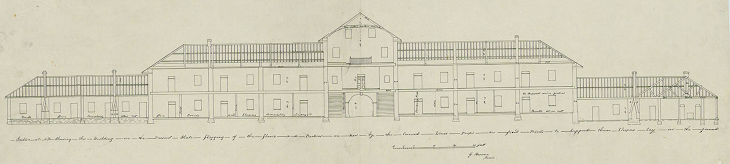
Early on the morning of November 19, 1831, Thomas O’Meara was in the Convict Barracks, making his way downstairs from the sleeping rooms to report to work. He felt a hot pain across his neck, someone moving behind him, and heard John Bluer say “take that”. O’Meara put his hand to his throat and felt blood seeping through his fingers. He ran down the rest of the stairs and into the yard and – thank God – Chief Constable John McIntosh was there to help him.
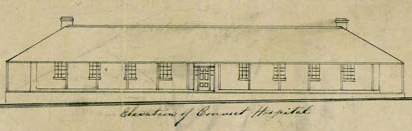
O’Meara was taken to the Hospital, and he remained there stitched up and recuperating until well after Christmas. Bluer was charged by McIntosh with cutting and maiming and conveyed to the cells.
John McIntosh’s Story.
John McIntosh had been at Moreton Bay the last 6 years. He’d come to New South Wales in 1818 for life from his native Glasgow and had tried to turn his life around in his strange new home. He earned a Ticket-of-Leave and volunteered to Moreton Bay in 1826 as Principal Overseer for 3 years. After this, he was made Chief Constable at Moreton Bay. Not an enviable job, but one with responsibility, and it was another step on the road to freedom.
On the morning of 19 November 1831, McIntosh was in the Barracks yard, talking to the Principal Overseer, and he saw Thomas O’Meara coming down the stairs. John Bluer was behind him. There was a scuffle, and next thing he knew, O’Meara was running towards him, clutching his throat and crying out “I am killed! I am killed!” Bluer made a run for it, and McIntosh dispatched a constable to get him. Bluer was quickly caught, with the blood-stained razor still on him.
“There’s another bloody rogue in the yard, and if I got alongside him, I would have settled him as well as O’Meara”, was all Bluer would say at the time. John McIntosh took that, and the razor, as proof of guilt. O’Meara was taken to Dr. Cowper at the Hospital, and John Bluer went to the cells to await an interview with Commandant Clunie.
McIntosh was there when Bluer went before Clunie and the prisoner told the Commandant that there was no-one he could call for his defence. Clunie acting as Magistrate, committed him to take his trial in Sydney.
Just before they were to go to Sydney, Captain Clunie asked Bluer again if there was anyone he wanted to speak on his behalf. Bluer said Martin Smith and Ryley Smith. That came as a surprise to McIntosh – those two prisoners were the ones Bluer left in the fields instead of bringing in for dinner time. Very odd indeed. Hoping for a holiday to Sydney perhaps? And Ryley Smith had been at least 20 yards away from him that morning. He couldn’t have seen a thing.
Ryley Smith’s story.
Ryley Smith of Warwickshire had been in Australia since he was sixteen years old. He got transportation for life in 1813. He’d been in a bit of strife in Sydney lately for being illegally at large, and that earned him 3 years at the Bay, and those 3 were very nearly up.
Ryley Smith went to Sydney in February 1832 to speak for his old Overseer Bluer at the trial. He heard that O’Meara was in a state about being called before the Court for 50 lashes for some pork and bread that went missing from the Courthouse. He reckoned he’d seen O’Meara with a razor the week before, and men who were facing the lash would cut themselves badly to avoid it. O’Meara and Bluer never quarrelled as far as he knew. He didn’t see anything, but Bluer wouldn’t have cut the man.
Martin Smith’s story.
Martin Smith, tailor by trade was 48, just a bit younger than O’Meara. He was transported the same year, but his Colonial Offence was not nearly as bad as O’Meara’s robbery. Smith was half-way through his 3 years for “Robbing a settler of a pair of trowsers, a handkerchief and a shirt, which were found on his person”. Well of course they were found on his bloody person, did they expect him to go around in a state of bloody nature?
Martin Smith also went to Sydney for Bluer’s trial. And did he have a story to tell. He told the Court that he had seen O’Meara sitting by the riverside the Friday before the incident, holding a razor and weeping. Smith asked O’Meara if he was going to have a shave, and O’Meara said it was the last he would give himself.
A couple of hours later, he reckoned, O’Meara came up to him, still in a state of gloom. Smith, knowing about the pork, asked O’Meara if he thought he’d be punished, and O’Meara said he would not give any scoundrel the satisfaction of punishing him. He would put an end to life. Smith told the Court that he said, Irishman to Irishman, “Tom, don’t do anything of the kind, you may get over this,” when he replied, “I do not care; I am for life at Moreton Bay, and I will be revenged on that Blewer right or wrong.”
Martin Smith did not see the wounding but thought that Bluer wouldn’t have done it. It was Smith’s view that O’Meara did it to himself. He reckoned if Ryley Smith had been paying attention, he would have seen the whole thing, but he wasn’t looking at that moment.
Just then a Juror piped up, asking what the revenge on Bluer remark meant. Smith told him that there was the business about the pork. O’Meara had got himself some, couldn’t account for where, and Bluer had reported him to the Superintendent. O’Meara was for 50 lashes on that one, and he couldn’t sleep, wandering about the Barracks all night before the cutting.
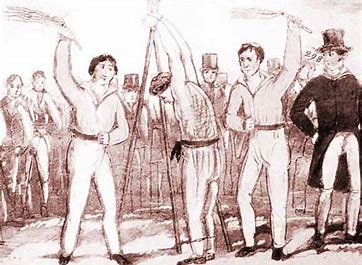
Men cut and maimed themselves all the time to escape the lash, Smith told the jury. They cut their privates, bellies, arms and legs. One man had jumped out of a 2-story building to avoid a scourging.
John McIntosh resumes his story.
John McIntosh found himself hastily recalled to the Court to be examined further after the Smith boys’ stories. He was not pleased.
McIntosh refuted the story of O’Meara being up for punishment. The man had some pork in his possession the week before all this happened, and he had been taken to Mr Spicer. O’Meara had been able to prove to Mr Spicer’s satisfaction that the pork was part of his rations. No-one was going to punish O’Meara. O’Meara and Bluer scuffled on the stairs in his line of sight, and no he did not think that O’Meara would cut himself and blame another man.
No, McIntosh added, he had not offered inducements to Bluer to confess. The man said what he said when he was apprehended with the razor and that’s all there was to it.
McIntosh repeated his record as a Principal Overseer and Chief Constable, and that was the trial done for him.
The rest of the trial.
John Bluer did not give evidence, but relied on what he had asked in cross-examination, as well as the evidence given by Ryley and Martin Smith.
Surgeon Cowper sent word that he didn’t have time to attend and give evidence, although he had come to Sydney. The Judge was most pleased to strike out the man’s witness expenses.
The Judge instructed the jury, the jury found Bluer guilty, and sentence of death was passed.
Weeks later, Bluer’s death sentence was commuted to hard labour in chains at Norfolk Island for life.
Martin Smith and Ryley Smith were not returned to Moreton Bay. Neither was Thomas O’Meara.
Sources:
Sydney Monitor (NSW : 1828 – 1838), Wednesday 22 February 1832, page 2
Sydney Monitor (NSW : 1828 – 1838), Saturday 2 March 1833, page 4
Sydney Monitor (NSW : 1828 – 1838), Saturday 10 March 1832, page 3
QUEENSLAND STATE ARCHIVES Series ID 5652 Book of Monthly Returns of Prisoners Maintained.
QUEENSLAND STATE ARCHIVES Series ID 5653 Chronological Register of Convicts, Moreton Bay.
QUEENSLAND STATE ARCHIVES Series ID 3739, Item ID 659 652. Convict Barracks.
QUEENSLAND STATE ARCHIVES Series ID 3739, Item ID 659 603. Convict Hospital and Surgeon’s Quarters.
Convict Triangle image credit: Tocat.com
 Moreton Bay and More