

The Book of Trials Held at Moreton Bay is an invaluable document, covering the final years of the convict settlement, and recording each action held before the Commandant sitting as Magistrate. Recorded in flowing longhand, every type of crime was dealt with – from the seemingly endless cases of “Refusing to do Work” to Committal proceedings for serious offences, to inquests into deaths at the settlement.
I have transcribed three inquests. One was for an Indigenous man, unnamed, who was shot for raiding a corn field. The next is for a female prisoner who died suddenly of asthma. The final inquest was held on the body of Barrack Sergeant James Wilkinson, who died in 1839. The length of the inquests, and trouble gone to, reflects the social standing of the deceased.
Deposition of William Adams per “Countess of Harcourt” taken before Foster Fyans, Esquire, J.P., touching the death of one of the Aborigines who was shot while plundering corn.
William Adams, duly sworn, states that he was employed as a Constable for the protection of the corn, that this day about 3 o’clock, two blacks came to him and brought him some parrots, he made them prisoners and got another man to assist him, and bringing them towards the town, one of them made his escape and in endeavouring to secure the other, he also broke away, when he fired his pistol and shot him through the body. He further states that he was in great danger of his life, from a number of other blacks, who were pressing upon him, and that he was fully sure that they came for the sole purpose of plundering the corn.
That’s it for the inquest. I don’t suppose that William Adams considered that the Indigenous people who gave him parrots might have been trying to exchange them for some badly-needed food. After all, the fields covered a lot of traditional hunting grounds.
Depositions taken before me, Sydney Cotter Esquire, one of the Magistrate’s Justices of the Peace for the aforesaid territory, touching the death of Elizabeth Hyland, a convict who died suddenly at Eagle Farm, on the morning of the 10th instant.
Assistant Surgeon Ballow, duly sworn, states that the deceased Elizabeth Hyland was of a delicate Constitution and affected with Asthma – she was subject to fits (of it) on exposure to cold and changes in the state of the atmosphere. About three months ago she had a severe attack and was under my medical charge suffering from cough and difficulty breathing. She was discharged from the hospital about 2 months since, quite well. Yesterday morning I was sent for by Mrs Cox stating she was in a dangerous way and before I could reach the farm, the woman was dead.
I have examined the body and found a congestion of blood in the lungs and am of the opinion that her death was caused by suffocation.
Colonial Assistant Surgeon David Keith Ballow
Maria Williams, Hospital Nurse, sworn, stated about 9 o’clock yesterday morning I was called from the Hospital Ward to see the deceased who had been taken suddenly ill – I desired some of the women to bring her to the Hospital and directed her to go to bed. She complained of suffocation and did not want to lie down and in about 15 minutes she expired in considerable agony.
Maria Williams X Her Mark
Chronic asthma can still cause sudden death in 2019, with all of our nebulisers and medications. The treatment for poor Elizabeth Hyland would have been poultices and broth, had she been reached in time.
Depositions taken on oath before me, Owen Gorman Esquire, one of Her Majesty’s Justices of the Peace, touching the death of James Wilkinson, late Barrack Sergeant at this settlement who was found drowned in the River Brisbane. 12th December 1839.
Evidence Thomas Smith:
Hospital Overseer Mr Thomas Smith being duly sworn deposeth that he went to the quarters of the deceased, about 11 o’clock on Wednesday 11th instant. Found the door of the sitting room locked, and the key in it. He looked through a hole and observed that the back door leading to the yard was open. He took no further notice, thinking that the deceased was out, and he returned home.
Went again to the quarters of the deceased about 2 o’clock that day and found that the key that was in the front door the first time had been taken out and the back door was shut, and the window blinds let down. Seeing the house shut up in this way he thought the deceased was lying on the bed. He did knock but returned home and came again to the deceased’s house about 6 o’clock the same evening. He found the house shut up in the same way, met William Crisby, a prisoner of the Crown who is servant to Mr Paget, who asked if he had seen any place as he was not to be found, and Mr Crisby had not seen him since early on the previous day. This caused an uneasiness in his mind, and he knocked at the door but got no answer. He then tried to open it, and on lifting the latch of the bedroom door, found it was not locked but that the key was inside. He desired Crisby to bring a light and Sergeant Barnes of the 80th Regiment. Searched the premises but they could find nothing of the deceased, nor did he see anything of him until this day when the body was found floating in the River Brisbane by Constable Black between three and four o’clock. Witness and the deceased were on intimate terms and in the habit of seeing each other every day, never heard him hint anything about destroying himself.
The rope with which the body was fastened to the stone is the same as some found in the quarters of the deceased, and witness thinks he drowned himself.
Evidence William Crisby.
William Crisby, a prisoner of the Crown, who is servant to Mr Paget being duly sworn, deposeth that between two and three o’clock on Wednesday the 11th inst. Overseer Henry Skinner of the Lumber Yard asked him if he saw Barrack Sergeant Wilkinson any place as he had been at his quarters twice that day and could not see him and he wanted him to point out where some repairs were to be done to the Military Quarters and no one seemed to know where he was. Crisby told Skinner he had not seen the deceased since early on the previous day about 6 o’clock. The same evening Crisby saw Mr Smith Overseer at the Hospital, go to the quarters of the deceased. Crisby then asked Mr Smith if he had seen the deceased any place as Skinner of the lumber yard and he could not find him any place and Crisby had not seen him since early in the previous day, on which Mr Smith knocked on the bedroom door and got no answer. He then lifted the latch and the door opened, the key being inside of the lock.
Crisby then brought a light and Sergeant Barnes of the 80th Regiment who came up at the time and Mr Smith searched the premises but could find nothing of the deceased, nor did Crisby see anything more of him until the body was found floating in the tied to a large stone. The rope being found fastened around both feet, then around the stone, then twice around the neck, then around the wrist by a running noose. The stone appeared to be in a fixed position. The weight brought the head, the hands and feet together and it appeared to Crisby that it seemed to have been done by the deceased himself.
Evidence Henry Skinner
Prisoner of the Crown Henry Skinner who is overseer at the Lumber Yard being duly sworn deposeth that on Wednesday the 11th inst., he required the deceased Barrack Sergeant James Wilkinson to show him where some repairs were to be done in the Military Barracks. Skinner went to the quarters of the deceased about 10 o’clock in the day and rapped at the door but got no answer. He then looked through the window and saw the back door leading to the yard open, he went down to the yard fence but could not see any one. Skinner enquired at the Military Barracks but could not get any account of the deceased. He went again to the quarters of the deceased between 2 and 3 o’clock, knocked at the door, got no answer, looked through the window. The back door was shut and the key that was in the front door of the sitting room when Skinner first went there was not in it then. Getting no answer, Skinner went away, met William Crisby and asked him if he had seen the deceased Barrack Sergeant James Wilkinson as he wanted him to know where some works were to be done in the Military Barracks, that he had been twice at his house and could not find him. Crisby said he did not see him since, and Skinner went to his work and knew no more about him.
Evidence Francis Black.
Constable Francis Black, a prisoner of the Crown, having been sworn duly deposeth that on the evening of the 12th instant he was directed by the Acting Chief Constable Mr White to take one of the native constables who is attached to the Police and go in search of the deceased Barrack Sergeant Wilkinson who was missing. He went accompanied by Native Constable Nucifora and two other blacks and searched in every direction for two miles until between three and four o’clock when he observed the body of the deceased floating in the River Brisbane nearly opposite the Hospital. A boat was brought, and the body taken out of the river when it was found to be tied to a large stone of thirty-seven pounds weight, the stone having been weighed by Kelly of the lumberyard. The rope was first fastened round both feet, then round the stone then twice round the neck then round one of the wrists, and lastly round the other wrist by a running noose. The stone appeared to be fastened in such a position that the weight of it brought the head, hands and feet together and it appeared to Black that it must have been done by the deceased himself.
Black did not see the deceased from early in the morning of the 10th inst., until the body was found in the river.
Evidence Doctor Ballow.
Colonial Assistant Surgeon David Keith Ballow duly sworn deposeth that about four o’clock in the day of 12th inst.: I was resent when the body of the late Barrack Sergeant James Wilkinson was taken out of the River Brisbane and shortly afterwards it was brought to the Hospital where I examined it and found it much swollen and livid through incipient putrefaction. The face was much disfigured, and the scalp lacerated and destroyed by the fish and infraction against rocks or stones. There was a rope fastened round the ankles, twice round the neck and wrists and I was told it was also tied to a large stone which had been taken off at the water’s edge. There was no mark of violence on the body and it appeared to me that the deceased’s death was occasioned by himself, as the rope with which the body was tied, corresponds with some found in the quarters of the deceased.
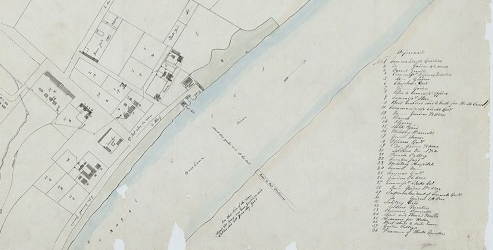
The little we can gather from the depositions suggest that Barracks Sergeant Wilkinson was lonely – he was not accompanied by a wife and family as many of his peers were. The wording of Smith’s evidence suggests, to the modern eye, that they might have been in a relationship. If so, they could not be exposed. Life alone in a tiny penal settlement in the subtropics, in a little house by an inviting river. This is only speculation. Wilkinson made sure he died, because an attempt to commit suicide was a crime in those far-off days, and by living he would have lost everything.

Again, speculating – did they bury the poor man “outside the fence” of the town cemetery near Skew Street? Or was he buried in the grounds? This new cemetery was for free citizens and the families of the military. The site of that cemetery is now E.E. McCormick place. The convicts were buried near North Quay with few markers and less ceremony.
Sources:
Book of Trials held at Moreton Bay, State Archives of Queensland ITEM No. 869682.
Brisbane Parks
 Moreton Bay and More