
Charles McManus (per “James Pattison”) and John Norman (per “Atlas”) were quite alike. They were both about 30, both 5 feet 7 ½ inches tall, both had sallow complexions with brown hair and hazel eyes. Both were sentenced to Moreton Bay for reoffending in the Colony of New South Wales, and both travelled from Sydney on the “Governor Phillip” on October 01, 1830. They worked on the same gang.
On October 22, 1830, just three weeks into their sentences at Moreton Bay, Charles McManus tried to kill John Norman. McManus was walking alongside Norman and lifted his hoe and struck Norman on the head with it, knocking him to the ground. While John Norman lay there stunned, Charles McManus struck him twice in the face with the instrument.
Did John Norman say or do something to make McManus want to kill him? It seems that he didn’t. The reports of the subsequent trial – whilst not very detailed – do not indicate that Norman had any sort of argument with McManus. The story was reported in the Monitor as another Moreton Bay Suicide by Sydney Hangman case. In this instance, Charles McManus got his wish, but John Norman got another sort of sentence – disability and disfigurement for life.
Charles McManus was transported to Australia for life by the Courts at County Dublin for burglary and robbery in July 1829. One year later, McManus faced the General Sessions at Windsor and received a 3-year sentence to Moreton Bay for robbery and absconding. His victim was looking at a much longer term and had been in Australia for 11 years already.
John Norman of Lincolnshire was sentenced to transportation for 7 years in 1819 and had been a prisoner in New South Wales working for Mr G Howell according to the Convict and Settler Muster of 1822. Gradually, throughout the 1820s, his prospects improved.
In 1825, Norman requested permission to marry a fellow convict, Mary Harding (per “Granada”). The Colonial Secretary’s office noted “the usual letter” in his correspondence, and there appears not to have been a marriage. Perhaps the usual letter was the usual no.
In 1826, a Certificate of Freedom was issued to John Norman. His description matched that on the Convict Indents when he arrived in New South Wales. Nothing out of the ordinary. His original sentence was complete.
Perhaps life as a semi-free man was harder than Norman had expected – he was a teenager when first transported. Perhaps he was just a thief. Whatever the reason, John Norman was convicted of sheep stealing in August 1830, and initially received the death penalty. He was reprieved, but the sentence was commuted to 14 years hard labour in chains at Moreton Bay. He was not going to leave until 1844, when he would be middle-aged. Better than death, perhaps.
Charles McManus, although his original sentence was life, was only looking at three years at Moreton Bay for his absconding and theft. He would go back to Sydney in late 1832, all being well.
Charles McManus apparently considered that the only way to get out of the hell of Moreton Bay was to kill a man, be sent to Sydney, have a trial and be hanged with a priest in attendance.
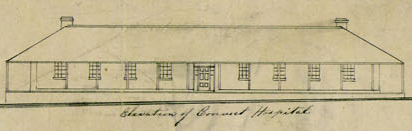
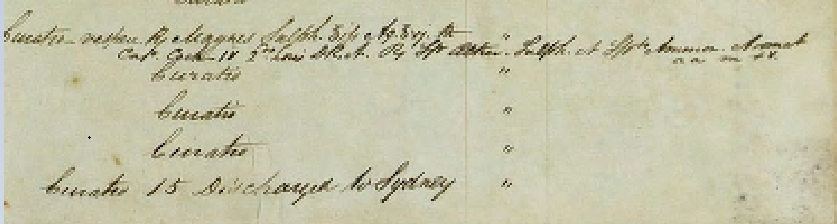
John Norman was taken to the Convict Hospital and remained there from October 22, 1830 until his release to Sydney on 14 January 1831. Dr Cowper was the Resident Surgeon there, and was astonished and no doubt relieved, that Norman survived. There was no anaesthetic for surgery, antibiotics for infection were nearly a century in the future, and pain relief was primitive. Dr Cowper had to beg for basic supplies from Sydney, so the recovery of such a badly injured patient is quite miraculous. Norman was released to Sydney because he would be giving evidence at a trial, and he simply was not in a fit state to endure the rigours of Moreton Bay.
Before the Supreme Court on May 20, 1831, Charles McManus pleaded guilty to cutting and wounding John Norman at Moreton Bay in October 1830. At first, he was determined to get the matter out of the way and refused to retract the plea. The Bench had no option but to remand him.
Whilst on remand, McManus had second thoughts, and withdrew his guilty plea. He was to be tried in the July 1831 sessions of the Supreme Court.
The trial was quick. The highlight for the press seemed to be a fellow prisoner at Moreton Bay, called as a witness, begging to be allocated to some other settlement after the trial, or he would be murdered by his fellow convicts on his return. The other prisoners in the Phoenix Hulk, where he was being kept, had already nicknamed him The Hangman. The Judge could offer no assistance but stated that he would pass the prisoner’s request on to the proper quarters.
On Thursday July 7, 1831, the jury found Charles McManus guilty of assaulting John Norman with intent to “kill and murder” him, and a second count of doing grievous bodily harm. The Judge pronounced the death sentence.
On Monday July 18,1831, Charles McManus was one of a group of prisoners executed at Sydney Gaol. He was, as he had hoped, attended by a priest. Prior to the drop, Charles McManus was the only prisoner to address the spectators, and he said in effect “Take warning by my fate. Drunkenness has brought me to this disgraceful death”.
And John Norman? He turned up in a prisoner muster in Tasmania in 1841, nearing the end of his Colonial sentence.
In 1847, he was in New South Wales and received a Certificate of Freedom for completing all of his sentences. In that document, John Norman was described as having “a dark ruddy complexion, hazel eyes, dark brown hair mixed with grey, has lost 3 front teeth upper jaw, has large scar extending from the left nostril to the left jaw. Disabled in the right arm and right leg”. That was John Norman’s real sentence.
SOURCES:
Sydney Monitor (NSW : 1828 – 1838), Saturday 21 May 1831, page 2
Sydney Herald (NSW : 1831 – 1842), Monday 23 May 1831, page 2
Sydney Herald (NSW: 1831 – 1842), Monday 11 July 1831, page 4
Sydney Herald (NSW : 1831 – 1842), Monday 11 July 1831, page 3
Sydney Herald (NSW : 1831 – 1842), Monday 18 July 1831, page 4
Chronological Register of Convicts at Moreton Bay 14.09.1824 – 15.11.1839. Item ID 869689, Series ID 5653, State Archives Queensland.
Register of provisions, medicines and patients in the Moreton Bay Hospital Item ID 1517409, Series ID 10810, State Archives, Queensland.
Registers of Cases and Treatment (Moreton Bay Hospital) 08.12.1830-18.01.1848, Item ID 2895, Series ID 10822.
Moreton Bay Penal Settlement Maps and Architectural Drawings, 28.09.1830-10.02.1842, Item ID 659634, Plans and Elevation of Hospital and Surgeon’s Quarters, Moreton Bay, Series ID 3739.
 Moreton Bay and More