
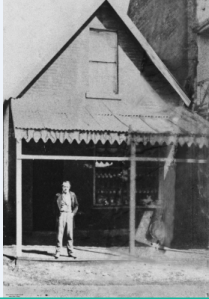
This is the first in a series of posts on the life of James Davis or “Duramboi”. The best-known convict absconder from Moreton Bay, he was considered a very bad character in his teens but after 14 years with the indigenous people of the Wide Bay area, went on to be an Interpreter for indigenous people in the Courts, and a wealthy businessman and landowner in Brisbane.
Glasgow to Moreton Bay and to the Bush
On September 29, 1824, James Davis appeared before the High Court of Justiciary in Glasgow and was found guilty in terms of his own confession to the offence of theft, habit and repute, and received, at 17 years of age, a sentence of Transportation for 14 years. Theft, habit and repute was the term used in Scottish law for a recidivist thief.
In late October, young Davis was among a group of male prisoners received at Calton-Hill Gaol, destined for the Hulks, and then transportation to Australia. The Edinburgh Advertiser of 09 November 1824 reported that:
“The eleven convicts belonging to Glasgow, before leaving the prison, were each presented with a pocket Bible, a collection of Tracts, and a catechism, neatly stitched. The delivery of the Bibles and Tracts was prefaced by a most impressive and feeling address from the Rev. James Morrison, chaplain of the prison.”
Davis, who could not read or write, would hardly derive much benefit from the Bible, tracts and catechism, beyond spiritual comfort. One can only speculate what the frightened teenager, facing a lifetime in an unimaginable country on the other side of the world, made of the impressive and feeling address. Perhaps it did resonate, because Davis was a lifelong Catholic, and he gave a substantial bequest to Brisbane’s St Stephens’ Catholic Cathedral at Brisbane in his will.
The Two James Davises
On 17 April 1825, two ships – the Minstrel and the Norfolk – departed for the Colony of New South Wales, carrying convicts under sentence of transportation. Both carried a James Davis. Both James Davises were very young men, convicted of crimes of dishonesty. However, Minstrel Davis was sentenced in Glasgow for 14 years for “theft, habit and repute”, and Norfolk Davis was sentenced to 7 years at Surrey Quarter Sessions for housebreaking.
The James Davis/Davies who was arrived New South Wales on August 18, 1825 on board the Norfolk was a pale, dark-haired 19-year-old man, with an inward cast on the left of his grey eyes. He stood just a hairsbreadth over 5 feet. He was a native Londoner and worked as a carter.
On August 22, the Minstrel arrived Sydney Cove with Jas Davies of Glasgow, a 17-year-old Cattle Boy, 5 feet 2 ¾ inches, with flaxen hair, light blue eyes and a very freckled complexion.
Moreton Bay
James Davis laboured in the convict system, still looking at ten years to serve when was convicted of housebreaking, or at least possessing the proceeds thereof, at Patrick’s Plains in January 1829. He was sentenced to three years at the Penal Colony of Moreton Bay, already a place to be dreaded.
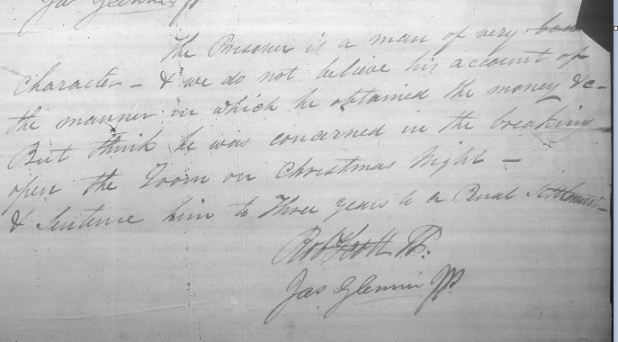
On February 18, 1829 James Davis arrived in Moreton Bay convict settlement via the brig Governor Phillip with 3 other prisoners. He is recorded in the Chronological Register as being Norfolk Davies.
However, the Alphabetical List of Prisoners has a physical description of the prisoner. “James Davis, native place – Glasgow, Age -19, 5ft 4 ¼, Freckled pock-pitted Complexion, Sandy Hair, Grey Eyes.” This description, based on actual observation, fits that of the Minstrel Davies. (His age changed from record to record – on the register for his second marriage, he claimed to be 64 in 1883, an age which would have seen him transported at the age of 5.)
Davis’ six weeks in the Moreton Bay penal colony were enough to convince him that life on the run was a preferable alternative. Moreton Bay’s sub-tropical summer was a shock to the system, and the settlement itself consisted of barely two dozen buildings, all less than five years old, spread over a cleared area at the edge of a river bend. Wheat fields surrounded the cluster of convict buildings, and at a bend in the river, a gardener kept 14 acres of vegetables under cultivation.
There were 772 prisoners in total, with 113 patients in the Convict Hospital on the day of his arrival. Heat exhaustion, insufficient fresh water supply, constant manual labour and poor rations had led to a devastating outbreak of dysentery over the summer of 1828 and 1829, and the rates of hospitalisation and death soared. Drought had ruined the crops of 1828-9, and the main fresh water supply to the settlement was a lagoon that stagnated in the heat.
For Davis, the prospect of dying of overwork, starvation or disease would have loomed large. Then there was the famously strict discipline given out to convict offenders under the command of Captain Patrick Logan.
“Oh, fellow prisoners, avoid Moreton Bay”
Accounts of Davis’ decision to abscond from the penal settlement give as the reason either a fear of the lashings meted out to convicts under Logan or becoming the victim of a murder plot by fellow convicts. There are no punishments against him in the records, but it would have been difficult to avoid seeing the lashings and their aftermath in the yard of the Convict Barracks.
There had been several murders and attempted murders committed by prisoners at Moreton Bay from 1825 until Davis’ time. They involved claims of provocation, fear of being informed on, and a desire to be put to death in Sydney rather than continue in Logan’s settlement.
The murderer Mathews went to the gallows protesting his innocence in April 1829, but it was his warning to other prisoners that caught the attention of the Press. “If you go to Moreton Bay, (said the culprit,) you are ruined beyond redemption. You are either flogged to death or worked to death. I have known many bright men murdered – completely murdered by the ill-usage of overseers, constables, and those above them. Take warning by me – take warning – never run from your road gangs or iron gangs. If may perhaps send you to Moreton Bay, and then you are a lost man. The last time I was flogged was for stealing a few grains of wheat. I received a hundred severe lashes. Oh, fellow prisoners, avoid Moreton Bay.”
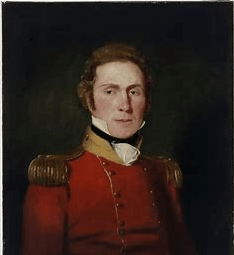
Captain Logan’s regime at Moreton Bay remains controversial nearly two centuries later. He was certainly a man in quite a hurry, having set about overseeing the building of most of the settlement upon his arrival in 1826, pausing only it seems to undertake long and hazardous journeys to ‘discover’ and map the surrounding countryside. He had a keen interest in the topography and botany of the area, keeping his superiors in Sydney informed of his findings and the progress of his penal colony – always in terms that did him the most credit.
Logan’s punishment of convict infractions was severe. His return of punishments was scrutinised by the Attorney-General, who felt it too brutal, and created a report stating so. Logan replied that he had neither the solitary confinement cells or the treadmill to resort as discipline, and therefore the lashings were, he regretted, a cruel but necessary substitute.
A treadmill was accordingly added to the Windmill building, but in September 1829, prisoner Michael Collins was killed after being caught up in the machinery. Working the treadmill became something for the prisoners to dread as much as the lash.
“Run. 30 March 1829.”
“Davis, doing duty in the lumber yard as assistant to the Blacksmith on 30 March 1829, being then only 17 years of age. The severity of the penal regulations being then very great, some murders had been committed by the prisoners with the intention of getting themselves hung; fearing he might fall a victim to some of his fellow prisoners, Davis absconded”. (As related by Simpson).
The records of the Moreton Bay Penal Colony show another convict ran on 30 March 1829, a Scot named John Downie. In the first detailed newspaper account of Duramboi, “Fourteen Years with the Aborigines”, we have an account of Davis and a companion taking to the bush. As they travelled northward, they were met and accepted by an indigenous group, until Davis’ companion unwittingly committed a sacrilege that cost him his life.
Downie was of a similar age and background to Davis, having been convicted in 1824, aged 19, of housebreaking and theft, habit and repute at the Aberdeen High Court of Justiciary. He received a life sentence, and was transported to Australia, arriving at Sydney on 29 April 1825, aboard the Royal Charlotte. Like Davis, he reoffended at Patrick’s Plains – having been convicted of Bushranging in August 1828 (at that time the term was associated only with convict absconding). As far as the records are concerned, Downie ran from the Colony on 30 March 1829 and was never heard from again.
To be continued.
Sources:
- Australian Convict Record Index, 1788 -1867.
- UK National Archives. Ref: HO 17/8/12.
- National Archives of Scotland. Ref: JC26/1824/146. The Edinburgh Advertiser, 09 November 1824, p 301.
- UK, Prison Hulk Registers and Letter Books, 1802-1849, Justicia, p 155.
- New South Wales and Tasmania, Australia, Convict Musters 1806-1849, General Muster A-L, 1825 p272.
- Chronological Register of Prisoners at Moreton Bay, Volume 1, page 3.
- New South Wales, Australia, Gaol Description and Entrance Books, 1818-1930. Entrance Book, Sydney.
- Chronological Register, Moreton Bay, reference 1682, page 40. Queensland State Archives.
- Alphabetical Register of Prisoners, Moreton Bay, Queensland State Archives. Alphabetical Register of Prisoners, Moreton Bay, Queensland State Archives.
- Sydney Monitor (NSW : 1828 – 1838), Wednesday 7 April 1830, page 2.
- Chronological Register, Moreton Bay, reference 1682, page 40.
- Journal of the Royal Historical Society of Queensland, Vol 10, Issue 1, pp 52-71. “The Runaway Convicts of Moreton Bay”, Mamie O’Keefe, 1976.
- New South Wales, Australia, Gaol Description and Entrance Books 1818-1932. Entrance book: Sydney 1825 -1832.
- Davis sentencing remarks: SLQ Microfilm records. Colonial Secretary Correspondence and other documents – Moreton Bay.
- Logan picture: blogs.slq.qld.gov.au
 Moreton Bay and More
Exactly what I was searching for, thanks for putting up.
LikeLike