
1842
Several factors combined to bring Duramboi back to Moreton Bay in 1842. His life amongst the indigenous people of the Fraser Coast would have become known to Europeans soon, due to the setting up of sheep stations near his family’s traditional lands. Explorers were mapping the Colony. And the times were changing.
1842 was a particularly significant year in the history of the Moreton Bay settlement. News reached Brisbane by steamer on January 27 that the dilapidated former penal colony would be open to free settlement, and events moved rapidly after that. Governor Gipps visited the area on March 24, infamously declaring that the planned wide streets were unnecessary in such an out-of-the-way place with such a hot climate, condemning the city to congested, narrow streets for centuries.
The Petrie Expedition
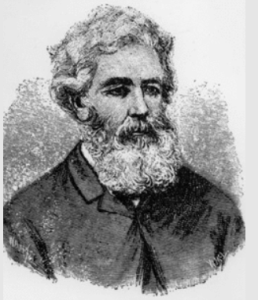
On May 4 1842, Moreton Bay was officially thrown open to selection, and Andrew Petrie, Henry Stuart Russell, Captain Joliffe and two indigenous guides embarked on an expedition north of Brisbane to explore and map the region. They would return with two convict runaways and the first account of a massacre that would have terrible consequences for indigenous and European people.
Andrew Petrie was a Scottish builder and architect, who had been brought to New South Wales by John Dunmore Lang in 1831 and had moved to Moreton Bay in 1837 to take up a position of Clerk of Works. As well as conducting repairs and supervising works in the settlement, he had a keen interest in exploration, and led expeditions around the south-eastern coast of Queensland. His mission in 1842 was to explore the Wide Bay area in the hope of finding more suitable pastoral land.
Henry Stuart Russell, who had emigrated to Australia in 1840, and had established himself as a pastoralist on the Darling Downs, was also an enthusiastic, if somewhat impractical explorer. His account of sunstroke and seasickness (he lost his hat and his temper attempting to capture a turtle) is a thing of beauty.
I suppose I was in some sort tortured by sunstroke; that night was a horrible seal upon my recollections thereof. One of the men was trying to make me a head-covering out of some canvas; but why should my limbs torment me? Well, no explanation of the cause could have cured me; and thus, I miserably stared the stars out of countenance with the help of the dawning day.
With the sun’s return came that of the natives. After much gesticulation to the party, an old man squatted on his hams on the hot sand, and with a queer crone began to scoop out a hole with his hands alongside of me. I took little heed, until it had assumed, under his vigorous and odoriferous exertions, almost the appearance of a shallow grave. As a man under his first ”flooring” by seasickness, so was I absolutely careless of what was going on around. Well I remember the queer sensation of hot sand being shovelled by their wooden implements—”eelamans”—over me, up to the very chin. After that I knew nothing till I came to the sense of where I was.
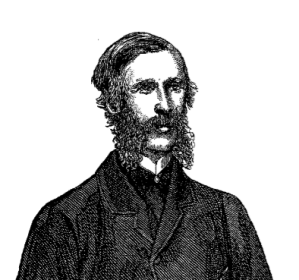
Petrie, though very concerned by his companion’s illness and relieved at his recovery, found Russell’s flamboyant exclamations about the quality of their boat, his travails and his symptoms just a little bit hilarious.
The explorers spent a few pleasant days mapping the coastline and naming landmarks after themselves, until on May 7, 1842, they arrived in the Wide Bay and found themselves near a gathering of hundreds of indigenous people.
David Bracewell
They had been told by the indigenous people who had ministered to Russell’s sunstroke that if they travelled a few days to the north, they would find a white man living among the aborigines there. If true, that white man might be able to keep them from harm at the hands of the unexpectedly large group of indigenous people. Petrie sent a handwritten note with one of his guides, and this led to the appearance at their camp of a white man who at first could not converse in English beyond saying his name, “Bracewell”. As the man recovered his English, David Bracewell or Wandi, advised them that another convict was living amongst the indigenous people, and that there was a great meeting of indigenous leaders being held at what is now Tiaro. They were meeting to discuss the response to the poisonings at Kilcoy.
[In 1841, workers under the direction of the Mackenzie brothers of Kilcoy, Scotland, began clearing the land and constructing huts and a dwelling for a sheep station. Their work took them through traditional lands and hunting and gathering grounds of the indigenous people of the area. The indigenous people initially conducted a few scavenging raids – their food supply had, after all, been interrupted – but these incursions were viewed with terror by the Mackenzie labourers, who left behind flour laced with arsenic in their huts. Between 30 and 60 aboriginal people died in agony.]
Bracewell explained to Petrie and his party that they were in danger from some of the attendees at the gathering, who favoured payback for the deaths. He would bring back the white man Duramboi, who could help him get the party out safely.
According to Russell, Bracewell stripped and took up his spear, and went into the gathering, locating Duramboi and impressing upon him in language that there was a group of white men nearby who could take him back to Brisbane town. Duramboi’s initial reaction was fury – Wandi (Bracewell) had brought Europeans, and therefore danger, into his home and place of refuge. Wandi slowly enticed the angry man towards the Petrie camp, pleading and arguing all the way.
Duramboi
The explorers got their first sight of Duramboi, thin but hardy, his body showing injuries sustained in battle, as well as horizontal cicatrices across his chest, and arm bands and bracelets. Duramboi in turn gazed sourly at the assembled white men. On hearing Andrew Petrie’s Scottish accent as he asked him to come down to them, Duramboi ran down an embankment to meet them.
“My name Jem Davis, of Glasgow.”
Russell, however fanciful a storyteller he may seem, was present at the first telling of the James Davis story – in language translated by Bracewell – a fear of his fellow-prisoners at the Moreton Bay settlement led him to escape and his adoption by an indigenous leader who recognised him as Duramboi, his dead son.
The exploring party were aware of the killing of two shepherds by the local indigenous people just before their departure from Brisbane. Davis explained that they were killed in vengeance for the poisonings, and there was a curious souvenir. His father, Pamby-Pamby, had taken a watch from the dead men. Davis knew it could be opened but said he had forgotten how. He promised to bring the watch back with him the next day, in exchange for a tomahawk for his father.
To the party’s mingled relief and alarm, Davis returned the next day, answering the two musket shots agreed to as a signal between the men. Although the expedition party could sense that many indigenous people had followed Davis, they only saw Pamby-Pamby, who Russell dismissed as ‘a ruffian’ and a ‘filthy brute’. The watch exchange was made, and farewells said.
For all of Russell’s apparently instant loathing of Pamby-Pamby, he wrote a long and rather overwrought passage describing the separation of father and son. Long speeches were made, promises to return given, voices fading as the boat pulled away.
Later that day, Davis shaved, dressed and recovered his use of English. He demonstrated his indigenous tree climbing technique and remembered how to sing Auld Lang Syne, apparently.
“His expressions were ingenious and noteworthy as he progressed in the use of his proper language; for when in difficulty he would literally render the blacks’ metaphorical phrases— repulsive and indecent often enough—into the required words which we could understand.”
Safe from attack, and with the two ‘wild white men’ on board, the party returned to Brisbane town without incident.
May 22, 1842 – Return to Brisbane.
Tom Petrie’s Memoirs recount the expedition’s return with Duramboi riding at the front of the boat, and throwing the boathook to dock her. Davis had been only 6 weeks at the penal settlement 14 years before, and that time was spent firmly in the custody of the redcoats and working in the Blacksmith’s shop. It is doubtful he would recall much of the scenery, and more doubtful still that he considered this a homecoming. Home may have been the Glasgow of 1824 or roaming in the Wide Bay area with Pamby-Pamby and his family.
There may well have been some understandable, lingering doubts that the gangs and overseers had really left, or that the future would be a return to labour in chains, or gaol – possibly with extra time to serve for his long absence. Bracewell and Petrie had insisted that Logan was long dead, the prisoners had returned to Sydney, and free settlement was on the way. As the boat made its way up the river, Tom Petrie noticed Davis, a solitary figure riding at the front of the boat, taking in his surroundings. No doubt there were mixed feelings – he returned to the English-speaking world, shaved and clothed, and to the realisation that he would not return to his indigenous family. The legal restrictions of a convict – even after his hoped-for ticket of leave – would involve living in the Moreton Bay area.
According to Tom Petrie, there was a very brief interval of time during which Davis spoke freely of his life among the indigenous peoples. His tongue was perhaps loosened by the rowdy welcome ‘home’ to a settlement with some neglected convict era buildings, a couple of rough inns and precious little else. Perhaps there was a desire to keep up with Wandi, the ‘big talker’, who no doubt held court on his adventures.
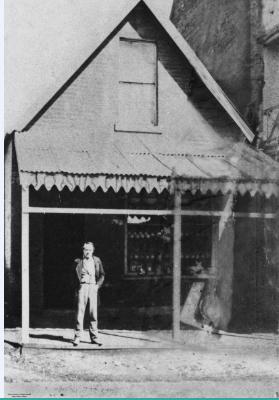
At some point in those first days, Davis stopped talking about his time away. Not long afterward, Petrie lamented, Davis would not give an account of his life, nor show his cicatrices to the King himself. In later years, the naturally taciturn man would be brusque in the face of curiosity and had to be coaxed at length into speaking privately with The Rev. John Dunmore Lang on the topic. Those who intruded upon the merchant in his George Street shop would be quite literally shown the door.
June 14, 1842 – The first published story of the journey.
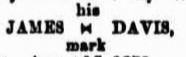
The first time the outside world heard of the James Davis – Duramboi – story was this account, published in the Australian.
COUNTRY NEWS.
MORETON BAY.
[From our Correspondent.]
An exploring party has just returned from the northward, having been absent in a boat from Brisbane, for three weeks. The following particulars you may rely on, as I have them from Mr. Petrie, the gentleman who headed the expedition: ” On leaving the bay they coasted along to the northward for about two hundred and fifty miles, when they discovered a large river, extending inland about fifty miles. It is navigable for vessels drawing eight feet water for thirty miles up and terminates in one of the finest pastoral parts in New Holland. They have brought with them two runaways from the settlement, one of whom, James Davis, a native of Scotland, has been living with the blacks for fifteen or sixteen years; the other man named Bracewell, is the man who brought Mrs. Fraser off the island where the Stirling Castle was lost; he (Bracewell), having been absent at that time for seven years; and having again made good his retreat, he has been absent for upwards of three years. Davis, when found could only tell his name and place in the English language; he now, however, begins to speak English pretty well. Davis had not seen a white man since he saw Bracewell, ten years before this. These men were found in separate places. Davis is not more than thirty years of age, and was naked, besmeared and cut the same as the natives. He is equally as expert in climbing a tree, &c., as they are. Both the men can give much information to the Government, and as they have been the means of saving the lives of Mr. Petrie and party, I doubt not but they will receive their free pardons.”
Working for Dr Simpson.
In his disorienting new world, Davis was free of his convict irons but still under sentence for his robberies in Glasgow in 1824 and at Patrick’s Plains in 1828. His future could still involve a journey to the Courts in Sydney to be dealt with for absconding, and to see out his sentence in custody or in servitude to a Master until such time as he could obtain a ticket of leave.
Fortunately, Dr. Stephen Simpson, the Land Commissioner for Moreton Bay, intervened, and Davis and Bracewell were set to labouring at his new property on the Brisbane, Woorgaroo. Not, perhaps, too different to the lives they would have led labouring in Sydney and the surrounds, but Simpson had influence, and considered the pair could reform and have bright futures in this wild place. Presumably, the two ‘wild white men’ grew accustomed to one another’s company; and working such a distance from the main settlement gave Davis a respite from being a Colonial curiosity.
Simpson’s letter to the Colonial Secretary spoke highly of both men, their industry and usefulness to the settlement, and he argued for clemency regarding their unexpired sentences.
To be continued.
SOURCES:
- The Sydney Gazette and New South Wales Advertiser, Tuesday 31 March 1840.
- Chronological Register of Prisoners at Moreton Bay, Volume 1, page 3.
- Truth (Brisbane, Qld.: 1900 – 1954), Sunday 15 April 1951, page 19.
- Lack, Clem “The Wild White Man”, The Truth, Brisbane, Sunday 15 April 1951, page 19.
- Tom Petrie’s Reminiscences of Early Queensland (Dating from 1837) recorded by his daughter, 1904, Watson & Ferguson, Brisbane, pp 245.
- “In the Early Days: History and Incident of pioneer Queensland”, Knight JJ, Brisbane, Sapsford 1895.
- “Kilcoy, the First Six Months – Sir Evan Mackenzie’s Albatross”, John Mackenzie-Smith, Journal RQHS Vol XIII, No.12, 1989.
- “Traditional Law and Indigenous Resistance at Moreton Bay, 1842-1855” Libby Connors, [2005] ANZLH E-Journal.
- “The Genesis of Queensland” Henry Stuart Russell, pp482-3.
- Tom Petrie’s Reminiscences of Early Queensland, pp 140.
- Illustration of Henry Stuart Russell, frontispiece, “The Genesis of Queensland”.
- Illustration of Andrew Petrie, “Australian Dictionary of Biography”.
- A. Morrison, ‘Petrie, Andrew (1798–1872)’, Australian Dictionary of Biography, National Centre of Biography, Australian National University, published first in hardcopy 1967 Volume 2, (MUP), 1967.
- G. Austin and Clem Lack, ‘Russell, Henry Stuart (1818–1889)’, Australian Dictionary of Biography, National Centre of Biography, Australian National University, published first in hardcopy 1967, Volume 2, (MUP), 1967.
- H. Hornibrook, ‘Bracewell, David (1803–1844)’, Australian Dictionary of Biography, National Centre of Biography, Australian National University, published first in hardcopy 1966, Volume 1, (MUP), 1966.
 Moreton Bay and More
2 Comments