
The final part of Jack Bushman’s story is about his life as a “free” man, and includes a shooting at Brisbane’s indigenous people known as the “York’s Hollow Shooting”, which occurred in December 1846. The murders of Mary Shannon and Andrew Gregor in October that year had made white settlers fearful of the local aborigines, and keen to apprehend the aboriginal men believed responsible. York’s Hollow was the site for many early corroborees and is now Victoria Park, between the suburbs of Spring Hill and Kelvin Grove.
A FEW RECOLLECTIONS-SPECULATING ON HIS OWN ACCOUNT-LIFE SAVED.
THE undisguised manner in which I have told the story of my life up to this point, permits me to recall certain trifles which I neglected in the course of my narration.
The usual punishment awarded to convicts was 50 lashes; and the offences which were deemed punishable by the “dose,” were of such a light nature as will appear insufficient to excuse the subjugation to torture.
The overseers were in the habit of walking after the convicts in the daily routine. When the season for planting the maize came on, we were made sensible of the honesty required from us; in that, taking a nib of corn was punished with the felon’s 50. The superintendents would sometimes walk over the ground which had been planted, after the day’s work was over, and, tracing the spots, if it was found that one of the convicts had taken a corn for his own eating, the regular result would follow. So initiated had we all become to this kind of punishment, when the number of lashes did not exceed 50, that the infliction of them and those who had to undergo the suffering, became a cruel jest; and the “bloody whip” was spoken of with a kind of facetious melancholy, which resembled the merriment of hell.
I have told enough about flogging to put the good people out of conceit with it. It was an inhuman mode of teaching obedience; and though the terror of it often prevented bad conduct, the infliction never answered the purpose of all salutary punishment-the reclamation of the offender. I know there were gathered together in Moreton Bay 1100 convicts of both sexes at one time; and with such a congregation of acknowledged scoundrels, and once partial or wholly prostitutes, it was absolutely requisite for the proper observance of order, that there should be some severe ordeal through which transgressors should pass; so that others might be taught the danger of disobedience. To tell free people if slavery is to raise a feeling of compassion for the portion of humanity bereft of liberty, and to call up emotions and enlist such in the path of duty, to aid emancipation.
For our slavery there was no balm. Those who believed in the freedom of men had cast us out; and those who were capable of reflection must have seen the impassable gulf between the stain of our bondage, and the free position of honest liberty. The thought of the past and the agony of the future, made some of the convicts demons. The language was disgusting. Oaths and blasphemous expletives were broadcast in conversations. The usual greetings were accompanied with expressions tabooed from civilized life. The language I have given as used by those few officials whose prominence in the scenes I have recorded made me well remember them, will show there was not a nice discrimination of expression in vogue.
An immoral taint seemed to be cast upon all, and the place was fast verging into a Pandemonium, when fortune sent a few free pioneers who cared for the observances of religion and morality, and these became the salt which prevented the putrefaction from extension. I knew that old tree in the Valley, which was burned a few weeks back, when it had its seasons of spring tide and autumn. It did not die a natural death. Its life was whipped out of it. In the light of the morning, before the dewdrops had been gathered from the blades of grass by the guardian of the day, would screams be heard of men enduring mortal agony, while at other times the formulas would be more gravely observed, and the flogging be given in presence of a multitude of guilty and suffering ones, so that they might learn how tremendous that power was which held their liberty. They flogged that tree to death. It was of noble growth, and its trunk was so large, that when an offender was made “a spread eagle” of, his body did not cover it. The lashes went against the bark of the tree, reaching over “the bared backs, until the bark was entirely whipped away; and then it died. They flogged at that tree long after its life had departed. I need say no more than there are hundreds in the district who have seen the marks from the lashes in the old stump. It stood until within a few weeks since as a way mark; and were it not that the remembrance of sad cruelly practised were better obliterated, I could have wished the old tree had been spared, with its thousands of indentations, worn by the whip, in flogging human beings.
I may be expected to say something of the female convicts. They were kept in the factory, (the old gaol) and there were some pretty stories told, how the soldiers and officers visited the place after dark of a night-how the walls were scaled, and the vigilance of the guard evaded. This breaking into prison when discovered, and the soldiers were the offenders, was severely punished. The officers managed better; they were not found out, though gossip was rife as to their guilt in breaking the regulations equally, if not more so, with those of meaner grade. In fact, it was believed that the stolen interviews on the part of the officers were ” a lead-the way” for the men; as example is so much more potent than precept. However, I would rather someone else, who is more intimately acquainted with these peccadilloes should become their historian. The common report was, that if by chance a modest female was known, the old hags of vice, those who had trodden the paths until their souls were seared, became willing decoys, and often baited the snares which were to lure the comparatively innocent ones to destruction. It was common with the male population to take delight in making “one as bad as the other;” but with the women, an incarnation of mischief brooded over the fair fame of those females who had not fallen, until the difference in point of reproach existed no longer; crime and villainy working together for the completion of disgrace.
I will not longer linger in this general description. I started by saying I was no angel myself; and I do not think, after you have finished reading these passages, you will think me exactly the kind of paragon you would extol as a teacher of virtue. I do not profess to draw morals from what existed; and if I have departed from the strict letter of history in what I have written, why, then, to make amends for my defalcation as a historian I will, at once, resume my own experience.
I was telling how I had fancied they might have let me go home. Finding they would not do so, I took to the bush, worked hard, and I may say drunk hard; but eventually I became steady for a time, grew wealthy a small way, for I had a bullock team, and talked quite large about the “great country.”
Having such a turn-out of my own was far too grand for such as I, who had for 21 years of my life been goaded by the relentless spirit of convict regulations? There was something terribly free in sitting under the gum trees while the bullocks were grazing; and rather more than I cared to think about in the remembrance that for ever all I had known in early life were dead to me. Do not imagine I wish to make merry with woe when I say I resorted to rum in my solitude; the result of some of my carnivals, with the one bright memory of existence dancing in my disordered brain, was like a feeling as of
“Moody madness,
Laughing wild, amidst extremest woe.”
At any rate my bullocks and my dray danced away. The savings were all gone, and I continued to work and spend, having secured enough by entering into a club to bury the carcase when dead, determined that no one should be the better for my death through any gear left behind. Thus you will have to picture me; sometimes ” sawing” sometimes “splitting” at other times clearing or fencing, and when I took it in my head, going a long distance up the country, just by way of a change.
I had led this kind of half-savage life some lime when, one day, about six or seven years gone by, I was working a few miles from the “Valley,” and had “a umpie” a short distance from the spot. The day I remember was a remarkable one in my history, and also in the early annals of Moreton Bay, as two white men were killed by the blacks, and consequently terror was rife in the timid. The story, as I always tell it, and shall continue to do, is as follows:
A black-fellow had put his hand through a shop window in the Valley, and had taken therefrom a few “lollipops,” which so annoyed certain of the whites that they armed themselves, paid a visit to the blacks’ camp, and fired indiscriminately amongst them. I do not know how many were injured. I was working a short distance away, and soon after the firing had taken place, two black gins, Susey and Alary, hastened where I and my mate were at work, and told us to go home, or the blacks would kill us. Warned by these friendly gins we hastened to our umpie, placed our guns in readiness, and waited anxiously to see if we had been truly apprised of danger. We had not stood long, before we heard the sound of approaching blacks, and when they came in sight, we soon understood the state of affairs.
They passed our umpie, but on seeing we were well prepared, they did not attempt to molest us. Translating as well as I could I found they were vowing vengeance. They were about 300 in number, and the most prominent amongst them was a gin, who carried a piccaninny on her back, which was dead, having been shot in the back, by a bullet, in the firing which had taken place.
The black mother wailed in her wrath-sent up piercing cries, pointed to the dead baby she carried, and with a yell which bespoke vengeance they passed on.
That day two white men were killed at Darby McGrath’s; and the murderers were those black-fellows who had passed my hut. Had not Susey apprised me of my danger I had that day been numbered with the dead. She saved my life; and I, in return for the kindness shown, took her, to provide for her comfort, as far as bush-life goes, the remaining portion of my days. Susey cooks and washes-has gone with me one hundred miles up the country, and ever proved faithful. She likes a glass of grog, and so do I; but we jog along very comfortably together for bush people, and if we quarrel, why, like sensible people, we try to make it up as soon as possible. Susey has donned the habiliments of civilized gear and looks upon a trip to do the marketing as a high day and grog day, in which luxury I indulge her to the extent of a nobbler.
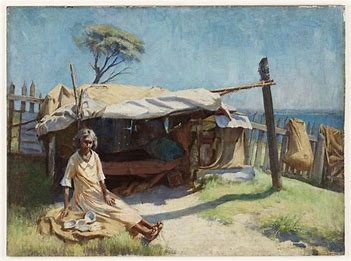
All those past six years my life has not much varied. A bark umpie, tea and damper, fresh or salt meat, as the occasion may be and a quiet pipe while Susey looks on, is about the height of my enjoyment. I have no rent to pay-no taxes to injure me, plenty of wood to burn, and good water to drink. Mine is not one of the most enviable positions in the world, but I tell you what, if you bad suffered twenty-one years as a slave, and six years as a ticket-of-leave man, had been obliged to live on ” hominy” for mouths as I have, and had your back torn with those hellish thongs until you felt as if your life was departing, I guess the contrast would take a favourable side for my picture, with the black gin into the bargain. I have plenty of work, do not know what it is to want for food, drink or money, have plenty of black-fellows who are pleased to serve me, because I always perform what I promise them; and for aught I know, my life will conclude in the same society, as that I have chosen from gratitude for having a life preserved, which to many, may not appear to be worth keeping. It is no use to moralise or draw comparisons. If there are those who have known some of the horrors of convict life in Moreton Bay who are better off than myself, and who have regained station and respectability, there are others who are worse off than I.
” Well, never mind, the world must turn upon its axis
And all mankind turn with it, heads or tails,
And live and die, make love, and pay their taxes!”
I am not skilled sufficiently in learning to tell what purpose my life has answered, so I turn to a luminescence of memory.
I had one companion in my misery, years gone by, whose name was Jack Banks. He and I were on good terms-for he was amongst the gang when I was guarded up from Sydney in 1825. I might have told how Jack ran away time after time, but that I fancied it would be best to give his history in a few words. After repeated failures Jack did manage to gain freedom. He exchanged the leg-irons and hominy for the bush, mingled with the blacks, who received him kindly, and stayed with them so long that he became as one of them. After fourteen years’ residence with the children of the wilderness, poor Jack was shot by a party out after the blacks, when he was in a tree looking for a sugar-bag. His appearance was so much like the natives, that the party doing the hunting could not discern the difference, and I am indebted to my knowledge of the blacks, and the confidence reposed in me by them, for my information concerning the end of poor Jack Banks.
I have spun out the story of my life long enough for the present. I have many stories to recount of the scenes I have witnessed since I landed in Moreton Bay, which shall be told when opportunity offers for Jack Bushman to yarn with old Tom, the Lifer, who was never dishonest through idleness, but who having lost the one charm, of his life, and yielding to false logic, entered upon that course which has been pregnant with such strange adventures.
HIS REFLECTION AND SOLILOQUY.
I had thought to finish. It is Saturday night. In front of the bark hut the place has been swept by Susey, and the fire burns brightly. I muse over the strange story of my life, as Jack Bushman reads to me page after page, and I reflect that shortly I shall be seventy yean of age. Push back the hand on the dial plate. I would that I could push back time with my knowledge, harsh and rough though it be, to the time, fifty years gone by, when I wooed and won that lass of whom I have spoken so much. If she was but here tonight to share my evening meal, and if idle and I were but gently walking down the hill of life together, oh how my heart would beat its thankfulness, and I could not refrain from singing a song of praise. They will picture me bad. And I have not endeavoured, by lying, to make myself other than I am, but whomsoever shall read these lines, and trace the avenging hand of justice for dishonesty, will acknowledge that I have suffered enough for my misdeeds. I and Susey are doing very well together; and if the life I have led has not learned me ought else, it has made me feel how sweet a thing is liberty. And it is my opinion people are foolish to risk its loss through dishonesty.
Farewell. A Lifer’s joys and sorrows have been given; and may the perusal be productive of as much good as the spirit desires which collated them for the public.
Moreton Bay Courier (Brisbane, Qld. : 1846 – 1861), Saturday 30 April 1859, page 4
See Jack Bushman’s Tale Part 2 for identification of the convicts, and probably, the author himself.
 Moreton Bay and More