
Isaac Alder had a long, hard-scrabble life. Born either in England or on the Hawkesbury, probably in 1826 or 1828, Alder worked as a drover and itinerant butcher in New South Wales and Queensland. He went by a number of aliases, including John King, Isaac Peter Houlder, Wright Houlder, John Smith, Isaac Alder, and John Brown. One thing he found irresistible, particularly in his later years, was poultry stealing.
Life as a largely itinerant drover and butcher was hard, but it left him fit enough to continue a life of crime, running from the law and resisting arrest well into his eighties.
His first offence was taking a daylight bath in a creek in Maitland, in a state of nature. Droving took him to Ipswich, Queensland in the 1870s, where he narrowly escaped a conviction for cattle stealing in company with a man named John the Frenchman. Two more stock theft charges were dismissed over the years.
Alder turned his attention to the henhouses of Brisbane in the 1880s. He appears to have continued his life on the road, never having a fixed place of abode, and stealing chickens to sell or eat. August 1887 found him in possession of five fowls for which he could not satisfactorily account – his explanation of buying them from a hawker on the Logan road was not believed – and kicked off his poultry stealing career with a fine.
In October 1887, a keen-eyed Constable noticed Alder walking on the Logan Road just before dawn with a rustling sack thrown over his shoulder. Again, Alder claimed to have acquired the birds ‘on the road’, and again he was not believed. This time, the Bench gave him three months with hard labour.
In January 1888, and fresh out of gaol, Alder was laid up with a broken leg, a result of some very slapdash 19th century municipal works:
A MAN named Isaac Alder, a butcher, fell, on the 6th instant, into the cutting in Mitchell street. Hill End, breaking his leg. Where he fell the street has recently been cut down, it being now from 8 to 10 feet deep. No protection, to prevent people falling over the banks exist, which should receive attention.
At least the henhouses of Hill End were safe for a while.
In July 1891, Alder was at it again. He hadn’t changed his style – he crept into the yard of the Bellevue Hotel and was witnessed stowing four roosters in his trusty sack. When he realised that he had been spotted, he fled, leaving the sack and the roosters behind. It didn’t take long for the police to tally the description with Alder, and he went down for three months’ hard labour.
Alder had a few days’ breather before he earned six months in a Court sitting featuring, I kid you not:
Vagrancy. Elizabeth Taylor, who was on remand charged with having no lawful means of support, was sent to gaol for three months.
Larceny. Isaac Alder, 65 years of age, a native of New South Wales, was sent to gaol for six months for stealing a fowl, the property of one John Lennon. The fowl was valued at Is. 6d.
In Alder’s case, there was a chicken giving evidence, and confusion as to whether one could regard the Boggo Road Gaol as a boarding house:
The fowl was produced in court, and “gave evidence.”
Defendant pleaded not guilty and stated that he was a butcher and drover of no particular place of abode. He had been camping in some stables on the Logan road, and left early this morning for Queensport. Taking a short cut, he passed through Lennon’s yard. A number of fowls flapped down from the fence, and Lennon came out and accused him of stealing them.
The following conversation followed the defendant’s statement: — Senior- sergeant Love: “Where did you live for the three months ending October 29?” Defendant: “On the Boggo road.” “Was it at a boarding- house?” “Defendant, after a pause: “I don’t think so.” “Who keeps that place?” ” I don’t remember.” Mr. Murray: “Am I right in supposing it was the gaol?” Defendant brightening up, “Oh, yes. I understood the gentleman to refer to some hotel.” Senior- sergeant Love: “Were you in gaol for three months?” “Yes.” “Have you ever been charged with fowl-stealing before?” “I have, sir.” Mr. Murray: “Well as three months does not seem to have worked a cure you will be imprisoned for six.”
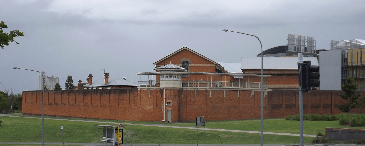
On release, Alder decided to look for pastures new, and spent 1892 revisiting the Ipswich Courthouse (Larceny, 2 charges, 14 days) and Gympie Courthouse to the north (Larceny, 6 months), before returning to Brisbane in 1894 to show again what an accomplished criminal he really was.
Police on the late-night beat around Tritton’s furniture warehouse on – conveniently – the Boggo Road, found a man trying to get in.
On seeing the constable, he ran away and hid under a tank. The constable after searching for a few minutes, noticed the defendant’s legs sticking out from under the tank and quickly had him out of his lair. The defendant forcibly resisted the constable’ s efforts to secure him but with the assistance of acting Senior constable Wilson, who appeared on the scene, he was safely lodged in the watch house. He defendant refused to say anything about the matter, but said he was under the influence of liquor.
In February 1895, Alder resumed his raids on henhouses. He scored seven fowls and three months. In May of that year, the puns were coming thick and fast in the Brisbane Telegraph as he was sentenced for stealing two fowls to ‘six months for reflection on the “fowl” records of the past.’

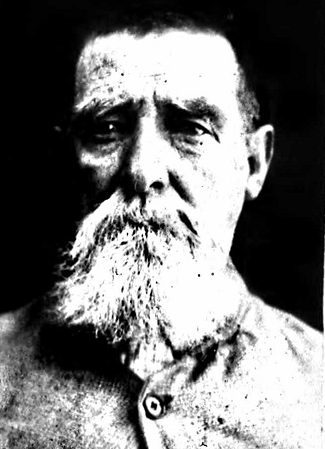
On June 6 1895, Alder’s photo was taken at Brisbane Gaol. It has faded badly, but shows a healthy looking, fairly cheerful man. I can only suspect that Alder rather liked (or did not completely detest) Boggo Road, because a photograph taken seven years later in Sydney shows a man in the depth of misery. Darkly lit and in painful close-up, every wrinkle and grey hair shows, and the look in his eyes is the deepest melancholy.
Christmas 1895 saw Alder a free man, but not for long. On that holy day, he helped himself to an umbrella belonging to a Mr Palmer of West Ipswich. The police, presumably, had nothing better to do than track Alder to Grandchester in the Lockyer Valley 34 kms away, where they got their man on 28 December. Another three months.
Saving time and effort, the Police arrested Alder on his way out of Boggo Road, charging him with an earlier theft of a watch, chain and coat. Another three months.
On 4 August 1896, Alder caught a break – some fowls he sold and for which he could not satisfactorily account were not claimed by anyone, and the Police and the Police Magistrate to their intense surprise, had to let him go.
Perhaps he temporarily tired of fowls after that. Perhaps he just liked having a roof over his head for three to six months at a time, because less than three weeks later, Alder was arrested for stealing a bundle of axe-handles from a shop on Eagle Farm Road and received another six months.

April 1897 found Alder being given food and shelter for the night by a Mr George Lacey, whose kindness was repaid by being relieved of a pick and shovel, which Alder quickly pawned. Another six months.
Precisely six months later, a pipe and coat valued at £2, and which belonged to someone else earned Alder another six months. He pled not guilty but declined to call or give evidence.
In January 1899, Alder was charged with drunkenness. He rounded out the century with Larceny (3 months), Illegally being on premises (6 months) and in April 1900 another Larceny (6 months).
Understandably, Isaac Alder had come to the conclusion that he was no longer welcome anywhere in Queensland except Boggo Road gaol. He was well into his seventies – accounts of his age vary by about a decade – and had spent most of the previous twenty years in gaol. Time to go back to New South Wales. Change of scene. Fresh start. Fresh henhouses.
In October 1901, Alder gave New South Wales a demonstration of his silky criminal skills:
Isaac Alder was charged at Redfern Court yesterday with stealing two fowls, valued at 5s, the property of Charles Saul, at North Botany, on the 29th inst. Walter Hardaker deposed that he saw accused near Mr. Saul’s premises. On being asked what he wanted there he, said he only came round to get out of the rain. Just as witness turned away to leave him two fowls dropped from under his overcoat. Accused was convicted, and fined £5, or two months’ imprisonment.
Whoops.
The following January, he did it again. With similar élan.
Accused was seen by Senior-constable Forrest getting over a fence with a bag on his shoulder. On being observed accused dropped the bag and made off. When asked by the constable what he was doing with the bag containing poultry accused said that he never had it. Feathers were found on his clothes by the arresting constable and Constable McKeown. Accused was sent to gaol for two months with hard labour.
In August 1903 in the Water Police Court, Alder pleaded guilty to having four fowls reasonably suspected of having been stolen. “He was ordered to be placed out of the reach of poultry for a period of three months.”
In December 1903, the Police at Waverley had their man again. So many henhouses in Waverley had been pilfered from that a special undercover operation took place to watch coops and roosts throughout the suburb. Alder was caught and received two three-month sentences to be served cumulatively.
By 1908, the sheer number of convictions, aliases and the advanced age of the offender put Isaac Alder in the headlines of Sydney’s papers.
A man 86 years of age, known variously as James Smith, John Brown, alias John Smith, Isaac Alder, and Wright, appeared at the Glebe Police Court today on a charge of stealing boots, clothing, and tools, the property of Richard J. Hansen, of Leichhardt. Accused indignantly denied any knowledge of the stealing. He was, he said, seven miles away on the date the goods were stolen, at a place called Salt Pans. “How many times have you been convicted?” asked Inspector Roche. “I cannot remember.” “Have you been convicted 43 times?” “I have been convicted a number of times on the evidence of some dirty low scoundrel.” The inspector proceeded with other questions. “I don’t think you need ask any more,” said Mr. Love, S.M., who was on the bench. “The point here seems: ‘How often have you been out of gaol? ‘ In view of your previous record,” said Mr. Love to accused, “and the number of thefts in the suburbs lately, I’ll sentence you to six months’ gaol. “Six months’ hard,” repeated the court sergeant, and “John,” as he is familiarly called by the police, left the dock with a murmured “Thank you”.
The final hurrah for Isaac Alder came in 1909. Fittingly the offence was stealing a hen. Headlined as “A remarkable criminal record”, his appearance in Newtown Police Court earned him his final six months’ hard labour. Even with his criminal sprightliness and terrible record, it seems cruel to sentence an elderly man to hard labour.
The accused, who pleaded not guilty, said he had no evidence to offer. The magistrate, looking at the police record: “I see you have been convicted no less than 44 times in the last 22 years. You started your evil career in Brisbane in 1887, and after a number of convictions in that city you came over to Sydney and have been continuously following your evil ways ever since.” The accused: The half of those charges are false, and I was wrongly convicted on them. I admit I have not been too good, but yet after all I am a much-persecuted man. The accused was ordered to be imprisoned with hard labour for six months.
Isaac Alder eventually passed away, probably aged 88 (according to his gravestone marker) on 13 May 1914. He had been giving or been given approximate ages for many years, having almost as many age variants as name variants. It is remarkable that this man survived for as long as he did, living on the rough, with only gaol to give him consistent shelter. He was still climbing fences and nicking things in his eighties.
He was buried in Rookwood Cemetery, and his grave marker is 185774202.
SOURCES:
- Northern Times (Newcastle, NSW : 1857 – 1918), Wednesday 7 January 1857, page 2
- Queensland Times, Ipswich Herald and General Advertiser (Qld. : 1861 – 1908), Tuesday 11 January 1870, page 3
- Queensland Times, Ipswich Herald and General Advertiser (Qld. : 1861 – 1908), Thursday 10 February 1870, page 3
- Telegraph (Brisbane, Qld. : 1872 – 1947), Monday 8 August 1887, page 3
- Brisbane Courier (Qld. : 1864 – 1933), Thursday 6 October 1887, page 6
- Brisbane Courier (Qld. : 1864 – 1933), Monday 10 October 1887, page 6
- Week (Brisbane, Qld.: 1876 – 1934), Saturday 14 January 1888, page 11
- Telegraph (Brisbane, Qld. : 1872 – 1947), Thursday 30 July 1891, page 4
- Brisbane Courier (Qld. : 1864 – 1933), Tuesday 3 November 1891, page 2
- Telegraph (Brisbane, Qld. : 1872 – 1947), Tuesday 3 November 1891, page 2
- Brisbane Courier (Qld. : 1864 – 1933), Saturday 7 April 1894, page 3
- Brisbane Courier (Qld. : 1864 – 1933), Tuesday 12 February 1895, page 2
- Telegraph (Brisbane, Qld. : 1872 – 1947), Friday 31 May 1895, page 4
- Queensland Times, Ipswich Herald and General Advertiser (Qld. : 1861 – 1908), Saturday 28 December 1895, page 4
- Brisbane Courier (Qld. : 1864 – 1933), Friday 3 April 1896, page 2
- Telegraph (Brisbane, Qld. : 1872 – 1947), Friday 3 April 1896, page 2
- Brisbane Courier (Qld. : 1864 – 1933), Monday 6 April 1896, page 3
- Brisbane Courier (Qld. : 1864 – 1933), Tuesday 4 August 1896, page 3
- Telegraph (Brisbane, Qld. : 1872 – 1947), Saturday 22 August 1896, page 2
- Brisbane Courier (Qld. : 1864 – 1933), Friday 30 April 1897, page 3
- Brisbane Courier (Qld. : 1864 – 1933), Tuesday 23 November 1897, page 3
- Telegraph (Brisbane, Qld. : 1872 – 1947), Thursday 26 January 1899, page 3
- Telegraph (Brisbane, Qld. : 1872 – 1947), Tuesday 20 June 1899, page 5
- Brisbane Courier (Qld. : 1864 – 1933), Tuesday 27 June 1899, page 6
- Telegraph (Brisbane, Qld. : 1872 – 1947), Tuesday 27 June 1899, page 2
- Australian Star (Sydney, NSW : 1887 – 1909), Wednesday 30 October 1901, page 7
- Sydney Morning Herald (NSW : 1842 – 1954), Friday 17 January 1902, page 3
- Australian Star (Sydney, NSW : 1887 – 1909), Tuesday 18 August 1903, page 5
- Daily Telegraph (Sydney, NSW : 1883 – 1930), Wednesday 2 December 1903, page 10
- Australian Star (Sydney, NSW : 1887 – 1909), Wednesday 28 October 1908, page 7
- Singleton Argus (NSW : 1880 – 1954), Tuesday 11 May 1909, page 1
- New South Wales, Australia: Gaol Description and Entry Books, page 250, 1902.
- Queensland State Archives Series ID 3693, Photographic Records, Descriptions and Criminal Histories of Prisoners – (Males and Females) [HM Gaol, Brisbane, later HM Prison (Boggo Road), Brisbane] Queensland State Archives, Digital Image ID 18862
- Findagrave.com
 Moreton Bay and More