
1865: Murder of a young German hawker
On this day in 1865, a young German hawker named Henry Bode went to collect some debts from farmers on the Logan River. He was not heard from again. Bode was quite young, only 21, and made his living in his new country by walking long distances, selling useful objects to remote households, and also giving credit to those who needed something to tide them over.

When he was last seen, he was wearing a striped Crimean shirt and flannel trousers and was headed over to the hut occupied by farm workers Rudolph Momberger and Caspar Schaig to collect some debts.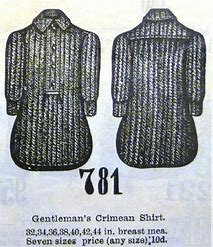
On the 5th of September, the body of a young man was found on the banks of the Logan River. An inquest was held in situ, but the presiding coroner did not remove the branches covering the body to examine it. “Found drowned” and quickly buried.
A few days later, a local publican noticed Momberger had a pouch very similar to the one carried by Henry Bode. He became concerned when he made enquiries about Bode, who had not been seen or heard from for some time. He went to the Police, and Inspector Lloyd set about finding out what had happened.
The unidentified body was exhumed and identified largely through the clothes and the teeth (Bode had an unusually impressive set). The “drowning victim” was revealed to have suffered a number of heavy blows about the skull.
Acting on the publican’s information, Lloyd searched Momberger’s now empty hut, and came up with a lot of disturbing forensic evidence – blood stains, a maul with hair and blood on it, and the hat and belt belonging to Bode.
Lloyd then set about finding Momberger and Schaig, a task that took time and effort for a policeman on horseback, and after interrogating workers along the way, located the two men working on the Dalby line. He arrested the pair and took them first to Toowoomba, then to Brisbane, where they were tried, found guilty and ordered to die on the scaffold.
Accounts of the trial show a lot of fairly advanced forensic evidence being presented – differentiating human and animal blood by the size of the corpuscles, and some fairly confronting analysis of stains on the maul.
When Momberger went to the gallows in December 1865, the Courier-Mail noted with distaste that, “the ceremony, which was disgusting in itself, was rendered more so by the cool and off-hand way in which the hangman performed his duty. It is scarcely an exaggeration to say that he did not appear to consider that the task he had to perform was in the least degree an unpleasant one.”
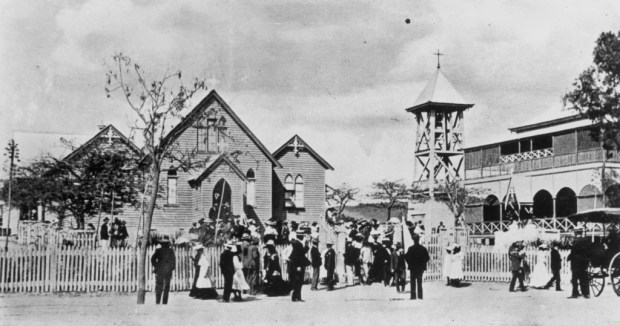
1879: Catholic Church at Charters Towers Blown Down.
Strong winds took care of the original Catholic Church in the new mining town of Charters Towers. The Courier reported:
We are sorry to learn from a telegram received in town last night that the Catholic Church at Charters Towers was blown down on Wednesday evening last. This building was a substantial one of its kind, costing about £900, and we feel sure that not only the Catholics of the colony but members of other creeds will, with accustomed liberality, help to restore the building to its original condition-in fact, to blow it up again.
Sources:
Brisbane Courier (Qld.: 1864 – 1933), Friday 29 September 1865, page 2
Brisbane Courier (Qld.: 1864 – 1933), Tuesday 17 October 1865, page 8
Brisbane Courier, Wednesday 22 November 1865, page 2
Brisbane Courier (Qld.: 1864 – 1933), Thursday 14 December 1865, page 2
Brisbane Courier (Qld.: 1864 – 1933), Friday 29 August 1879, page 2
 Moreton Bay and More