
On August 29, two German men were executed, six years apart, for crimes committed on the Darling Downs. The sentences on both men were hotly debated in the letters pages of Queensland’s newspapers.
1870 Brown the Bushranger.
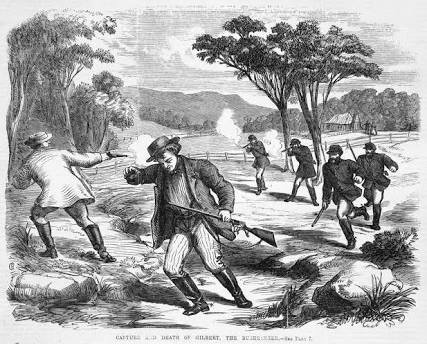
In 1870, a 20 year old German bushranger with many aliases, lost his short and extremely colourful life on the gallows. He answered to Brown, Bertram and many other names, but conceded that none of the names were his own, and flatly refused to offer up any details of family or friends. His family would never know what happened to him.
Brown had most likely left Germany aged about 12, working as a cabin boy to South Australia, but found horse stealing much more to his liking. He called it “a life on the cross”, but it was a outlaw’s existence, including running with Gardiner’s gang. An innocent man reposed in a New South Wales gaol for one of Brown’s robberies.
Described by the Court reporter in Toowoomba as “about two or three ad twenty years of age, powerfully built, of fair complexion and with a countenance that would have made Lavater’s hair stand on end”, Brown took shelter with the kindly Bakers, stealing their few shillings and shooting Mr Baker for good measure. Baker survived, but the bullet had come perilously close to his spine.
When word of the shooting spread on the bush telegraph, Brown was apprehended by angry locals, and chained to a veranda with a bullock chain around his neck.
As Brown’s execution loomed, letter-writers protested the sentence, pleading his youth, the small sum he had stolen, and Mr Baker’s recovery. It did not sway the Executive Council, who declined to commute the sentence.
The Darling Downs Gazette described Brown on the gallows thus: ”At times the prisoner exhibited the utmost indifference as to his position, and assumed a kind of callous bravoism, which was scarcely supported by the vacant and almost idiotic expression of his countenance, betraying what we have no doubt was his real character, namely, that of a weak-minded, neglected, and misguided boy.”
1876 “Charley, Charley, the German has stabbed me!”
In 1876, another German man on the Downs, John Wenzel was finishing up his job as gardener at Gabbinbar Station, when he had a disagreement with two carpenters about his missing gun. They thought little of it at the time, but it cost one his life.
As Charles Robinson called Wenzel and his mate Joel Archibald Martin in for their dinner, he heard no response. Then Martin called out “Charley, Charley, the German has stabbed me!”
Robinson rushed out of the kitchen and saw Martin fall to the ground. Wenzel retired to his cabin for the night.
Martin’s injuries were such that those attending him felt they should take his statement. Wenzel seemed neither surprised or particularly interested when the police, acting on the information given by the dying man, knocked on his door.
When tried in July 1876, Wenzel offered self-defence as his reason for the attack, claiming that Martin had knocked him down twice. The jury found him guilty, and the sentence was death.
Wenzel was brought to Brisbane for his execution, and while he contemplated his end, he also found support from the community. Letters flew back and forth to thee editors’ desks, one in particular stating that as an alien, Wenzel was not tried by his peers. The writer drew attention to Wenzel’s history of insanity, and the fact that two of Wenzel’s children were presently in Woogaroo Asylum.
None of this swayed the Executive Council, who allowed justice to take its course on 29 August 1876. Wenzel betrayed no emotion and mercifully, like Brown, died instantly.
Sources:
The Queenslander, Sat 13.03.1876
Telegraph, Mon 21.08,1876
The Week, Sat 02.09.1876
Queensland Times, Ipswich Herald and General Advertiser (Qld. : 1861 – 1908), Tuesday 28 December 1869, page 3
 Moreton Bay and More