
1606
Luis Vaez de Torres was on his way to Manila when bad weather forced him to take a detour below Papua New Guinea. On his way, he charted the coastline, stopped for provisions, claimed everything he saw for Spain and fought with indigenous people of the Islands, taking a small sample of the furious local population captive. Because history has been written by Europeans, no-one knows what became of his hostages, beyond the information that they were still with the expedition when it arrived in Manila.
He noted that there were large islands to his south, but felt no inclination to chart them or claim them for Spain. After all, he was on his way to Manila, and had a shipload of sailors and hostages to provision. Thus he might have discovered Australia without being aware of the fact.There was a great Southern land somewhere down there, but Torres contented himself with proving that New Guinea wasn’t part of it.
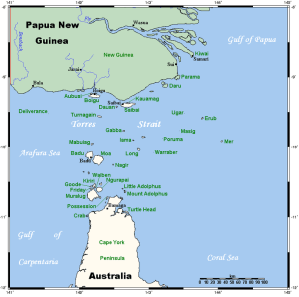

Posterity conferred Torres’s name to the passage of sea between northern Australia and New Guinea, but what became of Torres is a mystery. He intended to return to Spain and give his glorious account to the King, and wrote a précis, before vanishing from the records, probably in the Philippines in 1608.
In fact, another European, Willem Janszoon of the Dutch vessel Duyfken, came ashore in the Great Southern Land six months before Torres charted the Strait, but, sadly, nothing was named for him. He landed at what would become the town of Weipa, famously the wettest place in the State of Queensland. History is apparently written by dashing figures and Mr Janszoon did not fight the locals, take hostages or write a précis for the King of Spain.
The full history of the Torres expedition was written by his Spanish contemporaries, and provided excellent research material for a couple of English chaps later on, by the names of Banks and Cook, who claimed the Great Southern Land for England. Their findings convinced the authorities back home that this vast and diverse new acquisition would be a simply marvelous spot for a bit of a convict colony. And the rest is history.
 Moreton Bay and More