
In the early 20th century, the ghost of Captain Patrick Logan, late – very late – Commandant of the Moreton Bay, began to appear in newspapers.
Logan himself had died on October 17, 1830, murdered by indigenous people in the Somerset region of Queensland (official version), or by escaped convicts seizing an opportunity to get the tyrant alone (popular version).
Initially, only the Captain’s ghost appeared in accounts from 1909, but in 1941 a convict spirit that had haunted Logan joined in the stories. And this is where it gets puzzling.
Patrick Logan (1791-1830) was a Scottish Captain in the 57th Regiment, sent by Governor Ralph Darling to do something about the collection of tents and starving prisoners at Moreton Bay in 1826. He set about ordering successful building works, dashingly surveyed the South East of Queensland, battled a drought to try and get the crops to flourish, and in his spare time was notoriously strict with the twice-convicted men he controlled. During his lifetime, he was viewed by the establishment in Sydney (except Edward Smith Hall) as the model of an ambitious and gifted leader. Once he died, stories of excessive punishments filtered out, and his reputation was sealed in the popular imagination. He was “The Fell Tyrant.”
The Convict Ghost
“Beachcomber” in the Sunday Mail of January 12, 1941, tells the story of Logan encountering the apparition of one of his victims. Beachcomber admits his story is a re-telling of an undated clipping of the Moreton Bay Free Press published at some point in the 1850s. The only surviving copies of that journal are stored in the National Library in Canberra, and these manual search parameters are so vague, I hesitate to disturb the Librarians with them.

In the Convict Ghost story, Captain Logan was returning on horseback and alone from one of his expeditions, and nearing Brisbane Town when he noticed a convict near some woods. Logan called out to the man, certain he had an absconder on his hands. The convict came nearer, fixing the Commandant with a terrible gaze and seized Logan’s stirrup. Logan, with some difficulty, remained in the saddle, and lashed the convict repeatedly with the hunting crop he happened to be carrying. The blows went straight through the convict and on to the flanks of the already startled horse, and there was a brief interval where Logan was struggling with the horse, and the wildly staring convict who would not let go of the stirrup. Some recognition stirred – was this the man Stimson, who had perished after a lashing not so long ago? Logan was nearing the river, and a boat with a convict crew (all alive) was waiting for him. The convict clinging to his stirrup had vanished.
Stimson, according to legend, was an absconder who loved freedom and endured the escalating lashings meted out by the Fell Tyrant, until one took his life.
Inconveniently, no Stimson appears in the records of the Moreton Bay penal settlement. I know, I looked. There was a Stemson, a Sunstrom and a Simcocks, but they were all returned to Sydney alive. There was a Smithson, who was “killed by the native blacks” on 03 June 1830, and Benjamin Simcox who died on 14 November 1828 in hospital, who had never absconded. Simcox’s death is within the timeframe for the one unnamed convict who died in hospital of “flagellation” in the year prior to 24 December 1828.
Of the convicts who absconded and then died, we have William Acres, but he died six months after returning. George Massey seems to fit the bill – he ran twice and died 6 days after returning. His death does not occur during the period for the prisoner who died of lashing injuries.
Stimson is then an amalgam of several men, created in the folk-memory of those who lived and worked around the old settlement in the two decades after Logan’s death.
Pity, it’s a great tale. I would have loved a little more detail, though. Perhaps Logan trying to explain his lurching about on his horse to the convicts waiting at the boat. No, scrap that. Logan was not a man who would explain his actions to the convict wretches.
Logan’s Ghost
Captain Logan’s ghost has made a couple of appearances, in print and allegedly in the living world.
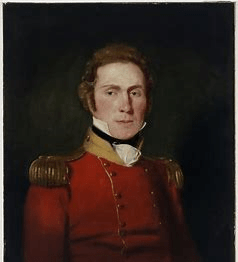
The first apparition occurred around midday on October 18 1830, as a group of convicts toiled on the north bank of the Brisbane River, near the Commissariat Store (William Street). Logan appeared alone on horseback on the south bank of the river, signalling “imperiously” to the convicts to row him across. When they got to him, he (and his horse, presumably) had vanished.
At the time that this occurred, Logan was already dead, but no-one in the settlement had any idea he was missing. Oh, and the poor horse was dead too.
Later reported sightings of Logan’s ghost have occurred in Ipswich, near the junction of Logan’s Creek and the Logan River, and also near his last camp site at Mt Beppo, Brisbane River Valley.
I confess I would love to see Logan’s ghost at the site the convicts allegedly saw it – now the site of the Museum and State Library at South Bank. What would the Georgian martinet make of his surroundings?
I did once have a famous Queensland historical figure loom out of the darkness at me one night, when I was enjoying the evening air at South Bank before a concert. Alas, it was the then very much alive Sir Joh Bjelke-Petersen, who was looking for directions to a taping of a television show called “Alan Jones Tonight”, to be held in the State Library. I deliberately gave the old horror the wrong directions. He should have known where the Library was, he opened the bloody thing. Overseas readers may Google the two men (former Premier of Queensland and shock jock respectively).
Sunday Mail (Brisbane, Qld.: 1926 – 1954), Sunday 12 January 1941, page 2
Queensland State Archives Series ID 5653, Chronological Register of Convicts at Moreton Bay
Louis R. Cranfield, ‘Logan, Patrick (1791–1830)’, Australian Dictionary of Biography, Volume 2, (MUP), 1967
 Moreton Bay and More