
1880 – Pedestrianism
On September 04, 1880, a famous pedestrian named Baker walked 115 miles in 23 hours and 40 minutes in the old Brisbane Theatre. Pedestrianism was a popular pastime for participants and spectators in the 19th century. Baker had been involved in some promoted events before – including a challenge against a wire-walker from a circus, and he was considered to be quite a celebrity.
However, watching Baker walking round and round in a ratty old theatre on the brink of demolition proved to be rather less of a crowd-pleaser than organisers thought. The crowds might have stayed away but Baker achieved his goal.
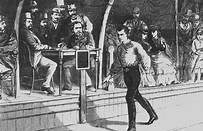
BAKER V. TIME.
At four o’clock on Saturday, Baker had still twenty-five miles to go and six and a quarter hours to do it in, and considering that he had already felt the effects of the confined track more than was anticipated, it did not look likely he would accomplish the 115 miles. He had, however, been husbanding his resources, and from four o’clock walked much more strongly. By eight o’clock he was so far on his journey that nothing but an accident could prevent his accomplishing the feat, and he seemed to improve in strength the further he went from this time. A few minutes before ten, he started on his last mile, and put on the steam, finally accomplishing the mile in nine minutes and forty-two seconds. The exhibition did not meet with much support from the public as might have been anticipated, or as the pedestrian deserved, but we hope that in the tour he intends to make, Baker may have better luck.
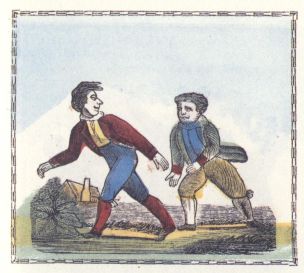
A much earlier pedestrian, William Harrington, decided that the returned runaway James Davis would be good for a spot of competitive walking in the developing hamlet of Kangaroo Point, Brisbane.
Brisbane 1847
William Harrington, new to the parish, made the most of Pedestrianism’s popularity by challenging the wild white man Duramboi to prove how fit he was five years after his return to civilisation.
Mr Harrington advertised directly below the notice of the foot race, proclaiming his ability to cure all equine disease, and castrate and break horses (at very reasonable rates of course). He was conducting business at the stables of the Highlanders’ Arms in August 1847 and putting out an advertisement for a foot race with a local identity, to be adjudicated by prominent local businessmen was a good way to generate attention.
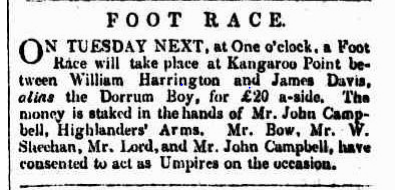
The adjudicators were the proprietor of the Highlander’s Arms, John Malcolm Campbell – not the John Campbell of the Boiling Down works; Michael Sheehan, a publican in Brisbane town; and the proprietor of the Victoria Hotel, David Bow. A wool classer and landowner named Edward Lord was also named as an adjudicator, which appeared to be news to him “We have been requested by Mr. Lord to state that he never authorised any person to make use of his name as one of the umpires of the foot race announced in our columns last week. The advertisement was the first intimation he had of the match.” (Moreton Bay Courier, Saturday 14 August 1847, page 2.)
Oddly enough, within a year, the fortunes of these men would change drastically. John Malcolm Campbell died on 21 April 1848 at 35, leaving a widow and two children. David Bow lost his wife to a stroke on 03 June 1848, became insolvent, and one month later lost the Victoria Hotel lease. Edward Lord gave up business in Moreton Bay and moved to the Darling Downs town of Drayton, where he became a shopkeeper.
Came the great day, and Harrington prevailed over 300 yards, having really only been challenged for the first 150. The Courier noted that Mr Harrington seemed to be “an old stager” at the sport, and although the race was well attended, it was not heavily staked upon. This event still lingered on in the minds of older settlers and was featured in “In the Early Days: history and incident of pioneer Queensland” by J.J. McKnight nearly half a century later. In a footnote to the book’s coverage of the story is mention that Dick Ben, who was wanted over the previous year’s Pine River Murders, had made an appearance about the settlement, and Davis and Harrington assisted the local Police to try and catch him, but none succeeded.
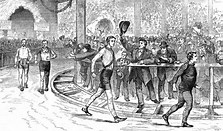
Harrington the rest of the year trying to get another foot race going “opponent and venue to be determined”. He succeeded in October by beating the wonderfully-named Caleb Supple in a £5 per side race, and then quietly disappeared from the town.
Telegraph (Brisbane, Qld. : 1872 – 1947), Monday 6 September 1880, page 2
Moreton Bay Courier (Brisbane, Qld: 1846-1861), Saturday 7th August 1847, page 3
 Moreton Bay and More