
A glance through the Moreton Bay Courier of September 5 1850 shows the reader the era in Brisbane Town in a nutshell.
Rosewood was out in the never-never, and locals banded together to discourage (in their worldview) indigenous raiders. This was the time when relations between determined free settlers, and dispossessed indigenous people was at its most violent.
LOCAL INTELLIGENCE.
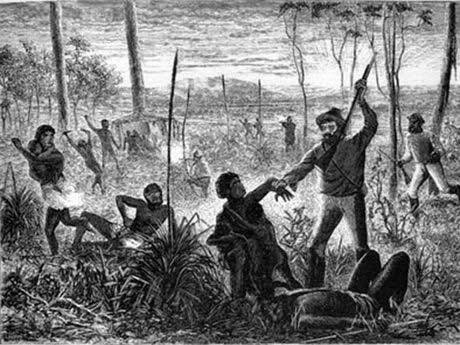
The Blacks. Intelligence reached Brisbane yesterday evening, that a body of the natives, numbering about five hundred, belonging to the Rosewood Scrub, Tent Hill, and other tribes in the neighbourhood of Lockyer’s Creek, tumultuously assembled at Mr. Coutts’ head station, headed by the notorious black, “Campbell;” and threatened to murder the inmates unless their demands for money and provisions were complied with. We are informed that Campbell, who both speaks and understands a good deal of English, accompanied by about twenty blacks, went up to Mr. Coutts’ hut, and demanded ten pounds, in “big fellow white money,” four figs of tobacco for each of his companions, and some ” budgere flour,” “bail ration” flour. Mr. Coutts refused to supply the rascals with anything; and matters were proceeding to extremities, when two of Mr. Coutts’ neighbours, with a black boy, opportunely arrived at the station. As soon as they had reached the hut, the great body of the blacks, who had ere now been concealed, emerged from the creek, and assumed a menacing attitude. Several spears were then thrown, and, in self-defence, three of the blacks were shot by the party who were assailed. One of them that fell was the ring-leader, Campbell, and the two others, were the supposed murderers of the unfortunate Mr. Uhr. As soon as the blacks found that they were likely to have “hot work for it,” they made a precipitate retreat to the scrubs, carrying the dead bodies of their companions with them. Thus, through the timely assistance rendered by Mr. Coutts’ neighbours, he and his family were providentially saved from massacre.
The skeletons of convicts, still in leg-irons, were being found as new building works took place. I don’t think that this was a murdered convict – he would be missed at the settlement – it was probably an absconder who didn’t get very far.
DISCOVERY OF HUMAN BONES.—A few days since, as one of the labourers, employed by Mr. Savary in building his new house, was digging in the garden, at the back of the premises, he discovered part of a human skeleton, with irons on the legs, similar to those worn by the prisoners during the time this place was a penal settlement. It is conjectured that the bones are the remains of some poor wretch who had, in all probability, been murdered by a fellow-prisoner, and afterwards placed by him under the sod to escape detection.
It is well known that murders among the prisoners were not infrequent, and that many of them committed the most diabolical crimes in order that they might be deprived of an existence which had become hateful as well as burdensome, on account of the severity of their punishment
The Servant Problem that so exercised the 19th century haunted rough and ready Brisbane too. Not only could one’s servants lose one’s livestock and expect to be paid, they could drunkenly ruin one’s dinner party and then insult one’s good lady wife. Even one’s convicts won’t do what they’re told.
CONVICT INSUBORDINATION. A prisoner of the Crown, named Ralph Coots, was brought before the Magistrates yesterday, charged with disobedience of orders, and insolent conduct to Mr. Nicol, the overseer of the Hospital. Mr. Nicol having substantiated the charge; the prisoner was ordered to be confined in the cells for seven days. Another prisoner of the Crown, named John Griffiths, was also placed at the bar, to answer the complaint of Mr. Jones, the Barrack Sergeant, for refusing to work when required to do so. The prisoner endeavoured to exculpate himself by saying, that he had never been set to do the same kind of work before, and that he did not consider he was bound to “make himself generally useful.” The Police Magistrate, however, soon undeceived him on that point, by ordering him to be confined for the same term.
BREACH OF HIRED SERVANT’S ACT. At the police-office, on Tuesday, a man named William Houlihan was brought before the magistrates to answer the complaint of Paul Lawless, Esq., of the Albert River, for disobedience of orders and neglect of duty. Mr. Lawless stated that the defendant had been a few days only on his station and had had goods out of the store to the amount of thirty shillings, when he positively refused to work, in consequence of his being required to shepherd a flock in which there were about twenty crawlers. The Police Magistrate enquired of the defendant whether he was willing to return to his duty, when he replied, in a very sulky manner, that he did not like to go back to any master after he had once made up his mind to leave him, and that he was ready to submit to the consequences. Upon this the Bench sentenced him to three months’ imprisonment, with hard labour, in the House of Correction in Sydney.
WAGES—At the police-office, on Tuesday, a man named Caton summoned Mr. Robert Coulson for non-payment of wages. Mr. Coulson stated the reason that the man had not been paid was that either he or the shepherd had lost fifty ewes; and Caton, who was watchman, had neglected to apprise him of the circumstance, which it was his duty to have done. He had charged him for twenty only, at the rate of seven shillings per head, which was considerably less than they were worth, as the ewes were heavy in lamb. The bench was of opinion that the charge was proper, and that the complainant ought to have reported the loss of the sheep to his master. The case was then dismissed. It is to be hoped that this decision will become generally known throughout the two districts, for hutkeepers appear to think that they have nothing else to do but sit down in their huts, smoke their pipes from morning till night, and “then take it out between the blankets.” It is quite time these men should be made aware of the responsible nature of their services, for the Bench, we believe, are determined to punish, with wholesome severity, every individual against whom complaints of neglect of duty have been substantiated.
And then there’s this enhancement to civic beauty.
PIGS. At the police-office, yesterday, William Clarke appeared to answer an information, which had been laid against him by the Chief Constable, for suffering pigs to stray in the public streets, contrary to the provisions of the Act of Council. The Police Magistrate said, although it was not his intention to fine the defendant, as this was the first case that had been brought before him, yet he would feel bound to put the law in force against others who might become obnoxious to its penalties. The pigs about the town had become a serious nuisance, as they rooted up everything in the place, and were a great annoyance to the inhabitants. The Police Magistrate also pointed out the circumstance of some of the town allotments (we believe all corner ones) being so exceedingly small, that it would be impossible for any of the inhabitants to keep these animals on their premises, unless they had two allotments, without infringing the clause in the Act, which requires that pigs should be kept forty yards away from the public street. In his opinion, the imposition of fines under such circumstances would be a great hardship, and he should take an opportunity of calling the attention of the authorities in Sydney to the circumstance, with the view of preventing what might hereafter, be the means of much vexatious litigation. [We wish that this was the only blunder committed by Sir George Gipps when he gave directions for the laying out of the township. Scarcely a week passes but something turns up to show the absurdity of the peddling system adopted by him in the disposal of town allotments.]
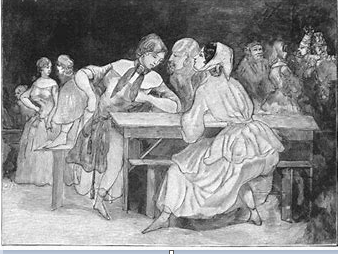
And finally, an enhancement to any municipality she may find herself in, was this uninhibited and festive lady.
A DISORDERLY CHARACTER. On Tuesday an abandoned woman named Ann Simpson alias Jane Spencer, was brought before the magistrates charged, under the Vagrant Act, with being found in a beastly state of intoxication on, the premises of Mr. Robert Rowland, in South Brisbane, on Tuesday night week. This woman is the same party who was sentenced, a short time ago, to three months imprisonment for indecent exposure of her person; but she does not appear to have profited by the lesson. The Police Magistrate reprimanded her severely for her disgraceful conduct and told her that if she came before him again, he would have her removed from the district. A bullock-driver, with whom the woman has lately cohabited, came forward and stated, that “except when she had drink, she was as good a ‘ooman as ever broke bread,” and that he would undertake to be answerable for her future good conduct; an undertaking which, it is not likely, he will ever be able to accomplish, as she is the most incorrigible drunkard in the district. With all due deference to the decision of the magistrates, we do not think that there were the slightest grounds for the extraordinary lenity shown in this case. Here was one of the most depraved characters in the district brought before them, and instead of summarily punishing the offender, as she deserved, they permit her to walk quietly away with her paramour with merely a reprimand, which probably will have the same effect upon her as such admonitions to such characters usually have. Had there been any extenuating circumstances in this case, we should not have felt ourselves called upon to make any remarks; for we are reluctant to animadvert harshly on a magisterial decision, which was no doubt given from benevolent, but, in our opinion, mistaken motives.
Moreton Bay Courier (Brisbane, Qld.: 1846 – 1861), Saturday 5 September 1846, page 2
 Moreton Bay and More