
On 11 September 1847, three men working as sawyers on the Pine River came under attack from a group of indigenous people who were armed with spears and waddies. William Waller and William Boller died, and James Smith was injured, but survived to give evidence to the Coroner.
James Smith was working a two-man saw with William Boller when he felt Boller let go of his end. There was a group of indigenous people by the saw pit, who threw spears at the men. One aboriginal man, identified by Smith as “Dundalli” threw a waddy at Smith. Smith was able to get out of the saw pit after a while, and went to the hut, where he found Boller incapacitated by spear wounds. Smith managed to get Boller to a nearby station, from where the injured man he was conveyed to Brisbane Hospital, where he passed away. A pet dog led searchers to the body of William Waller.
This happened a year after the murders of Andrew Gregor and Mary Shannon, also at Pine Rivers and also at the hands of indigenous people, and the effect on European settlers cannot be underestimated. In the distant farming regions, there was no local police force and the only way of communicating urgently for help was to despatch someone on horseback to raise a hue and cry in the district.
[A great deal of the tension can be traced back to a mass murder of indigenous people at the Kilcoy Station in February 1842. Shepherds in huts on the McKenzie property, afraid of visits from hungry aborigines, left flour tainted with arsenic for the indigenous visitors to take away. They did, and around 60 people died agonising deaths.]
The newspaper reports based on James Smith’s evidence to the Coroner’s Inquest, brought a new name to the public consciousness – Dundalli, an indigenous man, probably from the Dalambara people of the Blackall ranges. He lived with the indigenous people on Bribie Island throughout the 1840s. A tall and commanding figure of a man, Dundalli was characterised as a ruthless marauder (by contemporary whites) and a freedom fighter (by modern academics).
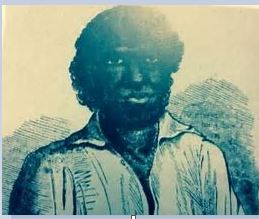
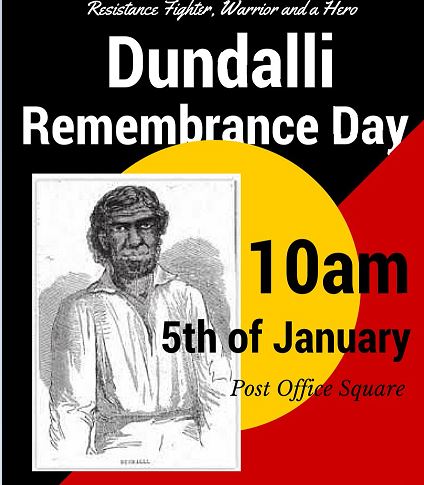
It is impossible to know the man’s motivation at this remove, but Dundalli became the focus of reports of black on white violence in southern Queensland, whether he was involved or not. In 1854, he was captured in Fortitude Valley – where he had been working and living in plain sight – and was tried, convicted and finally executed in Queen Street Brisbane. On the scaffold, erected on the footpath outside the present General Post Office, Dundalli is said to have cried out to the indigenous people gathered on the hillside from Wickham Terrace to avenge his death. The executioner famously bungled the hanging, causing the condemned man more pain and terror than even the fiercest critic of indigenous warrior would wish.
No one was ever executed in public in Queensland again.
Libby Connors, ‘Dundalli (1820–1855)’, Australian Dictionary of Biography, National Centre of Biography, Australian National University, Australian Dictionary of Biography, Supplementary Volume, (MUP), 2005
Moreton Bay Courier (Brisbane, Qld. : 1846 – 1861), Saturday 18 September 1847, page 2, an
Moreton Bay Courier (Brisbane, Qld. : 1846 – 1861), Saturday 11 September 1847, page 2
 Moreton Bay and More
1 Comment