
On 13 September 1866, a particularly daring bushranger known as the “Wild Scotchman” was sentenced to 25 years in prison for a series of daring raids during which no postman was safe, apparently. A quick glance at his first Queensland press reports give an extraordinary description of him:
We are informed that the man was dressed in a panama or grasstree hat, with a red scarf around it and muslin behind. He also had a red scarf over his shoulder and one around his waist. He wore patent leather boots and was altogether generally dressed after the orthodox style of the fashionable – or Ben Hall – bushranger. He is described as a person of fair complexion, about five feet eleven in height, and about twenty-four years of age.
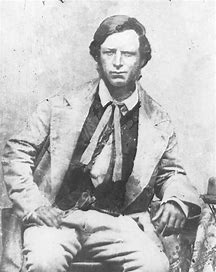
Striking indeed, but not perhaps the costume one would want to wear to avoid attention when making off with one’s ill-gottens.
The article written on his death thirty years later best sums up Mr Macpherson’s life and career.
A QUEENSLAND BUSH-RANGER. DEATH OF THE “WILD SCOTCH-MAN.”
The once-notorious bushranger, James Macpherson, better known as the ‘Wild Scotchman,’ was killed at Burketown last week through a fall from his horse: — Macpherson (says the Queensland Times) came to Moreton Bay in the ship William Miles about 1854 or 1855. He was then quite a lad, and there are a few people still living in Ipswich—shipmates who remember him well. He was a brother of Mr. D. B. Macpherson, of the Cross-roads, near Esk. The bushranger episodes of the “Wild Scotchman” in the Maranoa and Dawson districts, in 1865 and 1866, caused considerable excitement at the time, owing to the loss and annoyance through the frequent stoppages of mails— “stuck up” by the “Wild Scotchman,” about his biggest “scoop” being when he robbed the Roma mailman of £1600 and all his mail packages. In 1866 every effort was put forth to capture Macpherson, the Commissioner of Police (Mr D. T. Seymour) and a large force of sub-inspectors, constables, and black trackers patrolling the country, but none of the police were successful in bringing him to justice.
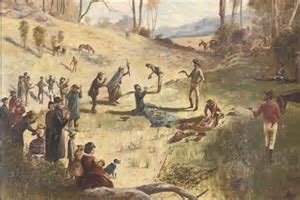
He was, however, eventually captured on the 20th of March 1866, the following being the particulars: “The capture of Alphin Macpherson, the bushranger, generally known as the “Wild Scotchman,” was reported in Maryborough on Saturday morning, the 31st March from the telegraph station at Golden Fleece, by a telegram from Mr. A. H. Brown, Gin Gin, to the Police Magistrate, requesting him to send on two constables to that station to take the prisoner on to Maryborough. The constables were immediately despatched, and reached Gin Gin late the same night, returning without delay to Maryborough with their prisoner, where they arrived on the evening of Monday, 2nd of April, A correspondent has since sent us the following account of the capture: —
“I suppose that the world will be wondering how the Wild Scotchman has been taken; the affair is simple enough in itself, and, of course, not by the police. A man answering to this description had been seen on the morning of the 30th ultimo, and had been inquiring for a road which he did not, it seems, intend to travel; he was again seen within a short distance of Munduran by two gentlemen living at Gin Gin, and they instantly proceeded to the Munduran head station, and reported their suspicions as to whom it was to the manager (W. Nott, Esq.), who with praiseworthy promptitude, joined them, together with another person, making in all a party of four, and immediately started in pursuit. They overtook him about five miles from the station, in the direction of Port Curtis. When he saw them in a full gallop, and nearly upon him, he let go his pack horse, and started at full speed down a very broken range. Being well mounted, they followed, and were fast gaining on him, when be pulled up, and commenced to unstrap a double-barrelled gun which he had with him. Upon his commencing to do this, Mr. Nott covered him with his rifle, and told him that if he did not there and then throw up his arms and surrender, he would fire at him.This threat, fortunately, was sufficient, as Macpherson at once said, “I give myself up.” He added, “I knew you were not the police by the pace at which you followed me down that ridge,” and he described, with some humour, the absurd attitudes which he had witnessed in police horsemanship — some holding on by the front, and same by the back of the saddle. The prisoner was very communicative and appeared cheerful. Those who were instrumental in his capture were Messrs W. Nott, Curry, Gadsden, and J. Walsh. The first night he was lodged at Munduran, the second night at Gin Gin; at both places he was watched day and night and was taken by the police from the latter place on Sunday (1st April). I trust that the Scotch ranger will not make April fools of us, but we have strong doubts of his safe arrival in Maryborough. There were found on him about £9 in notes and cash, pistols, gun, and sundry articles of clothing. His two horses are done up. He behaved in a very orderly manner since his apprehension and gives an amazing account of his adventures.” In reference to his “first appearance” before the Bench, at Maryborough, it was stated that the Courthouse was crowded with spectators, amongst whom there seemed some disappointment at the appearance of the prisoner. Some because he was not so “flash,” and others because he was not so ferocious looking as they expected.
The prisoner, however, answered to the ordinary description of a bushranger, such as of late have been so frequently described in New South Wales journals — a bushman, hardy, strong, and supple; in Macpherson’s case, we should say, of more than ordinary intelligence and courage. He evidently takes matters coolly and does not appear at all discomfited by his present position. He has been very communicative since his capture, relating, evidently with truthfulness, judged by the minutiae of the detail of his narrations, some very racy tales of his interviews with the police in and about Gayndah, whilst they have been in search of him. Macpherson was sentenced to twenty-five years’ penal servitude by Mr. Justice Lutwyche, but a petition was afterwards signed by all the men of note in the colony, including Sir Charles Lilley, for a reduction in in the sentence, and Mr. Macalister, the then Agent-General for Queensland, presented it to the Premier of England, Lord John Russel (since Earl Russel). After the petition had been considered by the Imperial authorities, Macpherson’s sentence was reduced to eight years.
Brisbane Courier (Qld. : 1864 – 1933), Monday 30 October 1865, page 3. Maryborough Chronicle, Wide Bay and Burnett Advertiser (Qld.: 1860 – 1947), Tuesday 30 July 1895, page 3
 Moreton Bay and More