
On 18 September 1849, Owen Molloy went to the gallows in Sydney for the murder of James Leonard. He died penitent, admitting his guilt and warning the large crowd gathered for the gruesome spectacle, to avoid the demon drink.
There was a sensational coda to Molloy’s story, but more of that later.
James Leonard was a diminutive, hard-working man who been in the service of James Garnett Ewer, Esq. the week previous, and was keen to work for the Squire again. To that end, he arranged to meet Ewer on Sunday 17 June on the Ipswich Road. Leonard would be on foot, with his trusty dog by his side. However, he did not keep that appointment, and it soon became clear that he was missing.
Mr Ewer was concerned and made enquiries at Brisbane. Leonard had been seen about with a man named Molloy and was believed to have left for Ipswich with him. Leonard had two money orders with him for substantial sums, and being an old bushie, had wrapped them around a small stick, that he kept in his pocket.
Early on Saturday morning, Maria Deeming, a resident of Mrs Graham’s public house, saw the two men walking on the road to Cowper’s Plains. Leonard passed the time of day with her. She remembered that he had a pilot coat on, and carried a pair of boot on his arm. His faithful dog trotted behind him.
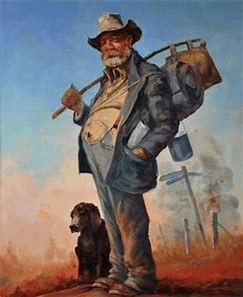
On Sunday evening, Molloy entered Mrs Graham’s pub alone, called for some grog and booked a room. Maria noticed that he had on a coat that looked like the one Leonard had worn the previous morning. Molloy was flush with cash, and he seemed to have a very familiar stick wrapped with paper in his pocket. He asked her to take down the cuffs of the jacket, because it was made for the “little man” – Leonard – who he said had given it to him. He also had Leonard’s dog, who would normally go nowhere without his master.
Maria Deeming’s was suspicious. She went into Molloy’s room and looked through his bundle of belongings – she found shoes that looked like the pair slung over Leonard’s arm the previous morning. She also found a black scarf, a razor, and a towel with fresh bloodstains on it. She left the room without being discovered but noticed that Molloy locked himself in there on Sunday night.
The next morning, the resourceful Maria Deeming caught Molloy shaving. He was wiping his face with the bloodied towel, but that the blood was drier. She asked if he had cut himself shaving, and he said no, he’d had a nosebleed.
The Police were suspicious too. Molloy was taken into custody and questioned about the money orders, razor, towel, coat, boots and dog. Molloy swore they all belonged to him. The Chief Constable released him, but two hours later, had a change of heart, and ordered Constable Maguire to arrest Molloy. By this time, Molloy was on the way to Ipswich via the Experiment steamer. Maguire hailed the steamer, which pulled to the shore and discharged Molloy into his custody.
Molloy expressed the hope that he wouldn’t be hung yet, because Leonard would be down from Ipswich in a day or so and wouldn’t they all look silly. In his cell, Molloy was observed to be trying to swallow something – Maguire grabbed Molloy and made him cough it up. Turned out to be three gold sovereigns.
A search was conducted on the Ipswich Road, with the Police, Mr Ewer, two native trackers and Leonard’s faithful dog. The dog kept stopping in one place, but it was getting dark, and the party retired to Cowper’s Plains station for the night. There they found bedding and clothes belonging to Leonard. The next morning the trackers found Leonard’s body where the dog had kept stopping.
James Leonard had been hit hard on the head, and his skull was fractured. His throat had been cut through to the vertebrae. Either injury would have been fatal. He also had a deep cut to his abdomen, and others to his torso and legs.
Owen Molloy tried to blame others he’d met along the road, but one by one, the men he accused were found to be innocent. Molloy, described by a court journalist as “a man of middle-size, with a sallow face, and a general countenance most unprepossessing,” was taken to Sydney to be tried. He was found guilty and sentenced to death.
And the coda?
During his time in the condemned cell, a turnkey (warder) overheard Molloy admitting to the several other murders, including the murder of Robert Cox a year before. A crime that William Fyfe had already been executed for.
There is no way of ascertaining whether there was any truth to the condemned cell admissions, but they are intriguing. Here’s Bell’s Life in Sydney:
Extraordinary Rumours
RELATIVE TO THE LATE EXECUTION
SINCE the execution of Owen Molloy, rumours have been afloat throughout the City that his confession included several other murders, and amongst them that of the shepherd Cox at Moreton Bay, for which a man named Fyfe was hanged some fifteen months back, and who died solemnly protesting his innocence.
We have endeavoured to arrive at the source of this report; and although hitherto unsuccessful, we fear that it may not be altogether without foundation, for we can scarcely conceive the probability of such a rumour emanating from any hoaxer, however heartless or imaginative. There is, however, no little difficulty in arriving at the truth in the case of Molloy, for, be it remembered, that the secrets of the Confessional are held sacred, and that unless an admission of the kind were made in the presence of one of the criminal’s attendants, or of the gaol officials, we entertain but little hope of being enabled to clear up the mystery.
It has reached us that the acknowledgment of the unhappy man relative to this particular murder (Cox) was overheard by one of the turnkeys.
If such be the case, and if such acknowledgment were made to his spiritual adviser in confidential conversation, but NOT in the Confessional, we conceive that the reverend gentleman will scarcely consider it his duty to withhold a revelation which, while vindicating the memory of an innocent man, cannot in any possible manner affect his unhappy penitent.
Neither can we understand why, if his repentance were unfeigned, Molloy himself should have declined to make the only reparation in his power, by a disclosure, the consequences of which, beyond the internal satisfaction it might engender, could have made no difference whatever to him—a doomed man.
If there be no grounds for the report, (which, notwithstanding its denial by the “Sydney Morning Herald,” we at present see no reason utterly to discredit) it would tend to allay the prevailing excitement were the reverend gentleman who attended the convict in his last hours, publicly to assert the fact ; while, in the absence of such declaration, the possibility of the truth of such report will gradually obtain credence even in the minds of the most sceptical.
While in Fyfe’s case we cannot reconcile the fact of his innocence with the damning evidence adduced against him on his trial, yet the chain of that evidence, apparently perfect in every link, was wholly and purely circumstantial.
That he was guiltless is certainly not without the pale of possibility; and it is a matter of painful notoriety, that many an innocent victim has been sacrificed to our sanguinary penal code. Granting for the moment the truth of Fyfe’s dying protestation, what harrowing reflections must be conjured up in the minds of the witnesses, jury, and judge who condemned him. How much, then, does it behove the arbiters of life and death, under similar circumstances, to weigh with scrupulous nicety each particle of testimony tending to a result which is eternally irremediable. What an argument in favour of the total abolition of capital punishment does the view of the case present; and yet how frequently has the innocence of the legally-murdered sufferer only been established when the means and opportunity of reparation have for ever passed away.
Bell’s Life in Sydney and Sporting Reviewer (NSW : 1845 – 1860), Saturday 22 September 1849, page 2
Moreton Bay Courier (Brisbane, Qld. : 1846 – 1861), Saturday 6 October 1849, page 4
Moreton Bay Courier (Brisbane, Qld. : 1846 – 1861), Saturday 7 July 1849, page 2
Goulburn Herald and County of Argyle Advertiser (NSW : 1848 – 1859), Saturday 7 July 1849, page 2
Moreton Bay Courier (Brisbane, Qld. : 1846 – 1861), Saturday 23 June 1849, page 2
 Moreton Bay and More