
I wrote about the beginnings of Moreton Bay at Redcliffe earlier this month.
There have been explanations of the abrupt departure to Brisbane less than a year later – it was either sandflies, hostile indigenous people or lack of fresh water.
My theory is the indigenous people of the area. It’s one thing to find a few white fellas needing a feed, like Pamphlet and co., it’s another when dozens of them turn up, clear your land and commandeer your drinking water.
The Amity Drops Anchor
On 12 September 1824, the brig Amity dropped anchor at Redcliffe, with a manifest of convicts and soldiers under the direction of Lt Miller (the first Commandant), John Oxley, Alan Cunningham and Lt Butler. They were twice (or thrice in some cases) convicted felons, and their task was to set up a new penal colony at Moreton Bay. Redcliffe had been noticed and named by Matthew Flinders in 1799, who had been looking for, but had entirely failed to find, a suitable river in the area. The cliffs looked, well, red.

In 1823, nearly a quarter of a century after Flinders had sailed by and named it, Oxley took a closer look at Redcliffe and Moreton Bay generally. Oxley noticed muddy sand, and freshwater molluscs that indicated a river might be in the vicinity. His travelling companion, Uniacke, noticed a rather tall and pale-skinned Aborigine waving at him from the shore. Imagine his surprise when that Aborigine addressed him in English, and turned out to be one Thomas Pamphlet, who had been shipwrecked months earlier with three companions. One had died, and the other two were trying to walk to a settlement. The other two castaways were Parsons and Finnegan, and when they all met up to give their stories to Oxley and Uniacke, they all mentioned crossing a jolly big river. Oxley claimed that jolly big river as his own discovery.
The following year, the Amity arrived with its explorers, soldiers and convicts. They anchored on 12 September, and exploring parties went out on 13 September to find fresh water. Oxley and Cunningham, both noted explorers, failed to locate any fresh water, and pottered about the bay islands scouting for a good place. Meanwhile, back on shore, the less notable members of the party managed to locate a couple of decent-sized waterholes, and on 14 September the convicts began setting up tents and pegging out building sites.
The first group of Moreton Bay convicts were useful men to have about a new settlement. They included:
John Anderson, sailmaker and tailor.
Henry Allen, Carpenter.
Thomas Bellington, Baker.
James Byrnes, Shoemaker.
Robert Butler, Carpenter.
James Crow, Shingler.
William Carter, Stonecutter.
William Francis, Sawyer.
William Green, Bricklayer.
George Gunningham, Stone Setter
William Hartlan, Cooper
James Hazel, Plasterer
Robert Humphries, Sawyer
Charles Hubbard, Limeburner
Lewis Lazarus, Tailor
Michael Morley, Quarryman
Thomas Mills, Seaman
John Pearce, Waterman
Thomas Price, Sailor
Matthew Sellers, Brickmaker
William Sanders, Seaman
James Turner, Seaman
Thomas Warwick, Sawyer.
The amenities the Amity convicts set up included a Convict Barracks, Commandant’s residence, Guardhouse, Soldiers’ Barracks and Commissariat Store, gaol, kitchens and a whipping post (of course – no hellhole was complete without one).
The footprint of the old settlement was still visible in the 1880s – the paved floor of the barracks kitchen, the whipping post, a well – and as late as 1970, a leg-iron was dug up by builders.
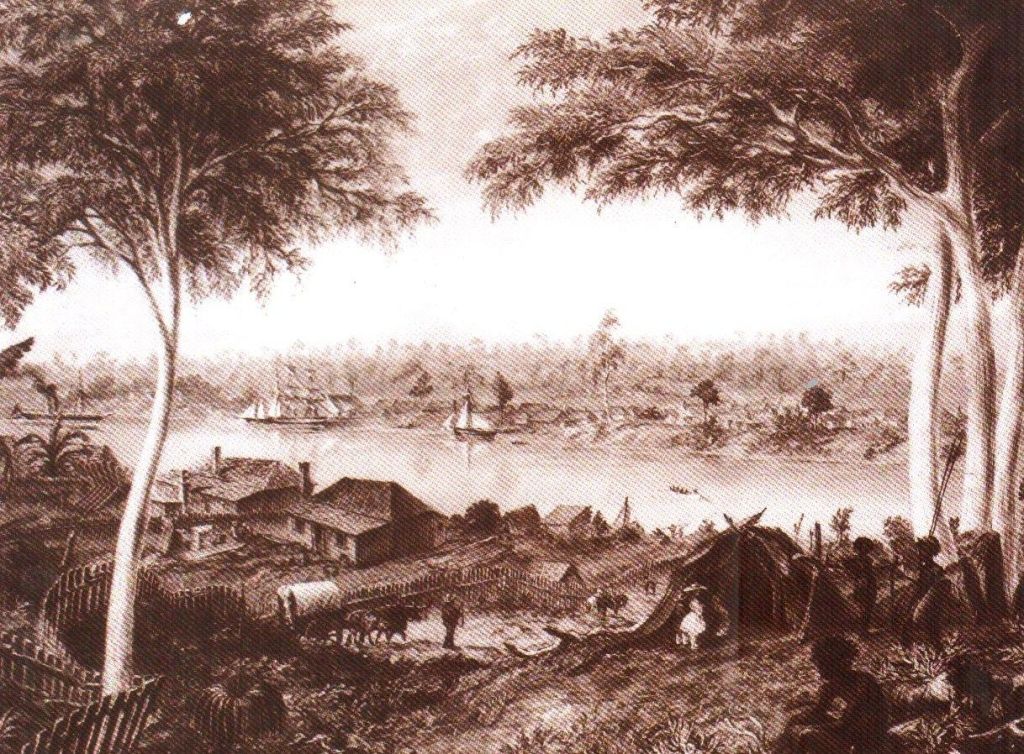
In May 1825, Lt Miller moved the convict settlement from Redcliffe to Brisbane Town. Several reasons have been given – poor health of convicts (although no convict died at the Redcliffe settlement), sand-flies, lack of adequate fresh water, and hostile indigenous people.
The reasons may have to do with the views of Oxley, Cunningham and Lockyer – once the river Brisbane had been charted, and the results reported back to the Governor, the days of Redcliffe were numbered.
Sources:
Redcliffe in 1824. Queensland Heritage volume 2 issue 6: pp. 20-25 . Steele, J. G. (John Gladstone), 1935- Brisbane. Oxley Memorial Library Advisory Committee for the Library Board of Queensland, 1972
In the early days: history and incident of pioneer Queensland: with dictionary of dates in chronological order. Knight, J. J. Brisbane. Sapsford, 1895
Queensland State Archives Series ID 5653, Chronological Register of Convicts at Moreton Bay
 Moreton Bay and More