
(Wikipedia)
THE MORETON BAY COURIER
SATURDAY, OCTOBER 5, 1850
WITH deep regret we record in this issue the death of Dr. Ballow, who expired at the Quarantine Station at about eleven o’clock on Sunday morning last, after a few days’ illness from typhus fever, which disorder he had contracted in the performance of his duty, as Acting Surgeon Superintendent of the Quarantine Station. It will be remembered by our readers that Dr. Ballow assumed the charge of the station upon Dr. Mallon being attacked by the fever, and that the arrangements which he was then enabled to carry into effect were very beneficial to the afflicted immigrants. Last week, however, the virulent disease, which has carried off so many, began to display its effects upon the constitution of the unfortunate gentleman whose demise we have now to deplore. Dr. Mallon applied such remedies as be conceived to be proper, but, after a temporary rally and a relapse, succeeded by delirium, death took place at the hour above named; thus sweeping off a second professional victim to the scourge imported in the ship Emigrant. When the melancholy intelligence was communicated in town on Monday afternoon, a general feeling of sorrow was diffused amongst the inhabitants; and on the next day nearly all the stores and shops were partially closed: thus giving evidence of the esteem in which the unfortunate deceased was held.
Dr Ballow was the eldest son of the late John Ballow, Esq., and was born at Montrose, in October, 1804. He received his education at the University of Edinburgh. He arrived in this colony in the year 1834, and was married in October, 1837, to Catherine Campbell, youngest daughter of the late Captain McArthur, of the Royal Veteran Battalion. In December 1837, Dr Ballow was appointed Assistant Colonial Surgeon, in Sydney, and in March, 1838, was removed to Brisbane, where he continued in charge of the Government Hospital until the breaking up of that establishment; and since, until the time of his death, was Resident Surgeon of the Moreton Bay General Hospital.
Dr. Ballow was also in the commission of the peace for the colony, and held the offices of Coroner for the Brisbane district and Visiting Surgeon of the gaol.
Potted Biography:
- Born 27 October 1804 at Montrose, Scotland
- Married Margaret Campbell 21 October 1837
- Career – Surgeon, Coroner, Magistrate, Cotton Farmer
- Died 29 September 1850 at Dunwich, Stradbroke Island
Dr David Keith Ballow holds a place of high regard in Queensland, not just because of the selfless service that led to his death at 45 years old.
He came to the Moreton Bay Penal Establishment in December 1838, as Surgeon to the Convit Hospital, treating a population of 300 convicts, soldiers and their families.
Between 1839 and 1849, Ballow ran the convict hospital, catering to the growing population of free settlers.
Dr Ballow was also a Magistrate, Coroner and was appointed Surgeon and also trustee of the new Brisbane General Hospital in 1849. In case he was in danger of becoming bored, he also conducted private practice and was one of the first to cultivate cotton in Queensland.
Dr Ballow was called in to conduct examinations of the scenes and victims in the most notorious murder cases of the 1840s. Ballow journeyed to Mount Lindesay with Commandant Gorman to recover the remains of Assistant Surveyor Granville Stapylton and William Tuck. The expedition expected to find the dead body of James Dunlop, but instead found him alive but injured and very weak. Dr Ballow was following the direction of a faint “coo-ee” when he parted some srub and came face to astonished face with Dunlop.
In 1844, a group of indigenous people at Limestone fell victim to symptoms that looked to Ballow to be very similar to arsenic poisoning. Ballow persuaded the aborigines to grant him permission to examine an old man’s dead body, and performed some CSI Moreton Bay experiments that detected arsenic in the stomach contents.
In 1846, Dr Ballow travelled to Pine River with the Police Magistrate to investigate the deaths of Gregor and Shannon, who lost their lives in an attack by the local indigenous people.
In 1848, Ballow, a Kangaroo Point resident, answered the call to the Bush Commercial Hotel, where a shocking dismemberment murder had taken place. This was the famous murder of Robert Cox. After a great deal of gruesome and confusing evidence was taken, a man named William Fyfe was charged with the murder. The two men had been convicts together nearly twenty years previously. Fyfe protested his innocence to his last breath. One year later, a man named Owen Molloy was overheard by a gaoler to admit to the murder. Nearly twenty years later, a rumour gripped Brisbane town that Patrick Mayne, a wealthy butcher and Alderman had apparently confessed to the crime on his deathbed. See the book, “The Mayne Inheritance” by Rosamund Siemon. Or don’t see it. See “Epitaphs”, whose author claims that the death of Cox was an accident, and that the shocked men present made a god-awful mess in trying to cover it up. Given the savagery of the crime, my first assumption would be that other crimes of violence would follow, which makes me lean towards the killer Molloy. I don’t know. It was 1848.
The following year, Dr Ballow would make another mournful visit to Pine River, this time to the murders of William Waller and William Boller, two sawyers who were killed by the local indigenous people.
In 1849 and 1850, Ballow waged a campaign for smallpox vaccination, and to set up a proper quarantine facility for the Bay. There were immigrant ships arriving constantly, and their passengers often fell victim to contagious disease outbreaks after months in confined quarters.
This concern was justified when a ship named The Emigrant landed in August 1850, with a deadly outbreak of typhoid fever amongst its passengers. Dr Mallon, who was treating the arrivals at Dunwich, fell ill himself. Dr Ballow took over the care of the immigrants, until he also developed typhus. He seemed to be recovering – Mallon was well again by late September – but Ballow suffered a relapse of fever and passed away.
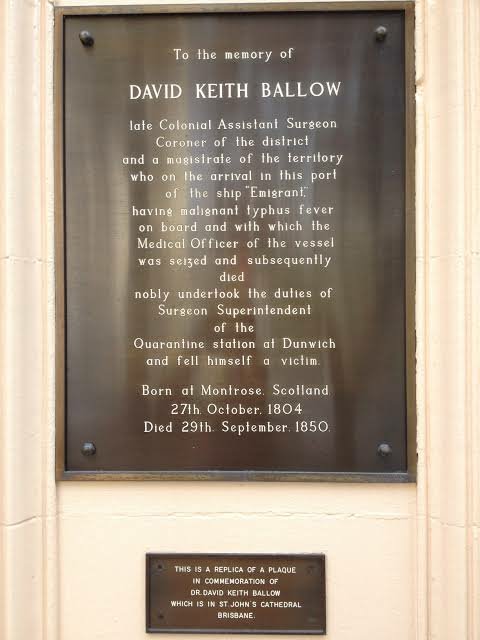
He is buried, along with other victims from the Emigrant, at Dunwich Cemetery. His legacy is honoured by plaques in St John’s Anglican Cathedral and on Ballow Chambers, an historic medical chambers named in his honour.
His contemporaries held him in great esteem, for the discharge of his public duties and his jovial, energetic personality.

Moreton Bay Courier (Brisbane, Qld. : 1846 – 1861), Saturday 31 August 1850, page 2
Moreton Bay Courier (Brisbane, Qld. : 1846 – 1861), Saturday 5 October 1850, page 2
Kathleen O’Donoghue, ‘Ballow, David Keith (1804–1850)’, Australian Dictionary of Biography, National Centre of Biography, Australian National University, http://adb.anu.edu.au/biography/ballow-david-keith-1735/text1913, published first in hardcopy 1966, accessed online 28 September 2019.
 Moreton Bay and More
1 Comment