

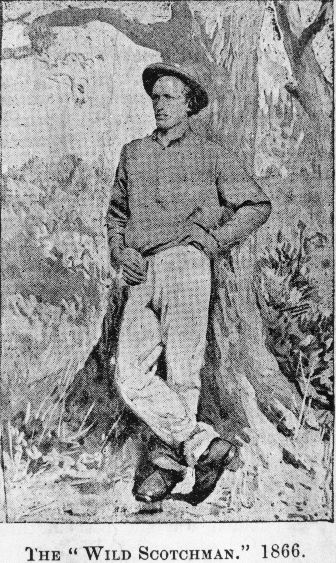
In outback Queensland in the late 19th century, everyone had a Wild Scotchman story. How he escaped from police custody and pinned his fetters to a tree with a file. How he eluded recapture time and again. How he was shot by Sir Frederick Pottinger in New South Wales. How he sent Governor Sir George Ferguson Bowen a collection of useless cheques from one of his mail robberies. How he had tried to join forces with Ben Hall. How he’d tried to escape an Island prison. How he reformed, married and became a father of seven. How he died a free man, but far too soon.
The Scotchman was lauded in the press for his intelligence and damned in the same publications for his insolence. He wrote letters to editors to mock his pursuers. He interrogated the victims of his robberies about his standing in the press, and as to where he might get his picture taken. In later life, he published his poetry under the pseudonym “Poor Jim.”

State Library Qld.
This restless spirit was born in Inverness-shire on 27 August 1841, the third of John and Elspeth McPherson’s ten children. The entire clan arrived in Moreton Bay on 27 January 1855 aboard the William Miles, as assisted immigrants.
John McPherson went to work at Cressbrook station, and sent his bright, able sons to good schools in Brisbane. James had an aptitude for languages and debating and was apprenticed to Tom Petrie (a Scottish-born builder, stonemason and alderman) in the early 60s.
In 1863, the apprentice left his master with no explanation, and became an itinerant farm worker, developing skills with horses and firearms that would stand him in good stead in his chosen career.
A career in crime begins.
Exactly what led the well-educated young man to take up a life of bushranging is not known. McPherson at one point blamed a passion for “Penny Dreadfuls” for becoming the scourge of outback roads. A taste for non-improving literature aside, the most likely catalyst was a dispute over pay that made him decide on rob the Cardington Hotel outside Bowen on 03 March 1864. McPherson, together with Charles McMahon and Charles Dawson, held up publican Richard Henry Willis, but the robbery turned into a struggle, and Willis was shot in the face. The ball lodged in Willis’ cheekbone, a painful, but not fatal injury.
McMahon, Dawson and McPherson had been working locally, so their identities were well known, and the Police Magistrate at Bowen offered a £75 reward for their capture. McPherson had become a violent outlaw in the pursuit of his wage claim. Time to leave town.
John Bruce in New South Wales
Six months later, a young Scotsman calling himself John Bruce turned up 2000 kilometres to the south, near Forbes in New South Wales. (John being his father’s first name and Bruce his mother’s maiden name).

McPherson stole a horse and sought to join up with Ben Hall’s gang. Hall’s story, “by one who knows” had been published in the Brisbane Courier in 1863 under the title “How Bushrangers are made.” It is not beyond the realm of possibility that a voracious reader like McPherson had read or at least heard of the story, and when he had wages withheld, he identified with Hall’s struggle with an over-zealous policeman named Sir Frederick Pottinger.
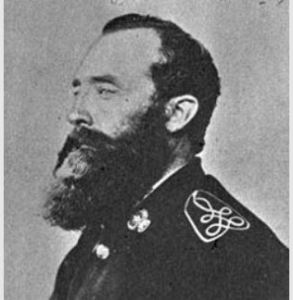

In a pleasing twist of fate, McPherson met up with none other than Sir Frederick Pottinger on 19 August 1864 at Wheogo. He exchanged fire with Sir Frederick and Sergeant Condell, ducking between trees, and was wounded in the arm. The heavy police issue boots of the two lawmen wore impeded their progress in the boggy ground, and “John Bruce” got away. The Scottish bushranger was now firmly in Pottinger’s sights.
McPherson lay low for a time, his wound – a bullet went into his arm at the wrist and exited just before the elbow – healed, although he kept the scar for life. In January 1865, the Scotsman was spotted in Goimbla, heavily armed and with a freshly stolen horse. Sir Frederick made haste to the area but was disappointed.
On 11 February 1865, Sergeant Condell and a party of four managed to capture “John Bruce.” He was either captured after a shoot-out (the Sydney Mail), or surprised whilst reading (Empire), and taken into custody on charges of horse-stealing and shooting at Sir Frederick Pottinger. The Sydney Morning Herald’s compositor managed to report his identity as “John Bounce,” which would have stung the image-conscious young bushranger.
The Forbes reporters though got the nom de guerre right, and were quoted throughout New South Wales and Queensland, and The Wild Scotchman legend was born:
“The notorious bushranger, who some time back had an affray with the police, and exchanged a number of shots with Sir Frederick Pottinger, has now been caught. He gives his name as John Bruce and is otherwise known as the ‘Wild Scotch-man.’ He hails from Inverness, in the Highlands, and has been in the country about five years, most of the time in Queensland. It is said that he converses intelligently upon general subjects. In religious matters he is quite fluent, and familiar with the writings and principles of Voltaire and Paine, towards which his proclivities are decidedly strong. He has travelled extensively upon the Continent and is well posted in European affairs. He gives his age as twenty-two and appears no older. In person he is well made, about five feet nine inches in height, has light hair, blue eyes, florid complexion, and altogether not a forbidding sort of a look about him.”
At the end of February 1865, the Wild Scotchman faced Sir Frederick Pottinger in Court at a committal hearing. Sir Frederick had incurred the wrath of his superiors in since their last encounter, and he prosecuted “Bruce” as the former officer in charge of Lachlan Police, a condition he intended to change at the first opportunity. Having seen the Bruce character remanded for his trial, Sir Frederick headed to Sydney to seek redress, his haste so great that he jumped on board a moving coach. Unfortunately, Sir Frederick’s weapon discharged at that moment, inflicting a wound that would eventually prove fatal.
When Sir Frederick died on 09 April 1865, the New South Wales police had little but a possible horse-stealing charge on which to hold this Queensland desperado, it was decided to send Bruce to Queensland where he would be facing rather more serious charges over the raid on Willis’ Hotel the previous year. Good riddance, basically.
After a 2000-kilometre steamer voyage in custody, James Alpin McPherson alias Kerr alias John Bruce, arrived safely at Port Denison for a committal hearing in early June 1865. Richard Willis was at last able to give his account of the night to a Magistrate, and by the evidence, it looked bad for the Wild Scotchman. He was sent under escort aboard the Diamantina to take his trial at the next Rockhampton Assizes.
He never arrived.
Constable Maher had been entrusted with the task of guarding the prisoner during the steamer journey. Maher found the Scot a fairly trustworthy fellow and disregarded the crew’s suggestion that the prisoner be locked away below decks. McPherson ranged about the vessel in leg irons, and took advantage of a stop in Mackay to vanish. His leg-irons were later found pinned to a tree with a file.
After relieving nearby stations of some pistols and a horse (and making sure to tell the gobsmacked station hand that “Wild Scotchy” was responsible), McPherson began his bushranging career in earnest.
To be continued..
Rockhampton Bulletin and Central Queensland Advertiser (Qld. : 1861 – 1871), Tuesday 15 August 1865, page 2
Maryborough Chronicle, Wide Bay and Burnett Advertiser (Qld. : 1860 – 1947), Wednesday 5 July 1865, page 2
Sydney Morning Herald (NSW : 1842 – 1954), Tuesday 20 June 1865, page 5
Kiama Independent, and Shoalhaven Advertiser (NSW : 1863 – 1947), Thursday 13 July 1865, page 3
Empire (Sydney, NSW : 1850 – 1875), Tuesday 9 May 1865, page 5
Sydney Mail (NSW : 1860 – 1871), Saturday 15 April 1865, page 2
Sydney Morning Herald (NSW : 1842 – 1954), Saturday 11 March 1865, page 5
Sydney Mail (NSW : 1860 – 1871), Saturday 11 March 1865, page 6
Armidale Express and New England General Advertiser (NSW : 1856 – 1861; 1863 – 1889; 1891 – 1954), Saturday 4 March 1865, page 4
Brisbane Courier (Qld. : 1864 – 1933), Tuesday 28 February 1865, page 3
Empire (Sydney, NSW : 1850 – 1875), Thursday 23 February 1865, page 4
Sydney Mail (NSW : 1860 – 1871), Saturday 25 February 1865, page 3
Sydney Morning Herald (NSW : 1842 – 1954), Saturday 25 February 1865, page 4
Sydney Morning Herald (NSW : 1842 – 1954), Friday 24 February 1865, page 8
Sydney Morning Herald (NSW : 1842 – 1954), Wednesday 15 February 1865, page 4
Sydney Morning Herald (NSW : 1842 – 1954), Tuesday 3 January 1865, page 5
Clarence and Richmond Examiner and New England Advertiser (Grafton, NSW : 1859 – 1889), Tuesday 30 August 1864, page 3
Armidale Express and New England General Advertiser (NSW : 1856 – 1861; 1863 – 1889; 1891 – 1954), Saturday 27 August 1864, page 3
Sydney Morning Herald (NSW : 1842 – 1954), Saturday 2 April 1864, page 7
Courier (Brisbane, Qld. : 1861 – 1864), Friday 24 July 1863, page 3
 Moreton Bay and More
1 Comment