
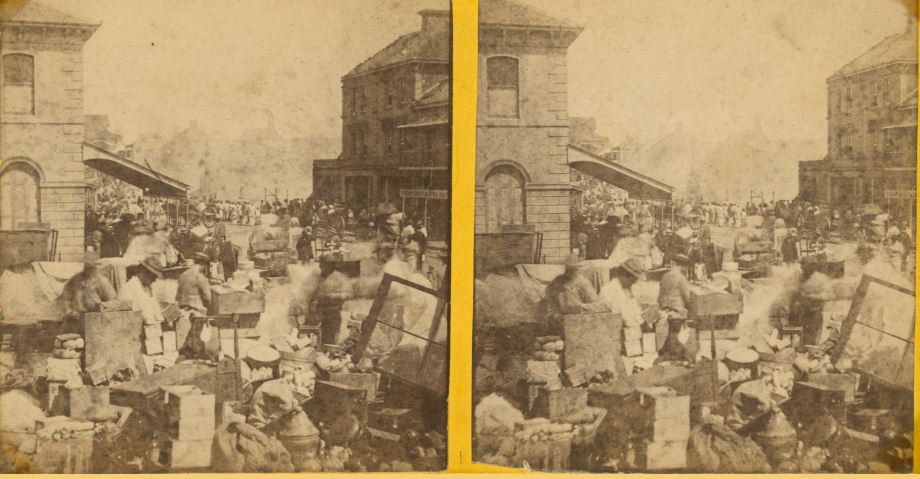
1864 was a turbulent year for Brisbane Town. Residents had barely recovered from catastrophic flooding, when, on 11 April, fire roared up Queen Street, destroying homes and businesses in its path.
There were photographers and journalists on hand, many of whom lived “over the shop,” and the accounts and pictures are striking.
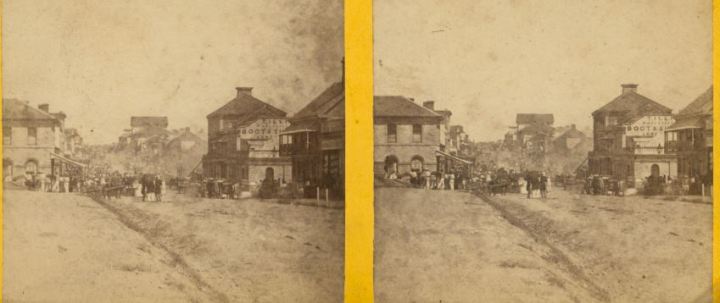
Before the fire
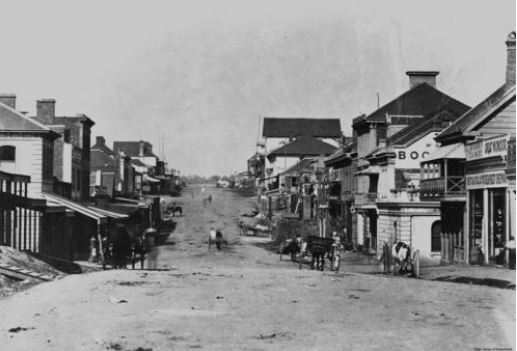
Queen Street was the main drag of Brisbane Town – it still is – although there is nothing recognisable from this 1864 photograph today, beyond perhaps the gentle uphill slope from Edward Street to George Street.
At the time, there were ramshackle shops and little cottages crammed together, mostly constructed of wood. A few brick buildings were dotted here and there, but overall, the impression is of a Wild West Town. Occasionally, bullock trains would have a nice sit-down in the street and horses and carriages had to negotiate their way around them until such time as the bullock driver was ready to set off again (by which I mean, had left the pub).
Nonetheless, most prominent Brisbane dwellers had a business or residence in Queen Street. Duramboi Davis owned property there, although he lived and worked mainly in Burnett Lane and George Street, and the Maynes had their residence and butcher’s shop on Queen Street.
April 11, 1864
At 4 am on April 11, 1864, Sergeant Lang was on his rounds in Queen Street, when he observed flames in the front of Mr Fegan’s grocery and wine and spirit warehouse, and raised the alarm. Soon Fegan’s and the neighbouring business, Ronald Illidge’s hairdressing and perfumery were engulfed. The Illidge family, who lived above the shop, tried to save some possessions and stock, and Mr Fegan discovered that his fireproof safe wasn’t fireproof at all.
Flames shot up in the sky as Brisbane residents made haste to Queen Street, to assist or gawk or nick things, depending on their nature. Goods piled up on the street and as the city police tried to coordinate the fire-fighting, rescues and protection of property.
Kingsford’s drapery shop was the next to be engulfed, then the fire leapt across an alley to consumer Fraser and Buckland’s auction rooms. The blaze consumed cottages, business and the North Brisbane Hotel. Property that had been stacked in the street to save it also caught alight.
Eventually, the volunteer Fire Brigade arrived in an engine provided by the Queensland Insurance Company, and completely failed to make an impression – water was in short supply. Every privately owned water tank in the street was used up.
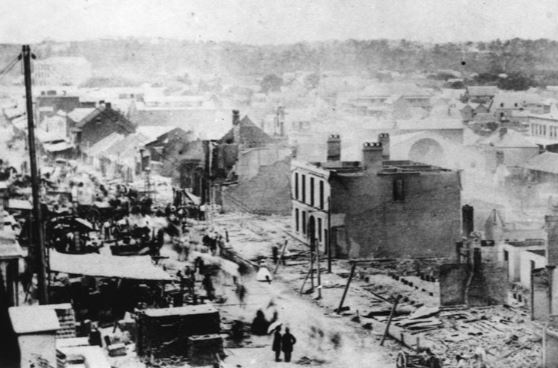
The situation was getting desperate. The Water Police turned up, as did the 12th Regiment, and together with local worthies, managed to organise teams to remove shingles from roofs and demolish properties to create a fire break.
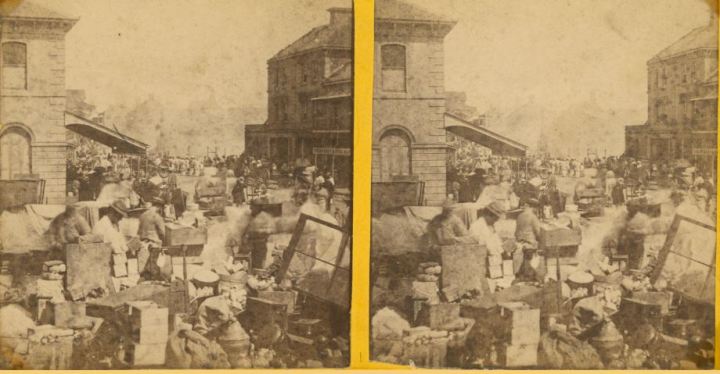
The Queensland Times summed up what had happened in the four hours the fire raged:
The buildings and places of business occupied by the following persons were destroyed: Messrs. Fraser and Buckland, auctioneers; Illidge, hairdresser; Fegan, grocer; Thomas, North Brisbane Hotel; Kingsford, draper ; Bulcock, fruiterer; Doyle and Macalister, solicitors; Walker, agent; Leck, photographer; Chambers, architect; McDevitt, barrister; Greville and Bird, telegraphic agents; Mandell, jeweller; Keith, ironmonger; Millar, stationer: Cowlishaw, architect; McNish, solicitor; Wilson, coroner; Le Gould, surveyor; Ball, barrister; Coates, dealer in china and glassware; and Markwell, ironmonger. The roof of the house of the Messrs. Flavelle was burned, but the fire did not extend any farther. Bulcock’s buildings, which were made of wood, went like so much tinder. The fire commenced at about four o’clock in the morning and was extinguished at about eight. A considerable amount of property that was carried into the middle of the street caught fire there and was destroyed. The fire could have been put out much sooner had it not been for the scarcity of water.
Once the insurance assessments had finished (everyone emerged the poorer – the businesses were shockingly under-insured) and the rubble had cleared, there were three conclusions. Brisbane’s volunteer fire brigade needed resourcing and training, water supply had to be seen to, and rickety timber buildings should be consigned to the past.
And, as frequently happens with good resolutions, people had trouble adhering to them.
Queensland Times, Ipswich Herald and General Advertiser (Qld. : 1861 – 1908), Tuesday 12 April 1864, page 3
Brisbane Courier (Qld. : 1864 – 1933), Tuesday 12 April 1864, page 2
All images are in the collection of the State Library of Queensland.
/
 Moreton Bay and More