
In January 1862, near Ipswich, a woman named Mrs Jane Rae was assaulted, probably sexually, on the banks of the river, as she did the family wash.
When her grown son came to her aid, she stated that a number of indigenous men had been responsible, although none were about when he found her. She soon made her complaint to the Police-Magistrate at Ipswich. Various indigenous men were named – Billy Horton, Johnny Stinkabed and another Billy.
On 25 January 1862, the Brisbane Courier reported that Billy Horton and a new person to the investigation had been arrested. “His name is ‘Kipper Billy,’ and he is not the Billy for whom a warrant is out, but another man altogether.”
From the start, identification of the perpetrators was the key issue in the case. Jane Rae, no doubt in a great deal of distress, gave conflicting accounts of who did what during her ordeal; but by the time Kipper Billy and Billy Horton were tried in the Supreme Court a bare fortnight later, she had one version of events and participants. Billy Horton she believed committed the sexual assault, and Kipper Billy aided in the offence, but had pulled Horton off her.
The trial began and ended quickly, as was the custom at that time. Billy Horton spoke and understood enough English to address the jury, but Kipper Billy needed James “Duramboi” Davis to interpret for him.
Mr Blakeney for the defence argued the inconsistencies in Mrs Rae’s account, and Duramboi spoke for Kipper Billy, who declared his innocence. A verdict of guilty and a sentence of death followed. It was February 4, 1862.
The two men were taken to the Petrie Terrace Gaol to await execution, as a debate on the fairness of the convictions took place in the letters pages of the Courier. By the end of February, when opinion was beginning to swing towards the two prisoners, a series of heartbreaking events took place, that took until 2018 to conclude.
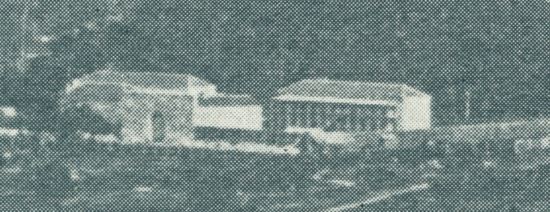
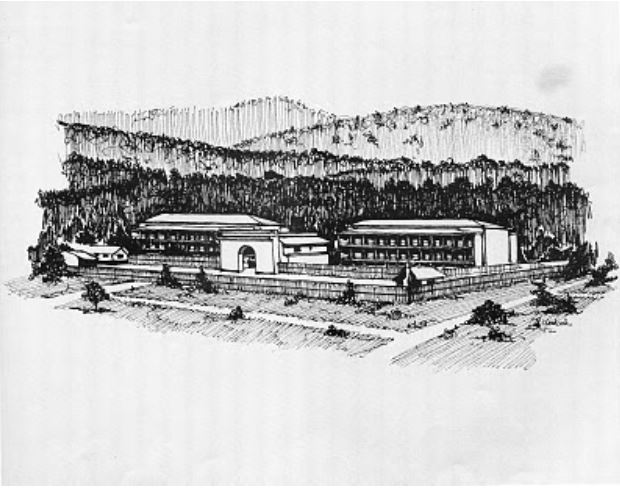
Kipper Billy, oblivious to the possibility of having his conviction overturned, sat in his cell and contemplated escape. On Wednesday, March 5, he was due to be taken out of his cell for an hour’s exercise. He sat on the floor with a blanket covering his legs, to hide the fact that he had worn through a link in his leg irons by scraping them on the stone floor, and told the turnkey he was sick. The turnkey turned his back and Kipper Billy flew past, ran across the yard and began scaling the fence. Billy made it over the first fence, but was felled by a gunshot on the second one. He was dead.
A quick inquest was held, the turnkeys exonerated, and Kipper Billy was interred in an unfenced section of the Paddington Cemetery. But that wasn’t quite the end of that.
One month later, the Courier’s reporter, fresh from watching the pitiful spectacle of a terrified Chinese man named Tommy being physically dragged to the gallows and forced to stand upright to be hanged, saw a happier spectacle in the royal pardon of Bill Horton.
In a few minutes after Billy had been informed of his good fortune, the heavy irons on his legs were stricken off, and as the last rivet fell, the poor fellow heaved a long sigh of relief, showing that, however calm he might appear externally, there were emotions of no ordinary kind going on within. Billy says that he shall stay in Brisbane, and does not seem to approve of the idea of going back to the scene of his capture, and of the crime of which he was wrongfully convicted. Courier (Brisbane, Qld.: 1861 – 1864), Thursday 3 April 1862, page 2
Billy Horton remained at Brisbane, where he had a childhood friend in John Petrie. And that might have been that, had a prominent Brisbane citizen not decided to do something atrocious in the name of science.
On 29 March 1862, two Wardens of St John’s Cathedral made a complaint to the Colonial Secretary of body-snatching, thoughtfully cc’ing the Courier while they did so. They had heard rumours that a prominent person had boasted of having the skull of Kipper Billy. They conducted an investigation and found that Kipper Billy’s grave had been disturbed, and his head removed. They named the prominent citizen as Mr Thomas Syne Warry, a member of Parliament and Justice.
Mr Warry thundered back in the letters pages, accusing the worthy wardens of “mawkish sentimentality” and a “ridiculous exhibition of puerility.” But in the end, the matter was apparently settled by the insertion of a letter in the Advertisement pages:
My Lord Bishop and Gentlemen,
It having been considered that I was very wrong in obtaining the head of “Kipper Billy” for Surgical and Scientific purposes, I beg most respectfully to express my sincere regret.
This apology is tendered with humble cheerfulness, inspired by a conviction that you will consistently follow up the course of Aborigine advocacy, thus auspiciously commenced, by insisting upon similar apologies from those numerous Members of both Houses of our Legislature who are amenable to the charge of having brought many blackfellows into the condition in which “Kipper Billy” was unfortunately found.
I have the honour to be,
My Lord and Gentlemen,
Your most obedient Servant,
T S. WARRY.
To the Right Reverend the Lord Bishop of Brisbane, and Henry Buckley, and Shepherd Smith,
Esquires. Courier (Brisbane, Qld.: 1861 – 1864), Wednesday 16 April 1862, page 3
Every few decades, the terrible tale of the wrongly accused men surfaced, usually to recount Kipper Billy’s end, often getting names and facts wrong.
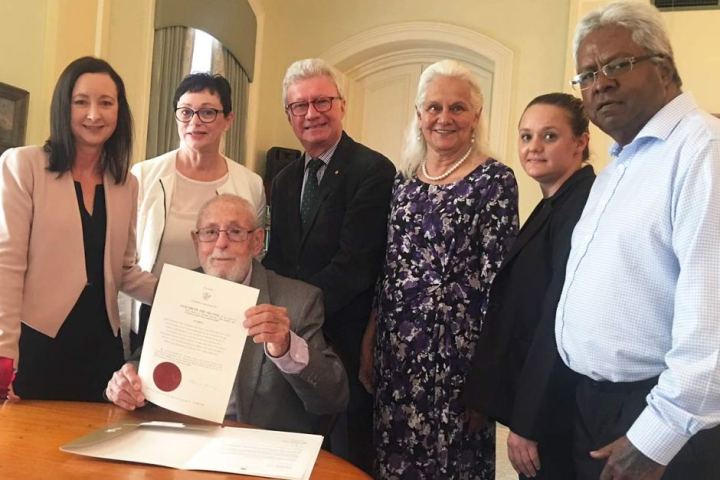
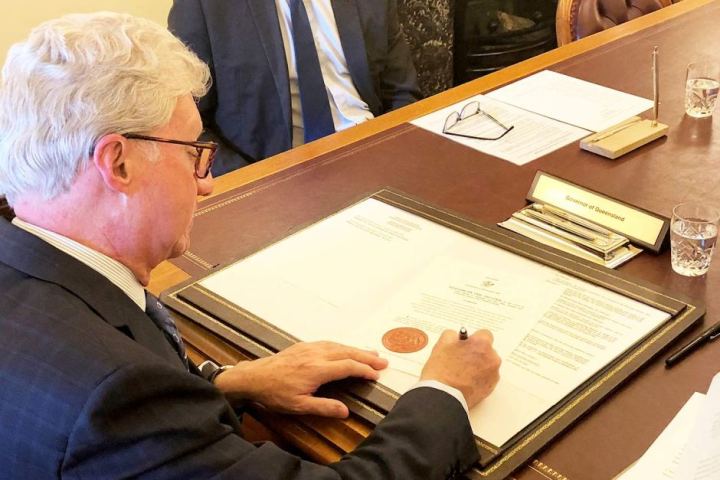
On November 18, 1990 a veteran Brisbane journalist named Ken Blanch wrote a piece on Kipper Billy, and began a campaign for a posthumous pardon. In 2018, the nearly 90 year old writer was successful, and attended a special pardon ceremony. His Excellency the Honourable Paul de Jersey, AC, Governor of Queensland signed the pardon papers in the presence of indigenous elders and the Attorney-General, the Honourable Yvette d’Ath.
Hopefully Kipper Billy’s spirit rests a little easier now. We have no idea of his real name, his appearance or age, just his place in Queensland’s history as a tragically wronged man whose treatment in life and death taught us a great deal about the behaviour of our own ancestors.
Courier (Brisbane, Qld. : 1861 – 1864), Thursday 24 April 1862, page 2
Courier (Brisbane, Qld.: 1861 – 1864), Monday 21 April 1862, page 2
Courier (Brisbane, Qld.: 1861 – 1864), Wednesday 16 April 1862, page 3
Courier (Brisbane, Qld.: 1861 – 1864), Thursday 3 April 1862, page 2
Courier (Brisbane, Qld. : 1861 – 1864), Thursday 6 March 1862, page 2
Courier (Brisbane, Qld. : 1861 – 1864), Friday 28 February 1862, page 2
Queensland Times, Ipswich Herald and General Advertiser (Qld. : 1861 – 1908), Tuesday 25 February 1862, page 3
Courier (Brisbane, Qld. : 1861 – 1864), Thursday 6 February 1862, page 2
North Australian, Ipswich and General Advertiser (Ipswich, Qld. : 1856 – 1862), Tuesday 28 January 1862, page 3
Courier (Brisbane, Qld. : 1861 – 1864), Monday 27 January 1862, page 2
Courier (Brisbane, Qld. : 1861 – 1864), Saturday 25 January 1862, page 2
 Moreton Bay and More