
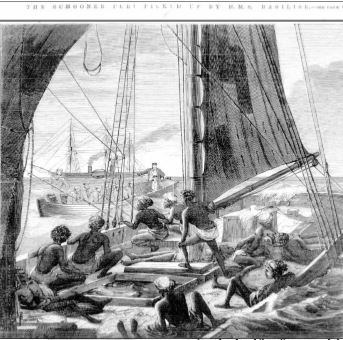
On February 6 1872, a schooner was noticed lying waterlogged off Rockingham Bay near Cardwell in North Queensland. Crew from the H.M.S. Basilisk boarded her and found a terrible scene. Three dead bodies, and fourteen starving Pacific Islanders with no food or fresh water.
The Police Magistrate from Cardwell, alerted to the horror found in his jurisdiction, boarded the schooner with a Polynesian interpreter, but the survivors would only utter the word “Solomon.” They were terrified of all the strangers, and seemed to be in fear for their lives. They were taken to Cardwell for food and medical care.
When the schooner was cleaned off, the words “Peri, Auckland” could be seen. It seemed that the original name-plate had been chiselled out and painted over. There were also bloodstains, indicating what might have happened to the crew.
The H.M.S. Basilisk towed her down the Queensland coast and into Moreton Bay, where a curious vice-regal party sailed out to the Basilisk to find out what the Captain knew of the Peri’s provenance and his plans for the schooner. The Captain assured the Marquis of Normanby (in his capacity as Governor and Vice-Admiral of the colony) that the Peri was to be treated as a prison hulk the property of the Fijian Government, not as salvage for profit.
Having treated His Excellency to a solid assurance, and an agreeable lunch, the Captain of the Basilisk took the Peri out of the bay and to Sydney.
prison hulk or slave ship?
Who were the fourteen starving men, and what led to their ordeal? Were they prisoners who took over their ship, or were they labourers “enticed” to work in foreign lands? Turns out, the Peri, even before embarking on its final voyage, had caused a stir.
It seems that the Peri was considered to be a British vessel in Fijian waters, particularly by Mr March, the British Consul in Fiji. On Wednesday December 2 1871, the British Consul decided to board the Peri in his official British capacity, and was greeted by an insolent party named Gough, who pointed a pistol at him and treated him in a most abusive manner. Addressing a meeting of the British residents in Fiji, the Consul declared that there was no bill of sale for the Peri which would prove it was not British. He added that the British flag had been insulted, and it was up to those at the meeting to decide if they would stand for it. (Cheers.)
It was not just a slightly comical affront to the Consul’s dignity. Mr March was also trying to stop the slave trade in the Islands, and if the Peri was a British ship, he had some jurisdiction. While ownership was still in question, the Peri quietly took on board sixty Solomon Islanders from the slave ship Nukulau, and headed for a plantation in Tavueni.
What happened next was related by a Fijian correspondent in touch with the Auckland Weekly News many months later.
The Solomon Islander “labourers” were treated harshly by the crew, who consisted of white men, Fijians and Rotumans. They were barely fed, and when they asked for some rations, a pot of rice was grudgingly prepared. Before they could eat it, one of the white crew decided it would be funny to throw the rice pot overboard.
The slaves rose up and threw the crew overboard, beating them with oars if they tried to swim back to the schooner. The boat, crewless and with dwindling stores, drifted to Rockingham Bay. By the time the Basilisk found her, all but fourteen slaves had died.
Once the men had recovered their health and strength, thirteen were put on board the Cossack. Eight escaped on a layover in Matuku (possibly unwilling to undertake any more sea voyages with white men), and the remaining five were brought to Sydney to give evidence against the Captain of the Nukulau. Language barriers and the suspicious fate of the crew and fellow passengers of the Peri meant that their evidence was not accepted. They were also repatriated to Fiji. Apparently, the one remaining Solomon Islander remained in north Queensland.
Illustrated Australian News for Home Readers (Melbourne, Vic. : 1867 – 1875) Thursday 29 February 1872 p 53 Article Illustrated
Brisbane Courier (Qld. : 1864 – 1933), Saturday 6 January 1872, page 5
Brisbane Courier (Qld. : 1864 – 1933), Wednesday 24 January 1872, page 4
Queensland Times, Ipswich Herald and General Advertiser (Qld. : 1861 – 1908), Thursday 1 February 1872,
Gympie Times and Mary River Mining Gazette (Qld. : 1868 – 1919), Wednesday 13 March 1872, page 3 (3)
Darling Downs Gazette and General Advertiser (Toowoomba, Qld. : 1858 – 1880), Wednesday 3 April 1872, page 2
Queenslander (Brisbane, Qld. : 1866 – 1939), Saturday 6 April 1872, page 2
Northern Argus (Rockhampton, Qld. : 1865 – 1874), Saturday 22 June 1872, page 3
Queenslander (Brisbane, Qld. : 1866 – 1939), Saturday 14 December 1872, page 7
Toowoomba Chronicle and Queensland Advertiser (Qld. : 1861 – 1875), Saturday 28 December 1872, page 3
 Moreton Bay and More