
How did Courts deal with mental illness in the Moreton Bay era?
Today, expert evidence would be sought prior to a trial as to the fitness of the defendant to stand trial. Psychiatrists and psychologists could be called for the defence at trial. The jury would be asked to decide on the balance of all the expert evidence.
But on February 18, 1867 William (aka John) Perry, had his mental health assessed largely by a jury, or to be exact, three juries. The fields of expertise in mental health had yet to be established, and Perry, who probably was sane, was left to attempt to establish his insanity on his own.
Mr Perry was charged with stealing a watch, pipe and pipe-case valued at £5 from George Cooper, a clerk at Mrs. Mayne the butcher. (Mrs Mayne was the widow of Patrick of “The Mayne Inheritance” infamy and ran the business in the years after her husband’s death.)
Cooper was staying at the Royal Exchange Hotel, and had left his watch, pipe and pipe-case on the dressing table when he went to bed. In the morning, they were gone.
A colleague of Cooper’s, who knew about the theft, was offered a pipe and pipe-case for sale by Perry, bought it and reported it to the Police.
On the day of his trial, Perry was brought into Court ranting and raving, and interrupted the Chief Justice, who promptly empanelled a jury to decide whether Mr Perry was sane. Dr Hugh Bell, who visited the gaol, was called to give his view of the prisoner’s behaviour on remand, and said that Perry was a strong man who ate his food, and appeared to be feigning madness at the gaol.
The jury found Mr Perry sane.
The arraignment was proceeded with, but Mr Perry did not enter a plea and remained stoically silent where shortly before he had been raving.
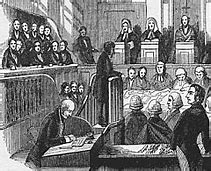
A jury was then sworn to decide if Mr Perry was “mute by malice.” Dr Bell obligingly came back to the stand and reminded the jury that the prisoner had been quite vocal before.
The jury found Mr Perry “mute by malice.”
The Chief Justice then turned to the question of fitness to stand trial. The jury, by now probably longing to get on with things, were sworn to deliberate on whether Mr Perry could, if he wanted to, defend himself. This jury was told to review the evidence of Dr Bell against the demeanour of the defendant.
The jury decided that Perry could defend himself.
The trial proceeded on the evidence above. William Perry declined to say anything when it came time to challenge jurors for his criminal case and appeared to pay no attention when offered the opportunity to cross-examine the Crown witnesses. He offered no defence.
The Chief Justice gave Mr Perry a rather steep three years, after taking evidence (again!) from Dr Bell and Samuel Sneyd, the gaoler at Petrie Terrace, who both felt that Mr Perry was feigning madness.

It appears that Mr Perry was trying it on in Court, offering different symptoms as the day progressed. He had already done a couple of stretches in rural gaols, and understandably didn’t want another sentence, although the Brisbane Gaol housed “lunatics” at that time.
Had the prisoner been genuinely mentally ill, his fate would have been in the hands of one GP, a Prison Governor, and the men who had been summoned for jury duty. The conditions in 19th century asylums were bleak, as were conditions in gaol. It hardly seemed worth the bother of putting on a show.
Brisbane Courier (Qld. : 1864 – 1933), Tuesday 19 February 1867, page 2
 Moreton Bay and More