
Charles Higgins had an eventful life in the Colony of Queensland. He kept pet tigers at Toombul, when it was then in the country. He ran a menagerie of exotic wild animals in George Street in the heart of Brisbane Town, suffered a severe mauling at same, donated iguanas to the Museum, and featured in a number of sensational court cases.
Higgins first came to public notice in the colony in December 1880, when, as a landowner in Toombul, he published a notice in the press of his intention to erect a boundary fence. His own accounts of his early life have him born in Ireland around 1830, and living for some time in California, where he claimed to have kept a grizzly bear, boa constrictors and a “wild man of the woods.” I’m not sure what that is, but Sid James and Tony Hancock had a song about one.
In 1881, he kindly donated “one large iguana” to the Museum, along with an Isaac Nash of Logan, who gave “flying mice,” a Mr Emmet of Doughboy who ponied up an echidna. I wonder if Mr Nash of Logan gave actual flying mice (not mice exactly, and natives of forest regions of central Africa) or sugar glider possums, which might have been more readily available to a resident of Logan.
In 1885, Higgins took advantage of the fact that the owners of the adjoining property at Toombul could not be located and applied to rent the property after paying the back rates. A delighted Divisional Board, seeing the rates debt disappear before its very eyes, was only too pleased to say yes.
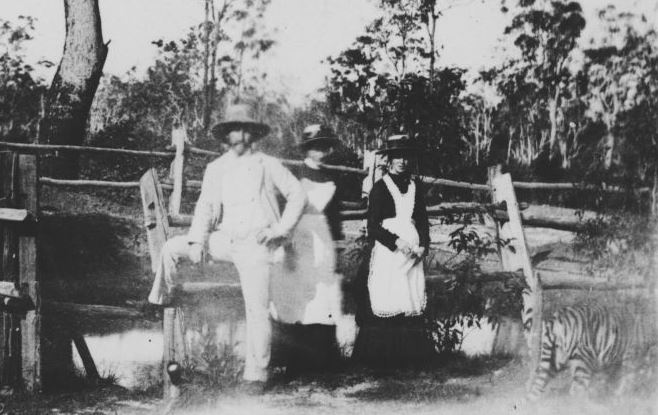
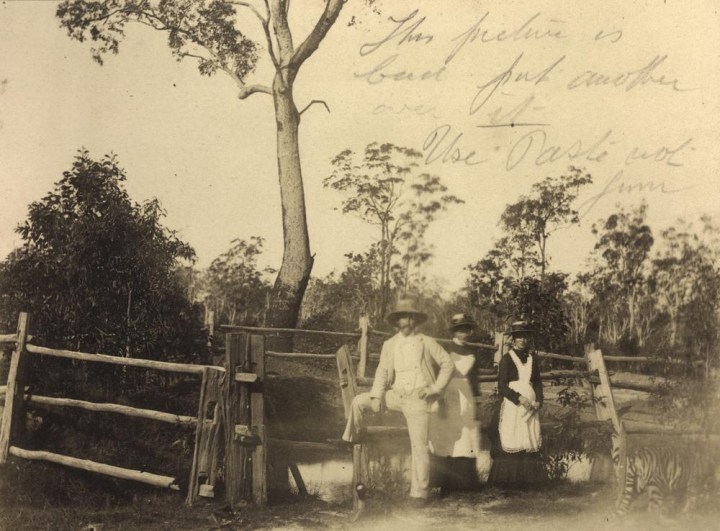
What Mr Higgins did with the land was unusual. Aside from erecting a des res, he kept wild tigers on the property. A photograph taken around 1888 shows Higgins, moustachioed and bearded in a white suit, performing a superb Colonial Lean on a rickety fence. Beside him are two young women who appear to be domestic servants, and who look at best somewhat perturbed by the tiger nearby. Mr Higgins is not looking at them, or for that matter, the tiger. He is gazing at the camera in full White Hunter mode.

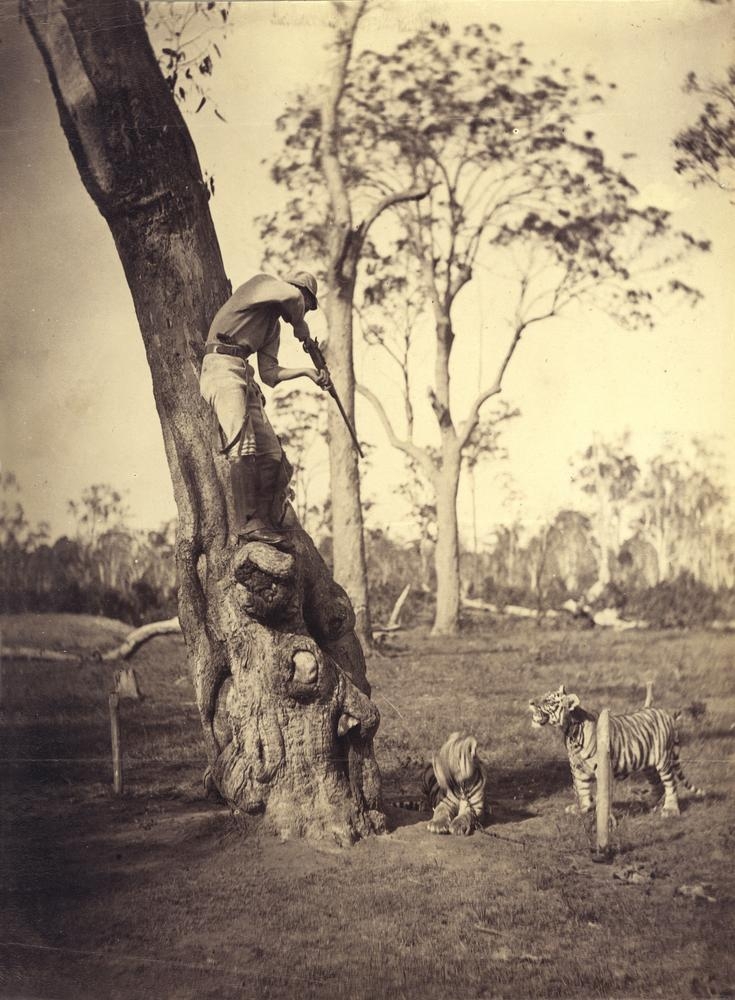
Another photograph of the Toombul menagerie has a young man named James Trackson up a tree and posed as if aiming a gun at two tigers below. Trackson had been a student of electrical science in the UK, before emigrating to Queensland and helping to introduce telephone and electrical services here. He became one of Brisbane’s most prominent citizens and the proud (and much-photographed) owner of the first horseless carriage in the colony. I do hope that the photo is just posed to look like he was aiming at the tigers, and not actually shooting at them – the poor beasts are chained.
Charles Higgins
Oh, wild animals. Well, the first pet of that sort I had was a grizzly bear, when I was a young fellow in California. He was a rough customer, and always in mischief. I afterwards was interested in lions, then with tigers, and followed up my inclination after I came to Australia.
Not content with owning a tiger menagerie at Toombul, in August 1887 Charles Higgins decided to set up a mini-zoo with side-show elements in an allotment on the corner of George and Turbot Streets in Brisbane Town. This establishment featured five tigers, five dingoes, a cheetah, a panther and a leopard and a number of monkeys and snakes. Not to mention a barrel organ, a carnival barker and the occasional visiting brass band.
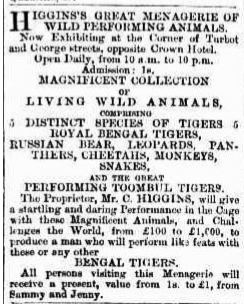
Imagine living and working next to this attraction.
Imagine being downhill and downwind from this attraction. Mr Arthur Jarvis, a venetian blind manufacturer was the unlucky soul who did, and he eventually became so distressed that he took action in the Supreme Court.
Higgins’ staff had a tendency to burn straw and manure directly under Jarvis’ workshop window. Initially, Jarvis was loath to complain, having been reassured that if he did, Higgins would shoot him. Jarvis decided to take up his concerns with an employee, Mr Gain. The burning stopped, but the excrement was then left to lie around, and washed into Jarvis’ premises in the rain. Higgins’ staff also thoughtfully stacked the manure close to Mr Jarvis’ dining room window, until an injunction had them remove it.
At one point, with his entire family laid low from the smell of old bones, Mr Jarvis glanced up from his sick-bed and saw a monkey on the wash-stand. The noise of the barrel-organ and the growling of the tigers when unfed robbed his children of sleep. A dead dingo reposed under their window, but the last straw was the tiger’s escape.

On the morning of 21 November 1888, when Higgins and his employee Peter Bertram were cleaning the cages, a tiger named Jimmy got out of his cage and chased Bertram down Turbot Street, mauling him badly about the head. Higgins’ arm was badly injured when he inserted it between the tiger’s jaws to remove Bertram’s head. Both men spent some time in hospital.
I heard a scream and a roar, and looking round saw Jemmy after the man. The man was pulled down; got up again and managed to reach the middle of the street, and the tiger pulled him down again and opened its mouth to bite. A moment and the poor fellow’s head would have been cracked like a nut, but I jammed my arm between the jaws and shoved the man away with the other. Look at my arm.
Charles Higgins
The Mayor took advantage of Higgins’ hospitalisation to check the conditions at the menagerie and once he had caught his breath, ordered the immediate removal of the old bones. It was thought that Higgins would relocate the animals after the attack. He did not.
In June 1889, Jarvis was granted the injunction and Higgins was ordered to remove the animals. Higgins had been hoping the Government would take over the animals to spare him the trouble and expense of moving them back to Toombul.
To Mr Jarvis’ intense relief, Higgins shut down the menagerie, and his animals found a new home at the Queensport Aquarium. Charles Higgins kept a shop for a time in Queen Street, selling trinkets he used to give away at his shows. In this capacity in 1890, Higgins gave evidence in a case of lead-stealing, having observed a young man carrying some purloined lead to a van via some broken fence palings. The lead came from a nearby roof and was considered a valuable commodity on the black market at the time.
In 1891, Peter Bertram, the employee who had been seriously mauled by one of Higgins’ tigers was involved in the shooting death of a young boy named Willie Gain, son of another of Higgins’ menagerie employees.
Bertram appeared to Court reporters to be intellectually impaired, possibly as a result of the severe head wounds he received in the George Street mauling. A lot of harrowing evidence was heard in the trial, but in the end, the jury could not agree to convict Bertram of murder or manslaughter, and he was released.
Charles Higgins, after so many years of adventure and controversy, retired to live at Brown’s Plains. He was killed when his horse-drawn cart overturned on Ipswich Road outside Chardon’s Hotel in July 1894.
Brisbane Courier (Qld. : 1864 – 1933), Friday 9 April 1886, page 5
Brisbane Courier (Qld: 1864 – 1933), Saturday 24 November 1888, page 9
Telegraph (Brisbane, Qld: 1872 – 1947), Wednesday 5 June 1889, page 4
Telegraph (Brisbane, Qld: 1872 – 1947), Thursday 6 June 1889, page 2
Telegraph (Brisbane, Qld. : 1872 – 1947), Friday 7 June 1889, page 2
Brisbane Courier (Qld. : 1864 – 1933), Monday 29 July 1889, page 7
Moreton Mail (Qld. : 1886 – 1899, 1930 – 1935), Friday 27 December 1889, page 4
 Moreton Bay and More