
On board the Proserpine, hardened juvenile offenders mixed with small children with desperately unhappy backgrounds. Life was exceptionally harsh in the 19th century for children from impoverished families, and with no social security, crime was an option.
The main difference between today’s tales of horror and the Victorian stories is that today there are Federal and State bodies, albeit horribly under-resourced and staffed, who are meant to help prevent modern children becoming criminals or victims of neglect.
Neglected Children
Charles Henry Dennison
Charles Henry Dennison was just nine years old in 1872, all of and 3 foot 6 and 36 pounds, with blue eyes and blonde hair when he arrived at the Proserpine, sentenced to three years for being a neglected child. His sentence was “to the Industrial School” rather than the Reformatory, because the crimes were not his own, but those of the people supposed to be caring for him.
A boy named Charles Henry Dennison, 9 years of age, was ordered to be sent to the Reformatory School on board the hulk Proserpine. He was brought up under the Industrial and Reformatory Schools Act, which provides that a “neglected child” shall mean, among others, “Any child who shall reside in any brothel or associate or well with any person known or reputed to be a thief, prostitute or drunkard.” It appeared that the little fellow, although well-tended had been living in a house of ill-fame, hence the order which transfers him to a purer moral atmosphere.
Charles Henry Dennison went on to live a long and productive life after his release on 6 March 1875. Perhaps his age meant that the custodians of the Proserpine took a little more care of him than some of the older, more streetwise boys.
“Officers of the Force, more especially those in large towns, are hereby informed that the hulk Proserpine, having been proclaimed a reformatory is now ready to receive boys of the criminal class.”
General Order No. 526 (Gazette 7 February 1872)
Francis Dunlop
Francis Dunlop was fourteen when he arrived a year later. He had been living with his mother and sister in Frog’s Hollow when a tragedy occurred that put his situation into the spotlight.
Jane Dunlop had been an ordinary married woman, but when her husband Francis died in 1865, she found herself unprovided for and with a young family to feed. At the time, a widow had few options. She could try to work, which meant leaving her younger children in the care of the older ones. She could seek some assistance from the Parish, the only vague form of social security at hand. She could hope to remarry, but not too soon. Or she could gradually slide into prostitution and alcoholism. It wasn’t a choice so much as a slow breaking down of resistance in the face of hunger and sorrow.
By 1873, the Dunlop residence in Mary Street was a brothel, notorious even in that neighbourhood. A concerned resident, Mr Brookes, had been watching the disorderly house and trying to gather evidence to stir the Police into action against it. He had a petition of over 70 signatures in hand, and was about to present it to the bench of Magistrates, when a horrible tragedy made it unnecessary.
Nineteen year old Jessie Dunlop was found dead in her bed by a sailor of her acquaintance on Sunday morning, 10 August 1873. When the doctor was summoned, he looked at state of the place and immediately sent for the Police, and another doctor to assist him. The teenager had been dead for some hours, and what with sailors coming and going on Sunday morning, it was clear that something rum was up.
Jessie had complained of a pain in her side the night before, but had seemed “her usual self” when she went to bed. Her post-mortem examination by Dr Cannan revealed no external marks on her body, but her liver showed signs of chronic alcoholism, and her lungs, brain and kidneys were congested. The smell of spirits pervaded the doctor’s surgery when he examined her organs.
The Police and the second doctor dealt with the other residents of the house. One was Mrs Jane Dunlop, and the other was a fourteen year old boy named Francis, after his father. The Police charged Jane Dunlop with keeping a disorderly house, and charged Francis with being a neglected child.
On Jane Dunlop’s first appearance at the Magistrates Court, with her daughter lying dead and her son in custody, Mr Brookes hurried into the Court with his petition, and said that he had long endeavoured to break up the establishment “and he hoped that the happy climax had arrived.” Inspector Lewis, for the prosecution, added that he had deployed officers for three months for the purpose of warning men off the house. Magistrate Rawlins opined, “This may be the beginning of the end, let us hope so.”
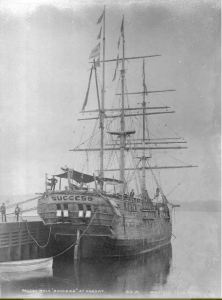
This is what the Proserpine
may have looked like.
Francis was sent to the Proserpine for three years. His mother was tried and convicted of keeping a disorderly house and received a year in gaol with hard labour. There being no-one left in the Mary Street house, the key was handed over to a custodian with a view to selling the furniture.
Jane Dunlop served her term, and lived until 1886. Her neglected son Francis kept his nose clean after the tragedy that led to life on the Proserpine and the end of his family. He lived to 76 years of age, passing away in the country, far from Frog’s Hollow.
SOURCES:
- Brisbane Courier (Qld.: 1864-1933), Friday 8 March, 1872, page 2
- Telegraph (Brisbane, Qld.: 1872-1947), Monday 11 August 1873, page 2
- Brisbane Courier (Qld.: 1864-1933), Tuesday 12 August 1873 page 2
- Brisbane Courier (Qld.: 1864-1933), Thursday 14 August 1873, page 2
- Brisbane Courier (Qld.: 1864-1933), Saturday 1 August 1873, page 5
- Telegraph (Brisbane, Qld.: 1872-1947), Monday 1 September 1873, page 3.
 Moreton Bay and More