

1848 was a year of unrest and revolution in Europe. The world seemed to be in uproar. And uproar would find its way to Brisbane Town that year, not in the form of an uprising, but in the form of the Queen of the Artemisia.
Before Dr Lang rounded up industrious protestants to populate “Cooksland,” as he called the northern Australia, the first immigrant ship sent to Moreton Bay was the Artemisia, which departed Plymouth in August 1848.
The Artemisia
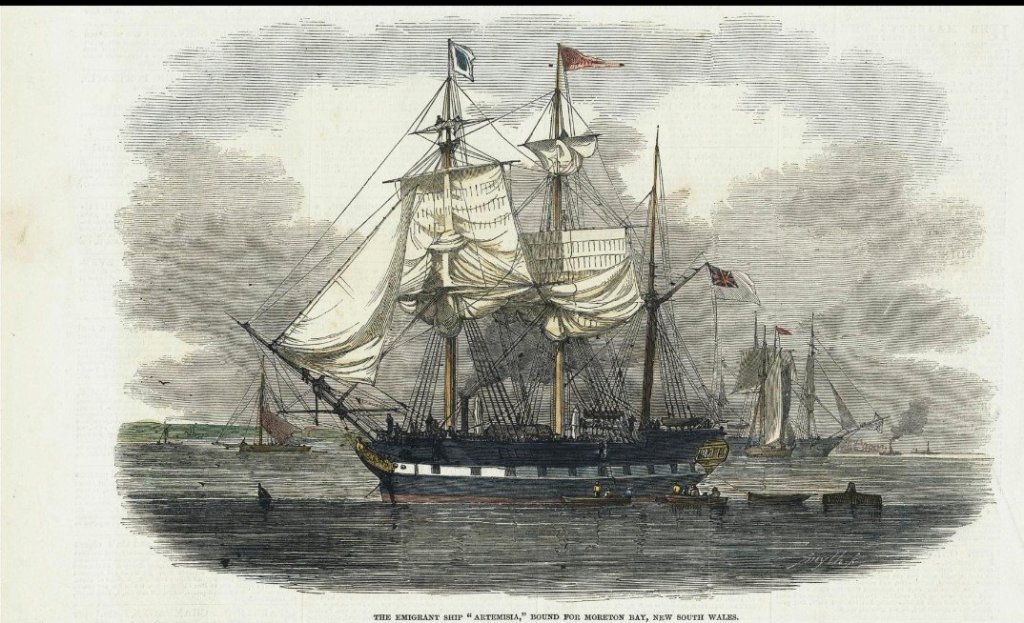
ARTEMISIA, barque, 558 tons, J.P. Ridley, commander, from Plymouth August 15, with 140 male and female immigrants under the superintendence of Dr. George K. Barton. (State Library of Queensland.)
One of the 20 single females on board the Artemisia was Anne M Kelly, who gave her native place as London and profession as cook. At 28, she was the second oldest single woman on board – a bit on the spinsterish side in an era when girls were expected to marry in their late teens. Still, she was in good health and spirits, and had nothing to lose. No family out here, and both her parents had passed away. Time for a new start.
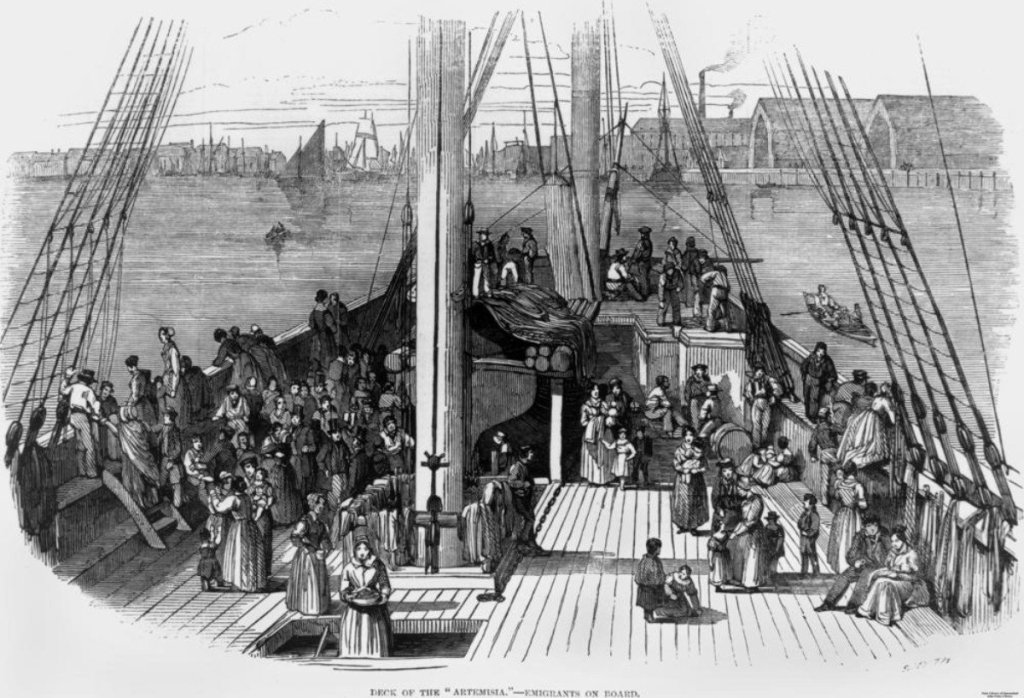
“Certain peculiarities of manner” earned Miss Kelly the nickname of Queen of the Artemisia on her voyage to the New World. In later life, she was given to displays of theatrical gentility in unlikely surroundings, so I imagine that the peculiarities of manner came from vigorously aping her betters, as the saying went at the time. Whether it was a left-handed compliment or not, Anne took it and ran with it.
The Queen landed at Brisbane Town on December 16 1848, and was quickly picked up for employment. Six months later, she married David Powell, a Welshman 17 years her senior, who worked about the town as a mason and builder. Anne Maria Powell, as she now styled herself, gave up work and settled down to a life as the lady of the house. Emphasis on the lady, thank you very much.
Early Married Life.
If only she hadn’t been so fond of the demon drink. Her married life was turbulent, marked by rows, separations, reconciliations and a lot of alcohol. Drink had a tendency to disinhibit the Queen, to put it mildly.
In 1850 the new wife made a spectacle of herself by becoming intoxicated and throwing herself in the Brisbane River. She was fished out by a passing Constable, and conveyed to the Police Office, dripping wet and thoroughly indignant, to spend 24 hours in the cells drying out and drying off.
By 1852, she had parted ways with David, and went to the Magistrates for an order of maintenance. Mr Powell was earning £40 a year, plus rations, and had left his wife with no means of support. The Bench decided that he should pay 7 shillings per week into the Court. The couple managed however to reconcile for another couple of years, until August 1855, when David left again and Anne took him back to Court. The maintenance was raised to 15 shillings per week, despite David grumbling that he paid “sundry little bills” for her.
Of course, they reconciled shortly afterwards.
Ipswich.
Anne and her consort made a fresh start in Ipswich, for David’s new job. Unfortunately, their marriage was by then at the armed truce stage, and there was just as much alcohol about as there had been in Brisbane.
On 12 November 1856, a disgruntled Anne made her debut in front of the Ipswich Magistrates, charged with using obscene language whilst drunk in Brisbane street the night before. She hotly denied using such language, and indeed, on the “honour of a lady,” had never made use of such language. A Constable and two neighbours gave evidence to the contrary. The reporter in Court for the occasion reminded his readers that this was the woman who went by the soubriquet “Queen of the Artemisia,” and unkindly pointed out that she had apparently seen better days (she was 36 at the time, but evidently the drink was taking its toll on her looks). The Queen told the Bench that the charges were cooked up by her husband and he neighbours to get rid of her.
Shortly afterwards, David was charged with stealing a cheque and notes from a shepherd, and committed for trial. Fortunately for him, the Attorney-General offered no evidence at the trial, and he was free to continue trying to support and/or avoid the Queen of the Artemisia. Sensibly, the couple left for Brisbane.
Anne Maria celebrated her return to Brisbane by getting drunk and using indecent language in the streets in April 1857. The fine and costs were paid, and this time she did not choose to make a spectacle of herself in the Courtroom.
A repeat performance that November, followed by a drunken fall in the street (“It was a lightness in the head,” she insisted to the Magistrates) saw David leave her again, and again, she summoned him for maintenance.
Ann Maria Powell, who is well known at the Police Court, summoned her husband, David Powell, for refusing to maintain her. She deposed that she was married to the defendant at Brisbane. He left her about a month ago and refused to maintain her. The defendant’s excuse was that Mrs Powell was a drunkard, and annoyed him day and night. The Police Magistrate reminded him that he took her for “better or worse” but he had perhaps found her worse than he took her to be. A scene of recrimination followed between Mr. and Mrs. Powell from which it appeared that neither “dear” was better than “it” should be. The Bench awarded a weekly maintenance of twenty shillings for the next twelve months to support the state of Mrs. Powell, who is known as the “Queen of Artemisia,” and who exhibited the gracefulness of her drawing room deportment in an amazing number of “bows and scrapes” and a profusion of “thank your worships.”
The Demon Drink.
By 1858, Anne’s drinking had reached decidedly unladylike levels. She managed to be arrested at least once for ten of the twelve months. She was back with David in March, when she sought refuge in his arms from a beastly constable intent on charging her with drunkenness and foul language.
Anna Maria Powell, better known as the Queen of Artemisia, was brought up for drunkenness and using profane language in the Valley on Sunday. P.C. Watts, who proved the case, was cross-examined by the prisoner, who tried hard to prove that she had been inhumanly dragged out of her house by the constable. It appeared, however, that she fled into her domicile on the approach of the policeman, who was unable to get her away from her husband, who “protected” her from arrest. She afterwards disappeared through the back door, but was finally “trapped.” She denied the accusation, and assured his worship Mr. Brown, “that the policeman rushed in unbidden and unwelcome, and seized her, when she was rescued by “Davie” (her husband), that she was in deshabille when this occurred, and that “her house was in the most respectable street in the Valley, and that was the reason why she lived in it.” In the absence of better testimony to the propriety of her conduct, his worship Mr. Brown sent the Queen to Brisbane gaol for 14 days.
The Courier decided to make an example of her:
QUEEN OF ARTEMISIA. -This woman who is grey-headed, and advanced in years, has been many times before our Police Court, and is one of those miserable beings in whom the vice of intemperance has poisoned the very springs of life. We commend the severity of the Police Magistrate in giving her 14 days imprisonment, and we trust he will redouble it if the prisoner should come before him again, until she shall find a permanent abode in prison or retrace her steps. It really presents a question worthy of the consideration of our legislators whether confirmed public shameless drunkenness should not be treated as insanity, and the evil example removed from our streets into safer custody, and a course of correctional treatment. This would tend greatly to inspire a wholesome dread of this abominable vice.
To be described thus at the age of 38 would surely give anyone pause. Not, apparently, the Queen. The editorial did seem, in its harsh 19th century way, to show that contemporary thinking was tending towards seeing the vice of drunkenness as a form of illness to be treated.
In May, the Bench saw fit to give her 24 hours solitary confinement. And of course, she parted ways with David and sought maintenance. This time, David was imprisoned until he could pay (fortunately, his employer advanced some wages, and he was soon free again).
Anne spent much of July 1858 trying to get her husband to pay for her upkeep. David had been ill and unable to work. The Bench, unwilling to send a sick man to gaol, begged the parties to find a compromise, but none could be found. David went to gaol, and Anne got roaring drunk.
In November 1858, Brisbane’s most famous warring couple were back in the Courts. Powell said that he couldn’t afford the sum ordered because “that wretch won’t let me go anywhere to look for work.” Anne, in full dignity, replied that she was “no wretch, but a lady.” The Bench adjourned the matter to allow David to organise his finances, but when the case was called back, the couple did not attend. They had, in the words of the officer of the court, “made their quarrel right, and began once more to enjoy the delights of each other’s society.” Hell, it was probably cheaper.
The Queen is Captured.
Anne marked her return to marital bliss exuberantly, and barely three days after the touching reconciliation, was sentenced to three months’ hard labour in prison for using profane and obscene language in the public street.
1859, the year of the separation into a colony that would be named Queensland, began quietly. Anne was still in gaol. On release, she slowed down a little until July, when she was convicted once again of profane language. She was fined £5, with the alternative of three months in prison. She chose the latter, and was released in October.
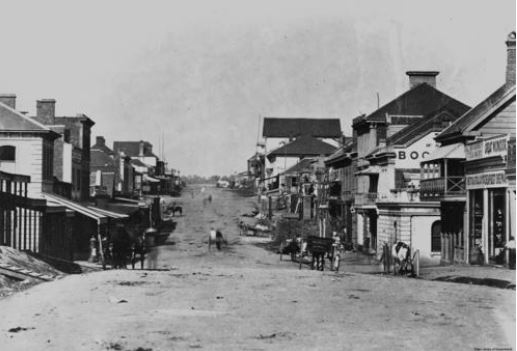
In January 1860, Anne gave her finest performance in the Police Court. Perhaps she was mentally ill as well as an alcoholic, because she gave the impression of living in a slightly altered universe. I can only quote it in full:
Mrs. Maria Powell, alias Queen of the Artemisia, was charged with drunkenness. A very lady like curtsey when she entered the box was the prelude to a scene which baffles description. Mrs. Powell declared that she was an ill-used woman, and also that she was too much of a lady to commit herself in the manner indicated. When P.C. Currie was about taking the oath, Mrs. Powell acquainted him that he was about to swear falsely, called upon Jackson Currie to consider what he was going to do, and finding that her appeals had no effect upon him she resigned herself placidly to her fate, exclaiming that she was too well known by those who presided at that court for the evidence of a policeman to injure her. P.C. Cross corroborated the statement of the former witness as to the state of the defendant, whereupon Mrs. Powell remarked to the Bench how a fiddle had been played while she was in the lock-up, and expressions used which testified rejoicing at the capture of the Queen. Mrs. Powell repeatedly extolled her husband to the Bench, saying that he was the best builder in Brisbane, and her care for him was so great that she had left her home to go over to where he was working to cook for him, and the policemen, owing her a spite, had arrested her illegally. All the eloquence of the lady failed to make an impression on the magistrates. They adjudged her to pay a fine of £2, and she left the court in custody of the police, as she had a month’s imprisonment to undergo if she did not pay, exclaiming, “Gentlemen, I think you have done wrong; when my husband hears of this he will be very sorry. What will he do if he has no one to look after him?”
When her husband heard of it, one suspects, he experienced mingled relief and embarrassment, rather than sorrow.
Anne Maria Powell was now 40 years old. She was spending more and more time in gaol – hardly the life of a woman who thought she was a queen. She had the misfortune to live in a time when there was no form of treatment for problem drinking, beyond hospital or gaol. Both institutions sobered you up, gave you a lecture, and sent you home.
The Queen would continue drinking, swearing and being penalised until 1868, when she suffered a gastric illness and lingered and finally died at home. She was 48 years old.
YESTERDAY magisterial inquiry was held respecting the death of a woman named Ann Maria Powell, well known to the inhabitants of Fortitude Valley as the ” Queen of the Artemisia.” The poor creature was taken ill about six weeks ago, and was sent to the hospital. There she remained for a week, after which she went back to her home, where she was visited by the Sisters of Mercy. For the last few days, she was speechless, and on Thursday night died. The medical evidence showed that she had died of exhaustion succeeding diarrhoea. The deceased was a very old resident in Brisbane, having come out in the Government immigrant ship Artemisia in 1848. She acquired her singular soubriquet on the passage out, on account of some peculiarities of manner. She was of intemperate habit, and was generally reported to be a little “cranky.”
David Powell outlived his colourful wife, passing away at Dunwich Benevolent Asylum, a convalescent home, on April 7, 1882.
The Moreton Bay Courier:
Saturday 16 December 1848
Saturday 21 September 1850
Saturday 22 May 1852
Saturday 04 August 1855
Saturday 02 May 1857
Saturday 23 May 1857
Saturday 14 November 1857
Saturday 28 November 1857
Saturday 19 December 1857
Wednesday 10 February 1858
Wednesday 31 March 1858
Saturday 08 May 1858
Saturday 22 May 1858
Wednesday 14 July 1858
Saturday 17 July 1858
Saturday 24 July 1858
Saturday 31 July 1858
Wednesday 04 August 1858
Wednesday 25 August 1858
Wednesday 27 October 1858
Wednesday 03 November 1858
Sunday 07 November 1858
Saturday 09 July 1859
Tuesday 31 January 1860
Saturday 10 March 1860
Saturday 23 June 1860
Monday 06 October 1862
Saturday 28 January 1865
Tuesday 30 January 1866
Wednesday 04 July 1866
Friday 02 November 1866
Saturday 20 April 1867
Saturday 09 May 1868
North Australian, Ipswich and General Advertiser:
Tuesday 18 November 1856
Tuesday 06 January 1857
NSW, Australia, Police said Gazettes, 1854-1930: 1859. Prisoners discharged from Her Majesty’s Gaol at Brisbane, during the week ending 16 October1859: Anna Maria Powell.
NSW, Australia Assisted Immigration Passenger Lists: 1848, Artemisia.
Queensland Register of Births, Deaths and Marriages: 1854/BMA/75: Date of Marriage 11.06.1849.
 Moreton Bay and More
1 Comment