
How did we entertain ourselves in those first days of free settlement? In the rough and ready early years, sawyers, blacksmiths and stockmen from out of town congregated in places with names like the Sawyer’s Arms and the Bush Commercial Inn. Apart from hard-working men getting really quite drunk together, organized public entertainments took a while to come to Moreton Bay.
Whilst no doubt the likes of Captain Wickham, Dr Ballow and the higher echelons of the 99th Regiment conducted dinner parties and ‘at homes,’ there were no theatres, music halls or dances to enliven the town.
Racing became the first public entertainment, and the brand-new local paper reported approvingly on the conduct of those assembled.
“THE Annual Meeting of the Moreton Bay Racing Club took place at the Racecourse, New Farm, on Tuesday and two following days in the past week. The attendance on the course was not only numerous but boasting more than an average of respectability.”
MR CROFT’S SPECTACULAR
Brisbane’s first real theatrical presentation occurred in 1847. It sounded suspiciously like a circus:
MR. CROFT will commence with Acrobatic Feats, will throw a Somerset through a Fire Balloon, 12 feet high; throw several Lion Leaps over chairs, tables, &c, &c.; DANCE A HORNPIPE ON HIS HEAD ON A CANDLESTICK!! and, to conclude the evening’s amusements, Mr. C. will walk up a Perpendicular Ladder, 10 feet high, and place himself in an Horizontal Position on his Head, when all at once the Ladder falls into a complete Cataract, leaving the Performer on his Head on One Pole SURROUNDED BY FIREWORKS!!! (Advertisement)
Yikes.

The Courier, frankly, did not approve of the shenanigans presented to the delicate sensibilities of a small town largely composed of ticket of leave men, soldiers, hut-dwelling new settlers and a few Government officials.
“We looked in vain, however, for the “deeds of daring,” so modestly announced by Mr. Croft; the most daring deed of the evening was the introduction of an obscene song, an outrage without precedent in our experience of public amusements. That the song was encored by a part of the audience could be no excuse for the insult offered to the rest; nor could any circumstance justify the unsolicited repetition of the indecency at a later period of the evening. That Mr Croft selected this song to grace the first appearance of his wife, may perhaps demonstrate his own notions of propriety, but he will find it dangerous to measure public opinion by such a standard. We would advise him not to suffer such gross impropriety in future… A number of the aborigines were admitted into the arena and stared in stupid amazement at the proceedings.”
Given the description of the evening’s festivities, I suspect that the aborigines were wondering what the hell kind of people were now inhabiting their country.
Croft and his troupe went elsewhere, the Courier’s strictures on vulgarity probably not ringing in their ears, but it would be years before another theatrical entertainment would be attempted in Brisbane.
PEDESTRIANSIM
That pervasive 19th century habit – pedestrianism – had a surge in popularity, as a chap named William Harrington blew into town in 1847 and challenged James (Duramboi) Davis to a race. Just below the advertisement for the foot race, was another by Harrington, offering to geld horses “after the English method.” Clearly a man of many talents.

Mr Harrington won easily, and got all carried away, challenging people left and right to foot races. After a few meets, the locals closed ranks, perhaps tired of being relieved of their hard-earned by this blow-in, and Mr Harrington’s next advertisement offered a race against “a stranger at present unknown.” Somebody, anybody? No? Mr Harrington, and his talents, left town. The local athletes, punters and, no doubt, horses must have been relieved.
The departure of Harrington did not mean that the taste for foot-racing abated. Enter, the Flying Pieman, who thoughtfully brought the latest newspapers to Ipswich while he was at it.
“After arriving here, instead of resting as ordinary mortals would do, he kept travelling round our little town at the rate of knots, carrying with him a tray full of “kisses,” which he readily disposed of, and at six p.m. again took his departure for Brisbane, so as to arrive there in time for supper, a distance which, at a moderate calculation, could not have been less than seventy miles in sixteen hours, but this he designated a mere stroll.”
In December 1848, the public love of vigorous outdoor recreation, coupled with liquid refreshments had grown to the point where Boxing Day festivities were advertised thus:
BOXING DAY!
TO THE MERRY BOYS OF BRISBANE.
SPORTS FOR THE MILLION.
ALL you laughter-loving folks of Brisbane come over to that far off, out-of-the-way place, Kangaroo Point, on Boxing Day, and make your miserable lives happy enjoying the following good Old English Sports: –
Climbing the Greasy Pole.
Jumping in Sacks.
Driving the Wheelbarrow.
Brisbane’s first real theatrical presentation occurred in 1847. It sounded suspiciously like a circus:
Hunting the Pig with the Greasy Tail.
Foot Racing, &c, &c, &c.
N.B.- Refreshments free to all comers, according to the established usage of Old England will be provided at the Commercial Inn, Kangaroo Point.
GOD SAVE THE QUEEN!

I like to imagine the indigenous people, at that time still very much in residence at Kangaroo Point, silently watching this as a further demonstration of the inherent insanity of white people.
RACE DAYS.
Race Days became very popular in Brisbane and on the Darling Downs.
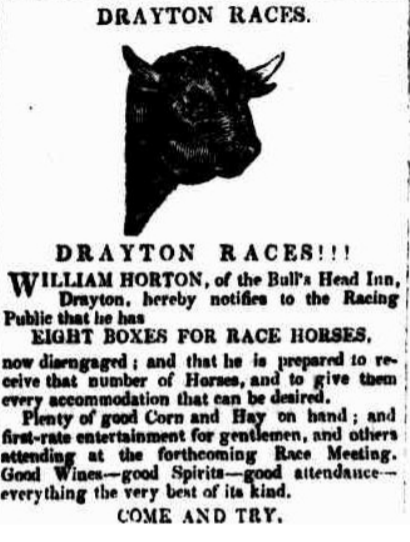
There were some very particular rules for participants, though.
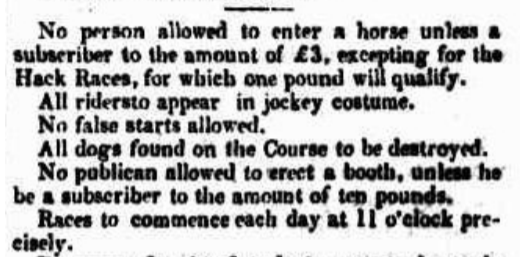
The poor innocent dogs of Drayton. I hope they stayed away.
In Brisbane, it was a truth universally acknowledged that Downs horses would always beat their city fellows, and the Courier waxed perhaps a little too lyrical at the prospects for Brisbane’s own Race Day and Dinner:
“Those who have held back this year, for the purpose of satisfying themselves first as to “what Mrs. Grundy would say,” will not withhold their countenance on the next meeting. There must not be any ill will for past weaknesses exhibited by those persons. Everything must have a beginning, and the Globe Theatre was exceedingly unfashionable at one time, although graced with the presence of Shakespeare, Ben Jonson, and Richard Burbage.”
Yes, the Globe, Shakespeare, Jonson and the Brisbane Race meeting. I can see it.
The 1850s
The new decade brought a gradual increase in population, but most of the entertainment in Moreton Bay took place at chucking-out time in the pubs, and the press reports of exasperated Magistrates dealing with the aftermath.

Culture arrived in the person of Miss Flora Harris, who gave a series of recitals in Brisbane in late 1854. Miss Harris did not perform The Classics, but instead trilled out “By Sad Sea Waves.” and “I Should Like to Marry.” Also on the bill was Mr K Hancock, who delighted Brisbane with “The White Squall,” and “Hurrah for the Red and the Blue.”
Miss Harris and company made their way to Ipswich, where a delighted audience and a surprisingly rigorous review from the Ipswich correspondent of the Courier awaited them.
“I am not aware that these singers would gain anything by my passing encomiums upon their performance. It is perhaps sufficient to say, that their audience was by no means an uncritical one, and the satisfaction given was complete. Miss Harris’s voice should scarcely be called a soprano.”
Ouch.
The next theatrical presentation was The National Circus and Hippodrome in January 1856, which by the sound of their advertising featured equestrian feats and tricks, and eschewed the vulgar ditties that marked Mr Croft’s presentation a decade earlier.
That year, the Courier declared itself in favour of a proper theatre being established in Moreton Bay, as long as it was proper:
“Believing that the stage, under proper management, may conduce to the national amusement of a people, without moral injury, we are pleased to observe this effort to establish the nucleus of a permanent theatre, and trust that it will meet with all due encouragement.“
No sooner had the Courier given its blessing to the idea of a theatre in town, than an intrepid man named Mr M D Finucane sought to build a theatre to be known as “Shakespeare’s Hall”, but was disappointed. Nevertheless he staged varieties at various temporary spaces, and expanded into Ipswich.
Finucane offered a program consisting of a Drama or Tragedy, followed by dancing, followed by a farce and “dissolving views”, which appears to be painted or photographic material projected for the audience, accompanied by suitable music.
Finucane had successes in Moreton Bay, but not enough to finance and build his theatre. As he faded from view, Brisbane and Ipswich found themselves besieged by theatrical Wizards.
WIZARDS, GOBLINS AND PROFESSORS.
The first Wizard to invade the tropical north was The Wizard (or Professor) Jacobs, who announced himself thus:
“Wizard of Wizards, Ventriloquist, Professor of Experimental Scientific, and Mechanical Philosophy, Great Modern Magician and Improvisator.
“The extraordinary and astounding Wonders he has to introduce are beyond description — no conception can be formed of his peculiar POWERS.
“Those who have seen this GREAT AMBIDEXTROUS PRESTIDIGITATOR can alone judge of the amusement he affords. To those who have that pleasure to come, it may be justly observed, ‘You will not look upon his like again.’
“The most scrupulous may venture upon visiting the WIZARD’S ENTERTAINMENT without the slightest fear of their good taste being offended, it being invariably his object to afford Instruction as well as amusement.
“The Entertainment will be enlivened by the comic drolleries of Mr. Goblin Sprightly, whose inimitable mirth-creating powers are irresistible.”
Wizard Jacobs simply loved to advertise. Prior to his arrival in Sydney in 1855, advertisements in all of the newspapers proclaimed “Wizard Jacobs is coming,” for what seemed like months. It became a running joke in the Sydney press, who thought they detected a whiff of snake oil. After all, Lola Montez had been running amuck throughout the Colony and its southern neighbour for months.
The Wizard’s arrival in Moreton Bay was heralded in a series of florid classifieds, all stressing the limited nature of his run. Engagements in Sydney and London (via India) awaited. Come and see the Temple of Enchantment while you could! And Goblin Sprightly! (I can only assume that the Goblin Sprightly was a little person, skilled at comedy and song.)
The Wizard did not disappoint critics or audiences. Houses were packed, and reviews were glowing because Wizard Jacobs, for all of his florid hoopla, was a quite learned man who believed in education with a bit of show biz. This underlying serious purpose was attested to by the Secretary of the School of Arts at Brisbane in a letter to the Courier, when Jacobs was accused of being a ‘harlequin’ by a God-fearing citizen.
Those pressing engagements in Sydney (not to mention London via India) that had meant a limited season, became less pressing as the receipts rolled in.
Jacobs and Sprightly eventually boarded a steamer for Sydney, only to be replaced, in Ipswich at least, by the Wizard Anderson.
“The wizard Anderson has commenced his performances here, and the Theatre Royal is crowded every night. Our population here seems to be rather of the play-going sort, for any novelty fills the Theatre Royal, and it will hold 3000 people easily.” sniffed the Darling Downs Gazette of the Wizardly run in Ipswich.
At least Ipswich had a theatre. Brisbane had the School of Arts, and some semi-outdoor spots for theatre, as poor old Finucane never did get to build his “Shakespeare’s Hall.”
1858’s final Wizard – Hall – billed himself as the Wizard of the South and toured Toowoomba and the Darling Downs. Given the “attractions” he had on his bill, I think Mr Hall was representing himself as the Wizard of the American South, rather than one from Sydney or Melbourne. There might have been some “natural magic” put on, but it came with a side helping of overt racism.
“SAN FRANCISCO MINSTRELS will sing some NEW SONGS and recite the Sayings and Doings at Public Festivities and Scenes of Plantation Life. To conclude, each Evening, with the CELEBRATED RATTLESNAKE JIG! By Yankee Smith.”
Enough said. Neither Hall nor Anderson could compete with Wizard Jacobs in the public’s affection.
Enthusiastic amateurs
One group who tried to compete with the touring sideshows was The Ipswich Amateur Dramatic Society, who, in late 1858 decided to use that big, empty theatre for some improving drama.
Their first program included “The Painter of Ghent” for serious drama and “A Fearful Tragedy in the Seven Dials,” which was apparently a farce, despite it’s gloomy-sounding title. “It is to be hoped that this praiseworthy attempt to provide recreation and amusement will be attended with success and ultimately lead to the diffusion of a taste for the works of our best dramatists,” said the Ipswich paper, wistfully.
The troupe followed up with some crowd-pleasing comic drama and another farce, which, were reviewed thus. “The style of these is much better adapted to the company and the taste of the audience than those selected for representation on the former nights.” The damage was done though by the earlier serious works – the public started to stay away in droves.
More to the Ipswich press and public’s taste was the December 1858 Grand Concert by “Madame Haimberger (late Kramer) and Mademoiselle Kramer, The celebrated Alpine and Tyrolese Minstrels, and Mr. Julius Haimberger”.
Art was satisfied by the Haimberger/Kramers, who performed folk songs and standards beautifully, and the desire for a rollicking good time was satisfied by the Tyrolese Minstrels, who appeared in National Costume. A Brisbane season was vaguely promised. Presumably if they could get to the School of Arts, and avoid having to perform in the backyard of someone’s pub.
Finally, in 1859, as Separation from New South Wales loomed, an act appeared in Ipswich and Brisbane that seemed to suit everybody.
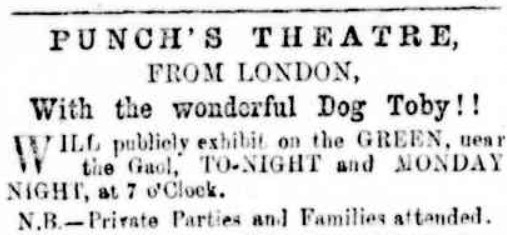
Punch and Co were able to perform in a theatre in Ipswich, but if the residents of Brisbane were leery of spending an autumn evening sitting on damp grass next to a House of Correction, there was always the storeroom of the pub:

Separation from New South Wales would bring a sense of identity to Moreton Bay, as well as a Governor and his aristocratic wife to keep amused. Brisbane was about to learn to entertain.
Sources:
Pictures of Queen Street and Kangaroo Point: State Library of Queensland.
Circus image: Wikipedia.
 Moreton Bay and More