
As seen by the Windmill Reporter, 3 November 1849.
Our Windmill Reporter was a regular feature in the early days of the Moreton Bay Courier. Claiming to reside in the Old Windmill in Spring Hill, the writer observed local growth and progress.
In this dispatch, the author notes the first signs of civilisation at Kangaroo Point per Lang’s Immigrants, the activities in South Brisbane, the danger of walking around the town centre, and the alarm at the arrival of the Mountstuart Elphinstone convict exile transport.
HOMER is said to have slept occasionally, and I, like other geniuses, have followed the illustrious example. Perhaps I have been too fervent in my imitation, but my protracted slumber, and other things that are going on, may have the good effect of keeping me wide awake for some time to come.
Kangaroo Point has been an interesting object of contemplation to me since I awoke. The progress of that settlement is wonderful. On those spots which but a few months since were monopolised by the drowsy, cud-chewing cow, and the squatting pig, I have, with a strong Dolland, observed the foot-prints—or rather boot-prints — of civilization.

Perhaps the most valuable result of Dr. Lang’s exertions, will be the reclamation of that hitherto waste country, and the ultimate extrication of its ancient colonists from gothic ideas and associations. I find that staunch missionaries— men whom neither the danger of that wild region, nor the brandy-and-water of its residents, could terrify or subdue—have now sat themselves quietly down to the task of giving “the world assurance of a” colony. Perseverance may perfect their efforts, and the men of after ages may behold Kangaroo Point taking its stand amongst the nations of the earth; with about as good a claim as many such stands have recently been rested on, in Europe.
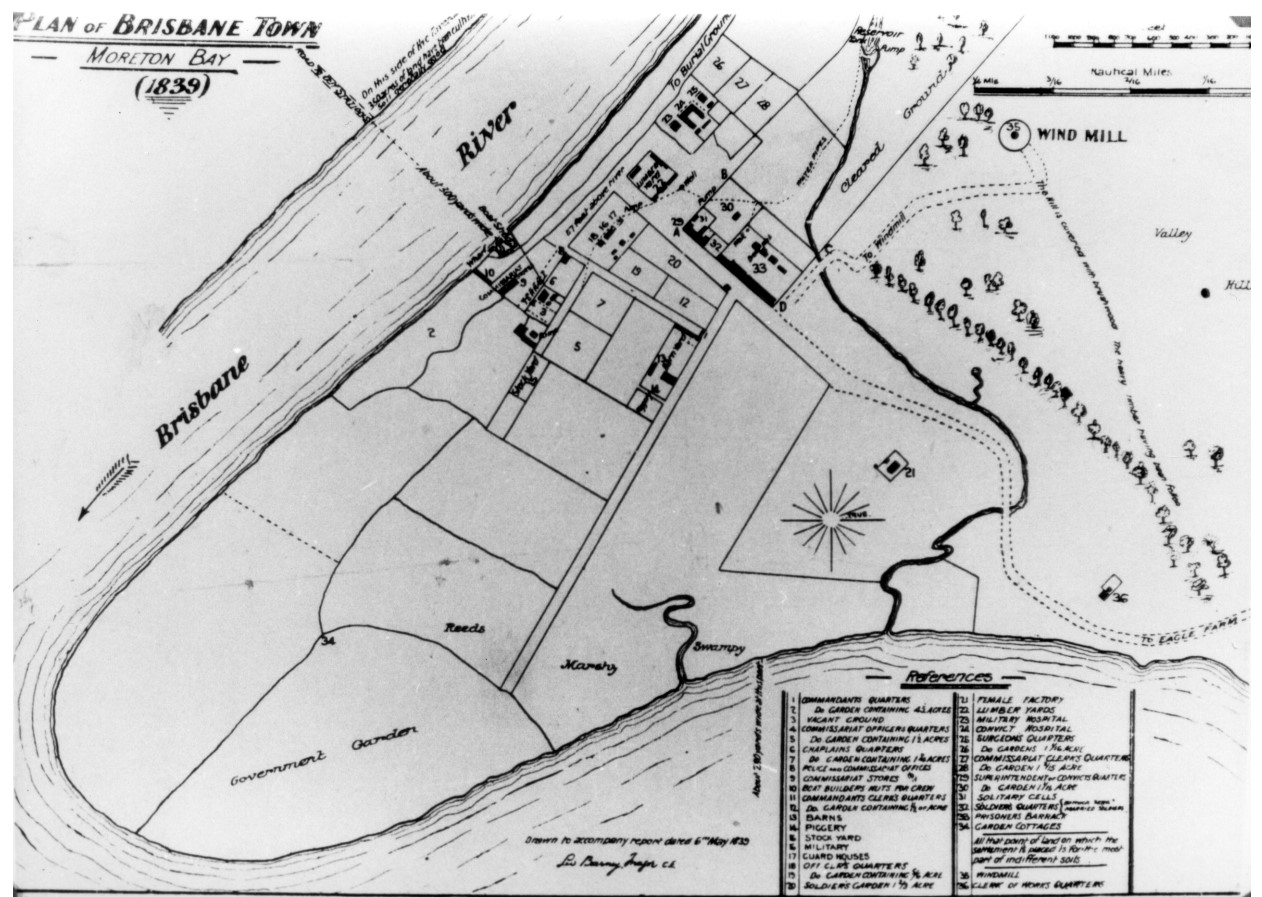
the Windmill and Government Garden Road
South Brisbane flourisheth. It is the manner of that quarter to be always flourishing. I observe that many houses have been built, and that others are being erected; that wharves are in process of construction, and that the main road has been improved, by being raised to nearly a level with the windows on each side of it. These are things that cannot be too much appreciated, or too often spoken of; but I miss the fine lakes that formerly added so largely to the picturesque appearance of the commercial capital.

Art has, as usual, overcome nature; and some hollow logs, sunk into a trench, have drained away most of those placid waters that erst delighted the visionary, and bogged the traveller. In one spot alone can the primæval beauties of South Brisbane be now discovered. In the rear of a very extensive establishment, and abutting on a most comfortable vacant allotment, the curious explorer will find the last of the lakes. It remains a memento of departed greatness, for it has been larger than it is now.
There is a dirty grandeur about this melancholy place that must be most pleasing to artistes of the Royal College of Surgeons. A rude bridge, consisting of two planks, five feet each in length, has been thrown over the gully that runs into the lake, and may be crossed with perfect safety. An ingenious person once suggested a plan for draining the whole of this territory, by means of a creek, which, as I have heard, exists in the vicinity; but this plan has not been adopted. Some enterprising surveyor ought to be appointed to explore the country, and ascertain the situation of the creek alluded to.

On the north side of the river, I see that everything promises well for the surgeons, and I am delighted to find that so many of that profession are settling among us. The lower part of Queen street presents a splendid field for their practice immediately after rainy weather. At such times much pleasing amusement might be combined with a first-rate business, by any active Sawbones who would take lodgings near the spot.
There is something exquisitely diverting in the sight of a woman, with a child in her arms, sliding and slipping down the greasy descent that I have indicated; and after a surgeon had enjoyed to the full this pleasing spectacle, and the climax—a heavy fall—had arrived, he could rush out, seize the patient, and set the broken limb. I hope that the hint will not be thrown away upon the faculty, and at the same time I cannot but express my surprise that no coffin-maker has yet established himself near the beautiful duck-ponds to the left of the government garden road.
I do not observe that you have made any preparations for a demonstration on the occasion of the arrival of the Mountstuart Elphinstone. I am surprised at this neglect but will point out what the inhabitants ought to do, grounding my programme of the performances upon what was done in Sydney, which is the proper place to go to for an example. Imprimis, then, the whole of the inhabitants of North and South Brisbane, and Kangaroo Point, should start off to the “Fisherman’s Islands,” from whence they will have a view of the ship lying at anchor. They must be sure to take with them “their wives and their little ones,” for this has been especially recommended in Sydney. They must then turn to and enter a “Great Protest” against the whole affair.

I don’t know what it is to be entered in, but perhaps a sixpenny memorandum book had better be provided for the purpose. In giving this advice, you must be careful to guard yourself against any writs “de lunatico” that may be issued against you. After this important business has been arranged, a little reaction may be agreeable, and I am able to point out the means. There are on board of the ship two intimate friends of mine, who had the misfortune to put their hands (accidentally) into another gentleman’s pocket. I think it only right that a little sympathy should be got up for them. For this purpose, I would suggest that a large punt be hired, as being capable of carrying more people than the river steamboat. I can recommend a lame drummer and a blind fiddler, who will form an excellent band for the occasion. On nearing the Mountstuart Elphinstone, the band should strike up ” Nix my dolly, pals, fake away;” and no doubt the gentlemen on board will take off their hats, and bow. The other airs I would recommend, are “The Bowl of St. Giles,” “Dick Turpin,” “My flash man’s in quod,” and “The Newgate Stone.” These little manifestations of sympathy will no doubt be most agreeable to the feelings of the exiles, and the punt-party may then retire to St. Helena island, where an excellent picnic lunch can be obtained from the oysters that grow on the rocks.
I conclude in haste but will soon signalise again.
Moreton Bay Courier (Brisbane, Qld.: 1846 – 1861), Saturday 3 November 1849, page 2
 Moreton Bay and More