

Convict Snapshot: George Baxter

George Baxter had led a law-abiding and successful sort of life until he got a job with rules he didn’t fully understand. He was a veteran of the 95th Regiment, and part of the Royal Veterans’ Company formed to populate New South Wales with useful, non-criminal settlers once their service was over.
The removal of a nuisance named Napoleon meant that there was a surfeit of employable veterans in the United Kingdom in the early 1820s, who could still be made useful in the service of the King.
Yet the scheme to settle these men in the Australian colonies was a failure. Particular blame can be laid at the feet of Governor Darling, especially as his brothers-in-law were the officers in charge of both the Royal Veteran Companies and the Royal Staff Corps, and he kept them busy with civil duties. Other officers were likewise tempted by the large salaries of civil positions, and virtually ignored their military responsibilities. Thus, the scheme was unsuccessful on various levels, most importantly because the officers did not fulfill their duties, and failed to provide leadership to the rank and file who, in turn, performed disastrously in their various roles. After discharge, most soldiers failed to take up their land grants, or forfeited them through non-residence. Military Settlers: Men of the Royal Veteran Companies and Royal Staff Corps (1825).
The Female Factory
Unfortunately, Sergeant George Baxter, who bore an excellent character in the Corps, was one of the men who performed disastrously in his role. He was appointed as Storekeeper of the Parramatta Female Factory, and set about his job with zeal. After all, he’d been so successful as a paymaster in the Regiment that he’d retired with the highest pension in the history of the 95th, together with the accolades of all who knew him. He’d sort this Commissary business out.
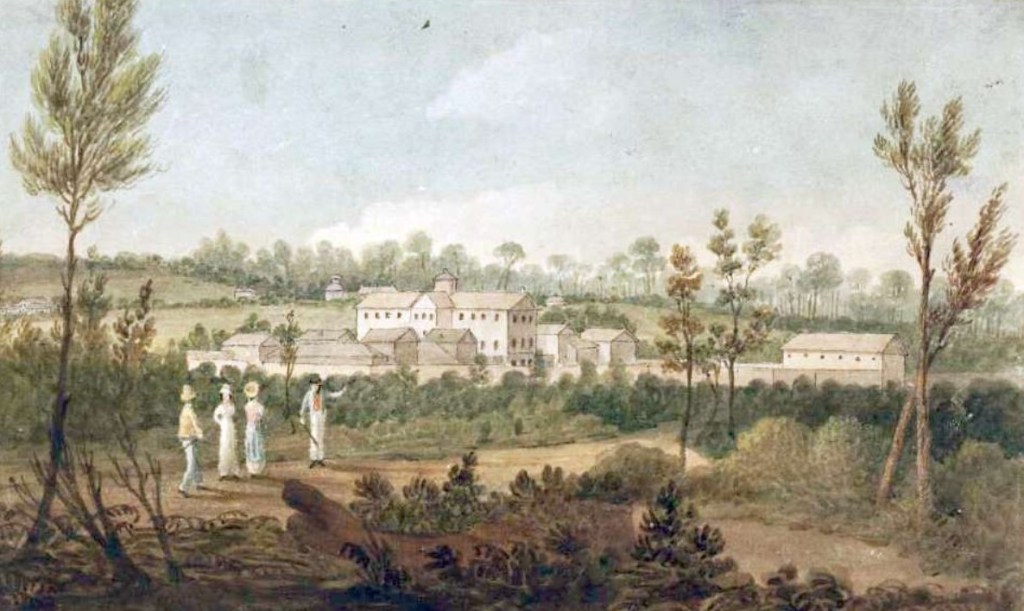
“And here’s where you’ll end up if you don’t behave, Amelia.”
Baxter noticed that there were unused supplies of soap and salt in the Commissary, and decided that these items could be sold to a local dealer. And that he could keep the profits of said sale. Thus Baxter drew 500 pounds of soap and 1000 pounds of salt from the Commissary and took them to a Mr Harvey to sell.
Unfortunately, these items were in fact the property of his Sovereign Lord the King. This is a nicety that one would think a former paymaster – used to handling sums of money that were not his – would be fully briefed upon. Perhaps the last Storekeeper didn’t leave instructions.
In August 1827, Baxter was tried in Sydney for stealing from the King’s stores at Parramatta. The Attorney-General prosecuted, and the defendant’s fate was decided by a Military jury. All of Baxter’s excellent references were produced. In fact, the Attorney-General himself conceded to the previous good character of the defendant, but Baxter was found guilty, and transported to Moreton Bay for seven years.
Forty-six year old George Baxter, together with his various testimonials and humble petitions, was conveyed to Moreton Bay, but not in irons. Further humble petitions from the prisoner and his wife meant that Mrs Baxter was permitted by Captain Logan to travel to Moreton Bay too. As long as she brought tea and sugar with her. (I believe that this meant that Mrs Baxter was accompanying the stores of tea and sugar on the journey north, rather than that she was told she could come, but she shouldn’t expect a cuppa when she got there.)
Throughout 1827 and 1828, the humble petitions and testimonials occupied the Colonial Secretary and the Commandant at Moreton Bay to an unusual degree. Every steamer, brig and barque that the Government employed on the route contained missives on the Baxter Question. Not that the officials seemed to mind – no decent chap likes to see another decent chap transported, after all.
Habeas Corpus

On Monday March 2 1829, the Supreme Court in Sydney heard a writ of Habeas Corpus in the matter of Sergeant George Baxter, directed to the Commandant of Moreton Bay. Mr Rowe for the applicant, stated that Baxter had arrived in the Colony a free man, and should not have been sentenced to transportation to a penal settlement designed as a place of secondary punishment.
A free first offender, Rowe argued, should at law be sentenced to confinement within prison walls, rather than transportation. The Court refused the application on the ground that the Justices had the power to decide on sentencing, and that Captain Logan as Commandant at Moreton Bay, was simply acting as a Government officer acting on a ruling of the Court.

Meanwhile, between accounts of hostilities with the local indigenous people over maize crops and requests for more horses, Logan and Alexander McLeay worked through George Baxter’s issues. Mr Harvey was asked to return the goods he’d been sold. This was done. Then a job opportunity came up for Baxter in Sydney – he could be assigned to work for the Secretary of the Australian Subscription Library, to act as his Librarian. Captain Logan allowed Baxter and wife to return to Sydney per the Isabella in late March 1829. No mention of tea and sugar though.
I think it’s safe to say that no other prisoner at Moreton Bay received so much consideration from Messrs McLeay and Logan. Then, on 02 April 1831, George Baxter was granted a full pardon in the following terms:
“By His Excellency Lieutenant General Ralph Darling Captain General Governor and Commander in Chief in and over His Majesty’s Territory of New South Wales and its Dependencies. Whereas George Baxter by the Ship Orpheus, Duff Master, in the Year one thousand eight hundred and twenty six was convicted in the Criminal Court of the said Colony on the twenty-seventh day of August one thousand eight hundred and twenty seven, on a charge of Simple Grand Larceny, and had Sentence of Transportation passed upon him for the same and whereas some favourable circumstances have been represented to me on his behalf; now therefore in pursuance of the power vested in me by Royal Commission, I do hereby grant to the said George Baxter a free Pardon for his said crime.”
The Visitation of God
Despite the support shown to him by the armed forces and the Government, George Baxter became downcast. He was a pensioned sergeant with a troubled history, and alcohol was the only solace he could find. His appetite and health declined, and he complained of trouble breathing on the night of Sunday 21 September 1834. His family sent for a doctor, who provided all the care he could, but Baxter died the following morning. He was 53 years old.
The Coroner held an inquest on George Baxter’s body at the Barley-Mow public house, Castlereagh Street on Monday 22 September 1834. Baxter’s son-in-law testified to the years of “excessive drinking of ardent spirits” that had weakened George’s health.
The Coroner’s jury returned a verdict that George Baxter had died by the Visitation of God.

“Military settlers: the men of the Royal Veteran Companies and Royal Staff Corps (1825).” The Free Library. 2009 Royal Australian Historical Society 24 Jan.

 Moreton Bay and More