

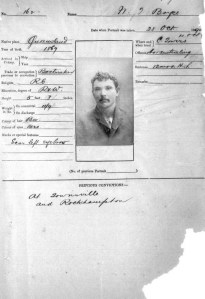
A pensive-looking young man sits for the photographer at Brisbane Gaol. It’s the 28th of October 1890, and the man, listed as W.T. Boyce, born 1867, has been convicted of horse stealing at Charters Towers. He will spend a year at Saint Helena Island. That’s enough to make anyone melancholy.
The report of his conviction gives his first name – William – and some hints at a past.
William T. Boyce, who pleaded guilty to stealing a horse and saddle put in a lengthy statement in extenuation and pleaded for a light sentence. He had been convicted twice before and His Honour thinking he had not altogether gone to the bad, although he was on the high road that way, ordered him to be imprisoned in the Brisbane Gaol for one year for each offence, sentences to be concurrent.
The Northern Miner, October 1890.
Hmm. A quick look at the record of his committal proceedings explains his full name.
William Townsville Boyce, the first white child born in Townsville, has been committed for trial at Charters Towers on a charge of horse stealing.
Rockhampton Morning Bulletin, September 1890.
That’s quite a name, and quite a story. But it’s still not quite his correct name.
A fair bit of hunting reveals that he is William Townsville Boyes, born in Townsville on 25 August 1865 to William Watson Boyes and Catherine Halpin. He’s a little older than his prison record shows, and he was charged and convicted under an incorrect version of his surname.
Having looked at Boyes’ family background, he can be forgiven for not correcting the Boyce error, and for keeping the Townsville part under wraps. It would be surprising if he wasn’t ambivalent about his heritage.
Father’s Early Adventures
William Watson Boyes was one of those swashbuckling figures who fetch up in the Colonies determined to make a new life, and exceed any expectations of adventure that they may have treasured. His c.v. is quite exhausting. And in places, a little suspect.
William Watson Boyes was born in Ireland in 1835 to William Arnold Boyes and Elizabeth Rynes Birch. He was the oldest son, and claimed an Admiral as a maternal grandfather. In 1852 young William Watson arrived in Melbourne, Australia and joined the mounted police as a cadet. William also claimed to be a member of a gold escort under the command of Robert O’Hara Burke (the explorer).
After dashing about the goldfields of Victoria, Boyes travelled to distant Queensland in the early 1860s. He is recorded as having held a publican’s license in St Lawrence, a hamlet between Rockhampton and Mackay, in 1862 and 1863. He was a shopkeeper when he became insolvent in 1865. Boyes did not attend the third sitting of the insolvency proceedings, because young William Townsville Boyes was due any minute.

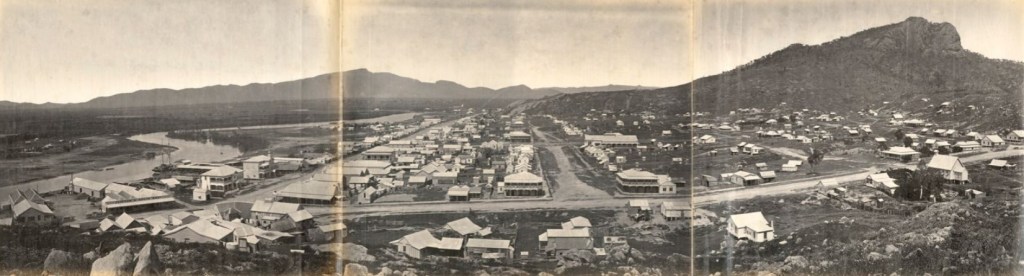
Townsville was a mere 340 miles north of St. Lawrence, and sparsely inhabited by Europeans in 1865. A search of the records shows that Catherine Halpin did not present William Watson Boyes with any further issue after the birth of William Junior. She stayed in Townsville and married a carter named John Frederick Hof in 1866, and they started a family of their own, with four more children. There was no such thing as a quickie divorce in 1866, meaning that William Watson Boyes had either died suddenly, or failed to make an honest woman of her in the first place. At any rate, he was no longer a resident of Townsville.
Another Family
William Watson had not passed away, but had moved on with alarming speed. He married Elizabeth Annie Clarinda Bembridge in Paddington, New South Wales in 1867, and set about having another family. Three children followed. Eva Geraldine was born in 1868 in Broulee, New South Wales and died at Waverley (near St Lawrence) in 1868. William Ellarick Bembridge Boyes was born in 1869 in Collingwood, Victoria, and happily survived to adulthood, and Adela Alice Boyes, also born in Melbourne in 1869 and sadly passed away on 16 November 1870.
Who knows why, but after three years of travelling the length of the continent, producing and losing young children, William Watson Boyes again disappears. Eliza Annie Clarinda Bembridge would remarry in 1877 and start a new family, but no divorce appears to have been sought by either party, and Mrs Eliza Boyes called herself Mrs Gardener on her remarriage (to an Isaac Ball).
Absent Friends and Fortunes
Meanwhile, up north, William Townsville Boyes was growing up in the Hof family, and his mother insisted that he retain the surname Boyes. Hof was a carrier and was on the road frequently, and the hard life of a woman who had to raise her children largely alone was telling on Catherine. She passed away in 1881, and Hof, full of fatherly feeling, promptly put William into the Rockhampton Orphanage. There was a certain block of land in Sturt Street that was gradually increasing in value and Hof was very grateful for receiving it through Catherine’s passing. Young William T. knew enough about his family heritage to be aware that the land was due to go to him, as William Townsville Boyes. He would have to bide his time.

Meanwhile, William Watson Boyes was being sought in Victoria, New South Wales and Tasmania per the Missing Friends pages.
This is a wonderful description of Boyes senior – bearing in mind that photographs were not yet available to all Police services – a distinctive gait or manner may well be the key to finding a missing person.
Coming of Age
While William Townsville Boyes was considered at 16 a little overage for the Rockhampton Orphanage, he still had to wait to claim the land in Sturt Street for his own. Once he was of age, he was able to take the case to the Civil Sittings of the Townsville Circuit Court in May 1887, and he had a win against his step-father. Mr Hof was quite put out about this reversal of his fortunes. The land would prove handy, because Annie Harrison had said yes to William’s offer of marriage. Their first child, Eva Alice Boyes, was born the following April.
Unfortunately, young William Townsville had developed a fondness for drink that led to crime, and he tended to be caught when committing the latter under the influence of the former. He used the alias of Kalpin, which is similar to his mother’s maiden name of Halpin (which may have been Alpin, another of the early settler names in Townsville). He certainly didn’t object when convicted under the surname Boyce rather than Boyes. I doubt he’d had much if any contact with William Watson since the occasion of his christening.
William Townsville quietly left Queensland after this sentence, having apparently sold the land in Townsville at some point in the 1890s. His subsequent life was quiet, with his distinctive name turning up in the Electoral Rolls in New South Wales until the late 1930s. There was nothing quiet about his old man, though.
Postscripts
William Watson Boyes, having exhausted the possibilities of Victoria, New South Wales and Queensland, settled in New Zealand and made an advantageous marriage in 1895. There he remained until almost 1920, when he moved to Victoria to be closer to his family (he was fond of one of his nieces, who looked after him prior to his death in 1923).
BOYES-BULLEN – On March 2, at St Sepulcher’s Church, Auckland, by the Venerable Archdeacon Dudley, William Watson BOYES, eldest son of the late Rev. William Boyes, M.A., and grandson of the late Admiral Ryves Birch, R.N., Enfield Estate, Ireland, to Louisa Johanna Dorothy Bullen, widow of the late Thomas Bullen and only daughter of the late H. August Marhenke, Hannover House, Elze-bei-Hildesheim, Hannover, Germany.
Auckland Star, 18 April 1895.
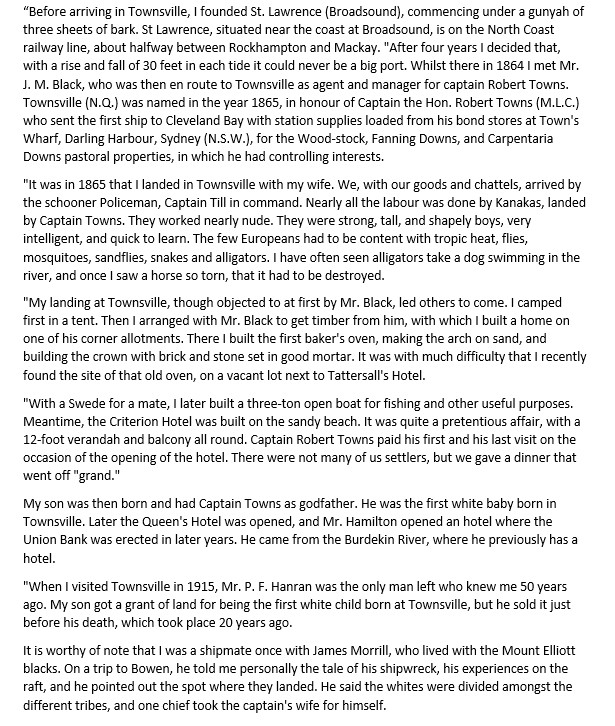
In later years, William Watson gave interviews in Australia, usually when on a visit to sell artworks and/or songs (he’d become a successful lyricist and artist in his 70s). He gave a couple of accounts of his adventures to the Townsville Bulletin, taking credit for a remarkable number of firsts. Before repeating them, in the interests of accuracy, a few picky disclaimers:
- The Centre for the Government of Queensland credits pastoralist James Macartney with the founding of St. Lawrence, and the opening of the transport to the mines. The infrastructure Boyes claimed to have created at St. Lawrence was the work of a gentleman with the truly memorable name of Septimus Nash Spong, and who held the post of Clerk of Works at the Colonial Architect’s Office.
- While at St. Lawrence, Boyes was a carter and shopkeeper. He held a publican’s license in 1862 and 1863, and he left St. Lawrence after becoming insolvent, not because his ambitions needed a larger canvas.
- Sadly, he was not married to the mother of the first white boy born in Townsville. Both parties married other people within 18 months of William Townsville’s birth.
- Poor William Townsville seems to have lived longer than his Dad admitted.

 Moreton Bay and More