
Mary Eileen Hagenbach, 1919
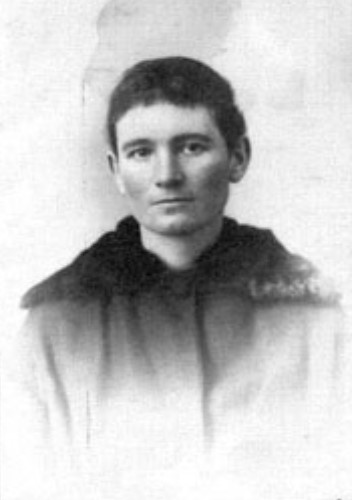
Mary Eileen Hagenbach was a tall, slender young woman of 23 years of age. A little severe-looking perhaps, an impression not helped by the fact that her hair had been chopped off roughly during a long illness. She’d just spent nearly four months in hospital after hemorrhaging during childbirth, and now she was facing serious charges.
Mary was a member of a well-known family in the Warwick area, and had worked as a saleswoman. She lived in town, boarding with the Glover family, and sharing a room with their daughter Jessie, aged 10.
Perhaps it was a desire to be a bit independent that made the young woman leave the family property and move to town to be one of several boarders who stayed with Allen and Ethel Glover. She’d boarded there on and off for three years and was a very quiet and private person.
At some point in the winter of 1918, Mary conceived a child, by whom she never said. She concealed the pregnancy from everyone she knew, even the people she lived with. On the 21st March 1919, Mary went out of the house around 7 pm. During the night, one of the householders heard a thump, but wasn’t sure what part of the house it came from.
The following morning, Mary couldn’t get out of bed. She said no to breakfast and wasn’t interested when her concerned landlady suggested getting Mary’s sister over to look after her. She was just sick, she said. She could see her sister another time.
Alarmed, Mrs Glover called Mary’s sister, Mrs Crawford. She lived locally and came straight away. Things happened quickly after Mrs Crawford arrived. The doctor was called, and it became clear that Mary had given birth. The police were called, and a disturbed area of the garden was located. Mary had buried her daughter in the yard. Bloodstains about the woodhouse and outhouse, marks on the dead child’s face and on a shovel led the police to believe that Mary had murdered her baby.
Mary’s health was so bad that she had to be admitted to hospital that day. The doctors were worried that she would not survive.
While she recovered, the police worked up a case of infanticide, and this is what Mary faced when she left hospital. It was the evidence of the doctor who saved her life that saved her from a charge of murder. He had examined her baby as well, and was able to prove that the injuries on the baby’s face had not been caused during her life. The injuries were an accident from the shovel during the hasty burial and had occurred post-mortem. There was nothing to indicate that the baby had been born alive.
Mary was charged with concealment of a birth instead of infanticide, and was released on a good-behaviour bond as a first offender. She was to reside with her parents at their property at Lower Freestone, near Warwick.
She was now notorious, an object of pity or suspicion. Her family were well-known about Warwick. The whole State had read about her going out to the garden at night to have a stillborn child and bury it in the garden.
Mary passed away on 20 June 1923, probably from the physical and/or mental after-effects of that night in March 1919.
Edna Rosamond Norton, 1919
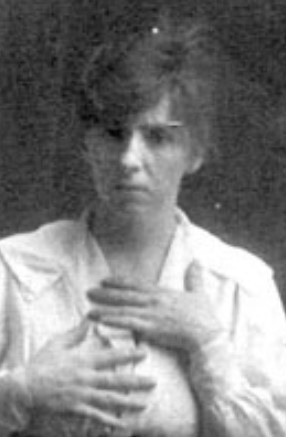
The three young Misses Norton caused their first sensation in Longreach by arriving in that town and setting up a dressmaking business. Whilst dressmaking was considered a traditional female line of work, three stylish young ladies arriving to set up a business in an outback town was dashingly modern.
The second sensation the Misses Norton caused in Longreach occurred when they were all arrested.
“Edna Rosamund Norton was charged that on or about September 21 she murdered her illegitimate child shortly after its birth. Adelaide Maud Norton and Stella Ethel Florence Norton were also charged with jointly assisting her in order to enable her to escape punishment.” Townsville Daily Bulletin
Once again, after all the sensation of the arrests and charges, evidence from the post-mortem on the baby showed that Edna had been delivered of a stillborn child, and her sisters took the body and concealed it by putting it in a bag and in the river. Edna was eventually convicted of concealing a birth, and given a good behaviour bond. Her sisters were sentenced to the rising of the court. In her discharge photo, Edna looks sad and confused. She had good reason. However, two years later, Edna married Edward Dillon, and she went on to live a good long life.
Norah Agnes Moore, 1921
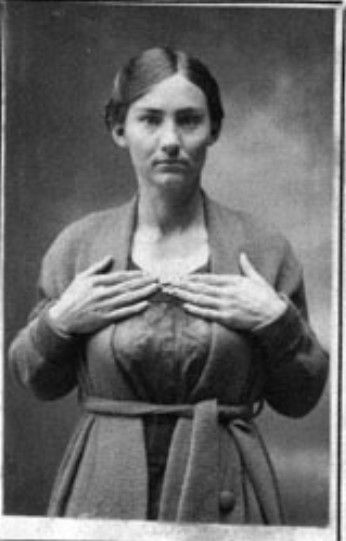
In 1921, another young single woman from a small town had a stillborn baby, concealed her pregnancy and concealed the birth. She was more fortunate that Mary Eileen Hagenbach and Edna Rosamund Norton though, because the newspapers and the courts concealed her identity. Why? Well, she was from another locally-prominent family, but “The Crown Prosecutor said there was nothing against the girl, except the charge before the court. The case was not very blameable.”
The girl had been seduced on a promise of marriage and abandoned. Her family had bought a trousseau for her in anticipation of her wedding. She left home and took her shame with her, but her father was willing to take her back.
A very pretty, serious-looking young woman, Norah Agnes Moore (for that was her name) was released as a first offender to reside on the family’s selection. Norah was in good health, and was able to move on with her life, marrying Victor Donald Smith in 1924.
Why so many concealed births, stillbirths and hidden babies?
A century ago, there was no reliable birth control. Condoms were available, but no gentleman would be caught dead buying them, particularly in a small town. There was nothing a girl could do to prevent a pregnancy, other than say “no” and hope that this was respected. Any attempt to produce and sell information about birth control could lead to charges of obscenity.
Society expected men and women to wait until after marriage before any sexual contact took place. If a young woman was seduced on a promise of marriage, like Norah, her case might be viewed with a little more sympathy.
The strain of going through a covert pregnancy, often working until the date of birth, would affect a woman’s physical and mental health. It is probable that some young women did not go to the doctor at all for fear of discovery. Others might neglect their health or wear tight corsetry to conceal their “shame.” Giving birth in secret would increase the risk of stillbirth.
And unless a woman was prepared to name her seducer, the fathers of these poor stillborn children went through their lives with no consequences to face.

 Moreton Bay and More