

TELEGRAPHIC DESPATCH.
(From our Windmill Reporter.)
The Flood.
I am happy to inform you that my elevated position has given me an opportunity of reporting to you the intended proceedings of the flood which has been for the last six years expected in Brisbane. The right wing of the flood will land at South Brisbane, and will advance thence, by easy marches, to Grey-street, the south-west side of which it will surround and take possession of. It will then push forward the vanguard to cooperate with a reinforcement that is expected by the way of Slack’s paddock. The approaches to Russell-street will be strongly guarded, and a running force will be constantly on duty in Stanley-street.
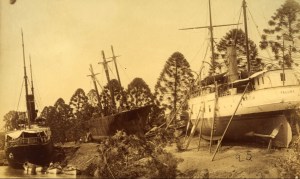
Garden, 45 years later. (SLQ)
The left wing is to invest North Brisbane, which it will invade at some point between the wharf and the Government garden. It will take up a position in the rear of Queen-street and extend its right flank across the lower part of that street to the foot of the Windmill hill, where it will be joined by a detachment from the reservoir. All buildings erected in those places should be founded upon water-tight hulks, which, until the flood arrives, might be steadied by the means ordinarily employed in shipyards. When afloat they can he steered to the mud banks off Cleveland Point, where they will be sure to get aground at any time. None of these precautions will be necessary if the flood should not come which, I am instructed to say, is the likeliest thing of the two.
(The Windmill Reporter is referring to a drought that threatened the success of the fledgling free settlement in the 1840s. Being a subtropical township located on a river, Brisbane would flood frequently in the ensuing decades, and the water would indeed take the general path described above.)
Haut Ton.

Old Tom gave a soiree dansante at his quarters in South Brisbane, last week. The company was neither numerous nor select, but highly convivial. Toe-and-heeling was kept up until a late hour, and the party separated mutually dissatisfied with each other.
(Old Tom was Tom Dowse, a former convict whose industrious nature took him from operating a skiff as a ferry, to auctioneering, to the office of Town Clerk. The man was energetic, civic-minded, good-natured, and could sell ice to the Inuit. He appears to have been a rather unsuccessful party-giver in the forties, though. A fact which may or may not have been connected with his lifelong temperance.)
On Dit.

That the Gaol at North Brisbane is to be finished at some remote period, at present unnamed.
(The Gaol at North Brisbane was the old Female Factory in Queen Street, which had not been used as a prison for over a decade. Indeed, the only inhabitants of note were the Petrie family on their arrival in Brisbane in 1837. Andrew Petrie made haste to build his young family a proper dwelling to get them out of the building he referred to as “that hole.”
The new Gaol was opened in 1850, over a year after the Windmill Correspondent wondered about its completion. The renovation was not an unqualified success, and a decade of overcrowding, escapes and unrest followed. The Petrie Terrace Gaol was opened in 1860 to compensate for the poor state of the Queen Street Gaol. Saint Helena Island and Boggo Road Gaol were deployed to compensate for the inadequacies of Petrie Terrace Gaol.)
Fashionable Arrival.
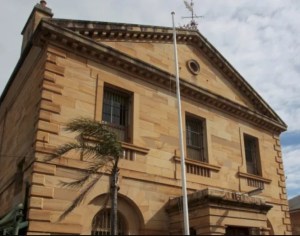
Mrs. C—-, from a visit at Parramatta.
(Mrs C did not visit Parramatta for its rural airs, or to see family. She had been sentenced to a term of imprisonment in Parramatta Gaol. Because the Brisbane Gaol was not complete, and there was no circuit court yet at Brisbane, indicted defendants had to go to Sydney to face trial and imprisonment.)
I send you the following pathetic lyric, as the effusion of my sleepless reflections last night: and, apropos, I shall be glad to know when I am to get my salary?
Subscribers were sleeping-the “governor” weeping,
Cash payments so slender ’twas frightful to see
His ledger was swelling, and creditors yelling
“Oh stump up, my darling, the rhino to me.”
His “browns” as he number’d, his patrons still slumber’d
Or laugh’d in his face as he tender’d his bill;
His agents were snoring-his milk-woman roaring
“Now see what you’ve come to by driving the quill.”
Poor soul! In the morning the steamer returning
Will open thine eyelids, and weaken thy knee;
And fondly caressing what cash thou’rt possessing
Thou’lt fancy the bailiff’ is whisp’ring to thee!
Windmill, 24th Nov., 1848.
[Our reporter’s observations are very impertinent, and we desire that he will not intermeddle with our pecuniary affairs for the future.]
Moreton Bay Courier (Brisbane, Qld.: 1846 – 1861), Saturday 25 November 1848, page 3
 Moreton Bay and More