
As seen in the Letters to the Editor. 1871 – 1875.
In 1871, Larrikins rather suddenly appeared in Queensland. Dire tales of disorder on the streets of stately Melbourne had begun to appear in the Queensland press, causing pious folk to glance nervously at any seemingly under-employed young person who crossed their path. Surely they wouldn’t come here. Would they?

Today, a larrikin is a person with a healthy disdain for authority in its more pompous forms, and who ususally displays a marked fondness for beer-related recreational activities. Their distant ancestors were similarly inclined, but took to assembling in gangs and committing public nuisances, ranging from general disrespect to violent crime.
Seemingly from nowhere, the predominantly young and disadvantaged emerged into the streets of Melbourne and Sydney, dressed in distinctive “flash” clothing, loudly mocking everyone they reasonably suspected of being respectable. Stones were thrown, obscenities were hurled, and the sleep of the just was murdered.
The first use of the word “larrikin” in Queensland newspapers occurred in August 1870, describing some onlookers to a crime in progress at Benalla in Victoria. It was then first used to reference behaviour occurring within our borders the following April, as an upstanding citizen under the nom de plum “A Sufferer,” described the appalling goings-on in Gympie.
TO THE EDITOR OF THE “GYMPIE TIMES.” SIR, – Lately a number of little boys and half grown up youths have made it their business to meet together at certain parts of the main street to make insulting remarks respecting everyone that is passing by. These street-Arabs and ragamuffins, for they cannot be termed anything else, apparently find great enjoyment in loudly calling out the name or occupation of every male passer-by that may be known to them, accompanied with “adjectives” of the most disgusting kind.
This I think you will admit is anything but pleasant to the “unfortunates,” but when females are also treated in the same manner, as I am prepared to prove, this species of “larrikinism,” as it is termed in Melbourne, becomes an intolerable nuisance that ought at once to be done away with. In England it would soon be nipped in the bud by the proper authorities, and doubles if one of these promising specimens of the rising generation were to be made an example of – say, for using obscene language, the rest of his tribe would soon drop their little game. A SUFFERER.
While larrikinism in its more organised and criminal form would make its way to Queensland in the coming decades, the kind of behaviour described by the good citizens of the Colony to the editors of our newspapers in the early years, was often little short of comical.
Parrot Liberators and Dangerous Dog Carts
TO THE EDITOR OF THE BRISBANE COURIER.
SIR, – Despite the benefits of free education the unfortunate human reed known as the “Larrikin” seems to flourish exceedingly in Brisbane. These wretched little Arabs are generally the children of drunken parents, who if they do not virtually encourage their offspring in thieving, at least never check or punish them for it.
One of these little waifs a day or two ago crept on to the verandah of a house in Spring Hill where some rare and valuable parrots were kept, opened the cage doors and let them fly away; whether from spiteful mischief, or in hope of reward for trapping them, cannot be known, as the pattering of his bare feet only attracted attention in time to see him disappearing swiftly in the distance.
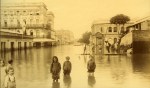
I fear, too, that there are some grown up larrikins in Brisbane. Last Sunday night, long after dark, sundry dog-carts and buggies came driving smartly into town along the Breakfast Creek road with not a single lamp lighted among the whole crew of them. Such careless disregard proves either that lives and limbs must be very cheap in Brisbane, or else that lamps and lights must be very dear.
Another favourite amusement on a dark night is, for a spring van without lights to emerge suddenly at full trot from behind a carriage with refulgent reflectors, being totally invisible to the dazzled eyes of the victim, till he or she is knocked down by it. This is great fun for the driver, but surely there must be some remedy – some fine imposed by law for these games of hazard. – Yours, & c., HALBERD.
Letting Off Firecrackers
TO THE EDITOR OF THE GYMPIE TIMES.
SIR, Are our police deaf and blind? I am led to ask the question by the increasing nuisance of our larrikins letting off fireworks. Night after night, groups of boys are soon assembled together with a light and indulging in the fun of letting off crackers and other fireworks. Considering the inflammable character of our buildings, and the really valuable stocks stored therein uncovered by insurance it is really too bad that our police neglect to take measures for the suppression of this nuisance. JONES
“Impure Streams of Colonial Blackguardism”
TO THE EDITOR OF THE BRISBANE COURIER.
SIR, – Our Botanic Gardens are greatly appreciated as a delightful promenade where young and old may admire the beauties of our semi-tropical productions, and combine recreation and instruction at the same time, thanks to the unremitting care and skill of the curator, Mr. Hill. There is, however, springing up in the midst of all the beauty and perfume that is to be found there, a nuisance which is becoming intolerable to the frequenters of that portion of the gardens fronting the cricket ground, which is desirable should be nipped in the bud.
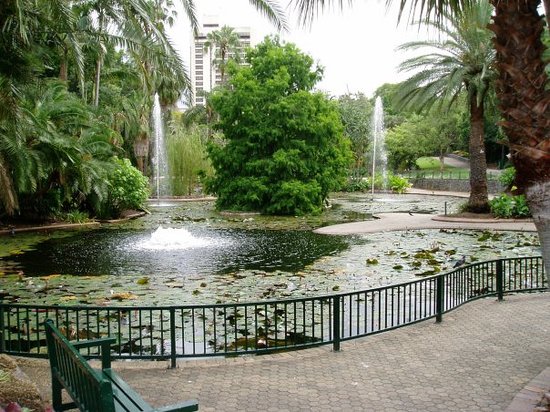
At this place, which is principally the resort of nursemaids with their charges, are to be found, particularly on Saturday afternoons, a number of youths who take up their place on the grass near to the seats between the gravel walks, and conduct themselves in a most disgraceful manner. Their conversation, turned on in a tone of voice sufficiently loud to be heard by any person passing along either of the walks, is coarse and filthy in the extreme, so that respectable people are glad to get out of their way as speedily as possible, and consequently are driven away from the seats placed there for the accommodation of the public.
This, however, is not the whole of the evil, the youngsters that are playing about in the neighbourhood, attracted by the noise and laughter of the youths referred to, are drinking in the impure streams of colonial blackguardism, at a place where of all others their too confiding parents doubtless imagine they will be free from such abominations. I am quite sure the matter only requires to be brought under Mr. Hill’s notice to be at once put a stop to, and hence this communication. – Yours, &c., PROMENADE
Climbing Trees in the Cemetery
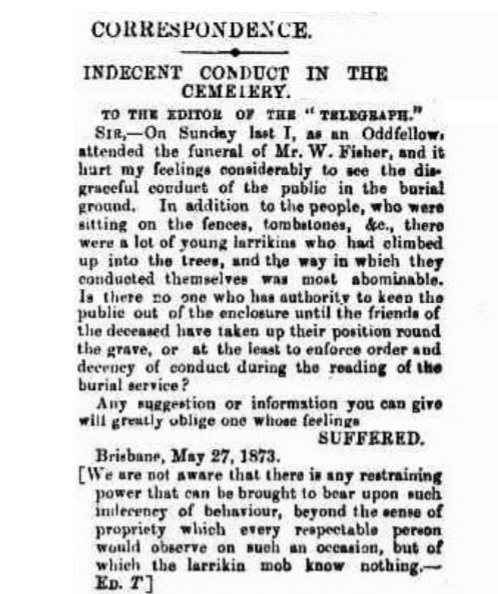
Highly disrespectful, but hardly indecent.
Frightening the Horses and Insulting Pedestrians
TO THE EDITOR OF THE BRISBANE COURIER. SIR,-One of the most noted strongholds of the ” larrikin” tribe is in and about Kelvin Grove. They muster strongly on Sunday afternoons, both males and females, and squat on each side of the very narrow culverts which mark the approach to Normanby Bridge, and spend their time in insulting the foot passengers who go by and in trying to frighten the horses of those who ride past.
These wretched young savages appear never to have heard of the Vagrant Act, and of a month in gaol with a couple of floggings given in, or I am sure they would rather go to Sunday School than vent their little tempers thus on the public after a full dinner, if they only knew what the law prescribes for such thankless young sinners as they assuredly are. They eat to the full, and by way of grace after meat sally out to swear and utter obscene words, and annoy all who travel past them. Yours, &c., EYE-WITNESS.
So, imprison and whip them, or starve them at home?
Throwing Things at Men Playing Soldiers
By way of explanation, Australia, being then a Colony, had no national defence force of its own. In the 1860s, volunteer brigades of fellows who liked to march, drill and shoot targets assembled in the name of civil defence. And marching, drilling and shooting.
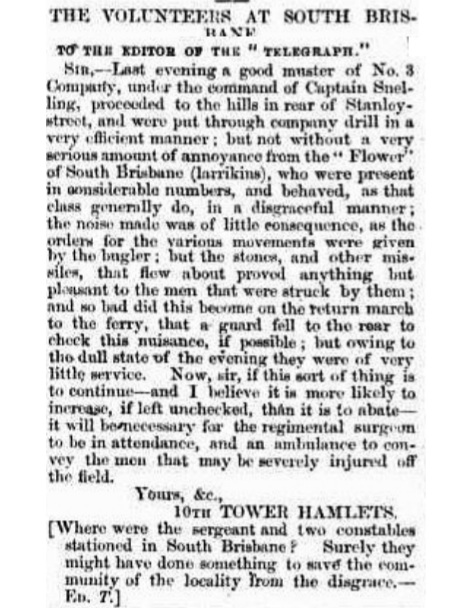
Throwing stones is very naughty, but the goings-on they were disrupting sound frightfully pompous.
Hanging Around the Post Office and Swearing
TO THE EDITOR OF THE TELEGRAPH. Sir, — We in this part of Brisbane should like very much to know if we are under police protection, as the larrikin element is getting unbearable up here. From about 8 to 12 at night they congregate about the dark parts of the street, and render the night hideous with their cat calls, obscene songs, and disgusting language. If spoken to by anyone they greet him with gross insults. They have made the Post Office pillar their particular rendezvous, so that women or girls are afraid to go near it in order to post letters as they are liable to meet with the foulest epithets.

Both for the sake of the, public and the residents’ in the neighbourhood this club requires to be broken up, and it is only the police who can do it. The older larrikins, from the ages of 17 to, 20, are training up a lot of young boys every night to follow the same courses they do themselves, and by all signs the youngsters will soon surpass their tutors. We are glad the Police Magistrate’ has taken them in hand, and it only requires a few of the ringleaders to be taken out of every club in order to keep the wretched element of larrikinism under. VESPERS Leichhardt-street.
The Systematic Torture of Anglicans
All Saints’ Anglican Church on Wickham Terrace is a lovely old building, restored with great care in the early 2000s. If you find yourself at the bus stop nearby, you can gaze at its beautiful stonework and stained glass, listen to the organist practice, or as I did on one occasion, see a funeral procession leave, complete with a solemn procession of pipers.

In the 1870s, it suffered from the scourge of children who fidgeted, talked and pulled girls’ pigtails. They didn’t put anything in the collection plate, either. The torture went on for years, if the Letters pages were anything to go by. (I can’t condemn the ill-behaved children entirely – I used my Anglican confirmation classes to hone my skills at yawning with my mouth closed.)
TO THE EDITOR OF THE BRISBANE COURIER.
SIR,—Why do the larrikins of Brisbane congregate outside the south-west door of All Saints’ Church, Wickham-terrace, on Sunday evenings during church time? Why do they then and there discuss in so loud a voice all and sundry weighty affairs of their own, which have, apparently, but little reference to, or bearing upon Church matters, judging from the strong sentences which fall from time to time upon the ears of the worshippers inside?
Why, oh, my larrikin, why so strident in thy tone? Why, oh why, do’st thou stroll in and out of church every ten minutes in so unsettled a fashion? Is not Australia a big country, and is there no room for thee to discuss “pegknife” and “toffee” elsewhere than at the church door during the soft summer hour of twilight even-song? Might I venture to suggest to thee the summit of Taylor’s Range or the breezy sands of Moreton Island, oh, my Bedouin. Why the church door, of all places, oh youth with the fearful and wonderfully constructed bluchers?
But, alas! I fear that the punching of heads, the abstraction of caps, the insertion of pins, the interchange of slang, would lose all their zest for thee, unless some respectable worshippers had to suffer at the same time; and, of a truth, it surely vexeth my soul to think that we shall never be rid of the greasy horror, the unmitigated nuisance of thee, oh! irrepressible, abominable, and unendurable waif of the city. Don’t you think so, Mr. Editor?—Yours, &c., E. B. L. B. L. BULWER.
With Bulwer sounding off, Dickens just had to get involved.
TO THE EDITOR OF THE ‘TELEGRAPH.‘ Sir, — The Courier’s correspondent ‘Bulwer’ failed to notice one very serious aspect of the ‘larrikin’ question as it affects the service of All Saints’ Church on Sunday evenings. I have not myself observed the noise outside so much as a more crying evil inside, all evidently in full training to join the ‘dangerous classes’. Numbers of boys and girls crowd into the church a quarter of an hour before Service begins. They jostle and push, four and five of them at a time, into seats only meant to hold three; giggling, skylarking, pulling of hair and ribbons goes on freely, but they are too languid to stand up, even during the utterance of the creed itself; their behaviour is in short simply infamous, and the matter does not end here.

Numbers of respectable people who would contribute half-crowns and shillings to the offertory, come to the door before service begins, and seeing the church so apparently crammed in the back seats, turn away and leave the place! They lose the service, and the church (a ‘free seat’ one) loses one means of its support. This is the more vexing, as the he and she larrikins, invariably find the fun getting tame after a while, and many of them go out for good after about half an hour of it, – having in the meantime, kept more than double their number of respectable persons from coming to church at all, besides scandalizing all who are unlucky enough to sit near them, and setting a fearful example to all the children at hand. The rest of the ‘larrikin mob’ invariably make a stampede of it when the plate is about to come round. So no revenue ever comes from any of them, while a – great deal is lost, as I have shewn, through them. It is a serious matter in a church that depends on offertory contributions, and the only remedy is to make the larrikins all sit up at the top of the church, where all may see their low theatre gallery style of manners; but they would never fare this, and the result would be that the church, would be then rid, and well rid, of them altogether. Yours, &c., C. DICKENS.
Mr Pounds was all for banning the little rascals from the institution altogether.
TO the editor of the ‘Telegraph.‘ Sir, — This Sunday evening nuisance has now been transferred to the inside of the building, owing I suppose to the cold nights. The larrikins behave in a manner which would not, for a moment, be tolerated in any school room, public or private; and why then, should the house of God be marked by behaviour that would barely suit the gallery of the theatre, just be fore the curtain draws up for the pantomime?
The verger sits on one side of the church, and he cannot be in two places at once; and the larrikins carefully avoid his side of the building, and crowd to the other one. During prayers the sport is confined to the less noisy acts of laughing, talking, pinching, and pulling the hair of the girls in front; but when the organ begins to play, then the psalms, under cover of it, are shouted out in a loud burlesque voice, till a blow in the ribs from his next neighbour forces a sound between a roar and a gasp from the lips of the comic youth, which, coming in the middle of the song, elicits plentiful laughter from the young ladies in front. Why is not the remedy applied to every young person, if unaccompanied by a respect able adult – compelled to sit at the top of the church, where all can see them? The true larrikin will invariably leave the church when this unpalatable proposition is put before him. It is as infallible a test for the larrikin as salt is for the slug.

It would be a mercy to themselves if all these untaught brats of both sexes were kept out of the church altogether; for they don’t come to worship, they don’t contribute to the offertory, and they are, by being allowed to come to church to scoff, being deprived of the last little remnant of reverence or veneration that is left in them. If they be allowed to make sport of the church worship, what is there left in heaven or earth that they can be expected to look up to?
Let exclusion therefore be applied to teach them that there is yet something they do not understand and cannot be admitted to some thing real and actual, however mysterious to them, reverenced by their betters which they are very unfit to partake in until a change comes over them. What can the wretched waifs come to think of a matter they are allowed systematically to abuse and burlesque, except that there is ‘nothing in it.’
I was much amused by the reply of a Pharisaical churchwarden of All Saints when I once complained of this matter; he said that respectable people ought not to sit at the beak of the church, but I was unable to see that one part of the building was, or ought to be any less sacred than the other. Was it not all consecrated alike? Is there any selvage in a church, as in a piece of cloth? My reason for writing to you in place of the churchwardens is, that in the former case the larrikins would never know why they were taken to task; but at the risk of hurting the churchwardens’ feelings, I prefer to let the larrikins have the benefit of seeing themselves thus gibbeted and pilloried in print, in the hope that the moral mirror thus held up to them may give them a fright when they look in it, and do them some good at any rate, for I study the boys more than I do the men. — I am, Sir, Yours faithfully, JOHN POUNDS.
After this, the parishoners were either cleansed of the larrikin nuisance, or had learned to tolerate the ribbon pulling and rib-elbowing.
A Fate Worse Than Larrikins

SEVERAL complaints have been made in the local papers lately about the increase of “larrikinism” in Brisbane. These complaints must either be gross exaggerations or the larrikins keep a good distance from this end of George-street. As an incontestable proof we may mention that, for the last two or three evenings, some misguided mortal has commenced to practise on the Scotch bagpipes close to this office, and has “hotched and blew with might and main” for an hour or so at a stretch without any larrikin sticking a penknife in the bag or molesting the player in the slightest degree. There cannot be a larrikin within sound of those horrible pipes, or the temptation to let the wind out of their stomach would be irresistible, and we know one person at least who would be disposed to deal leniently with the young vagabond who committed such a crime.
Exposing Their Youthful Weaknesses
(To the Editor of the Chronicle.) Sir, — It must be apparent to every impartial observer that the above offence is gaining ground and favour in- Maryborough, and I would like to suggest the expediency of swearing in a few special constables (in addition to our police force), in order to give a chance of surprising some of the guilty individuals in the act or commission.

The fact is to be regretted that a gang of larrikins are in the habit of daringly parading our principal streets during midnight hours, exposing their youthful weaknesses without the least regard to consequences; and I feel bound to say that the telling punishment, as now enacted, and in use in Melbourne, would be the most effectual remedy likewise here, and, at all events, promotive of peace and order in a respectable town.
Larrikinism is but a remove or two from bushranging, and. if great vigilance is not exercised, and severe punishment meted out, and that soon, the time will come when every householder must either take the law into his own hands, or quietly withdraw from a town which cannot afford him reasonable protection for person or property. Allow me, Sir, to solicit a little space in your issue, and oblige, Yours, &c., FLAGELLATOR.
Well, that’s a telling nom de plume. Still, things had reached a pretty pass when the shopkeepers of Warwick, deep in the Southern Darling Downs, had people standing outside their doors.
The Larrikin Goes West
(To the Editor of the Examiner and Times.)
Sir,-Allow me through your columns to call the attention of the police to the crowds of youths who assemble every Saturday night at the corners of the streets crossing Palmerin street. This has lately increased to such a height that it is now a positive nuisance. The passers up and down that street have frequently to listen to the most filthy language from these hobbledehoys, and if an unprotected female should pass them, their remarks are particularly coarse and unmistakably made for her hearing. Apart from this bad habit it is a great inconvenience to the public to have to step off the path to avoid a collision, and must be very annoying to the shopkeepers to have these congregations in front of their doors.
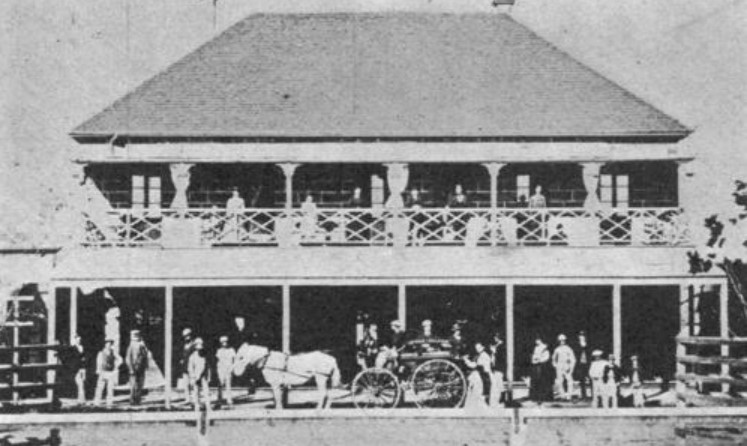
I need not here point out the evil that has attended Larrikinism in the southern colonies; that is or ought to be well known to the authorities. But I would state boldly that it is the duty of the police to put down anything like rude behaviour in the streets and the congregation of a lot of youths at street corners who don’t seem to have any other object than that of insulting people and assailing passers by with vulgar and obscene language. Trusting that this will have the effect of directing the attention of the police to the nuisance, I remain, Yours truly. TAXPAYER.
Larrikins had truly penetrated the entire Colony, infiltrating doorways, church pews, post office precincts and benches in the Botanical Gardens. What would the following years bring?
Sources:
- Gympie Times and Mary River Mining Gazette (Qld. : 1868 – 1919), Wednesday 18 April 1871, Saturday 6 July 1872
- Maryborough Chronicle, Wide Bay and Burnett Advertiser (Qld. : 1860 – 1947) Tuesday 6 October 1874
- Queensland Times, Ipswich Herald and General Advertiser (Qld. : 1861 – 1908), Saturday 17 August 1872, page 3
- Rockhampton Bulletin and Central Queensland Advertiser (Qld. : 1871-1878) Thursday 04 May 1871
- Telegraph (Brisbane, Qld. : 1872 – 1947) Saturday 27 December 1873, page 2, Wednesday 4 March 1874, page 2
- The Brisbane Courier (Qld. : 1864 – 1933) Saturday 13 May 1871, Tuesday 01 August 1871, Monday 17 February 1873, Friday 5 December 1873, Thursday 26 February 1874, Tuesday 16 June 1874, page 3
- Warwick Examiner and Times (Qld. : 1867 – 1919), Saturday 10 July 1875, page 2
Images: State Library of Queensland, Tripadvisor, Wikipedia, Anglican Parish of Brisbane.
 Moreton Bay and More