
After a lot of exhausting research, there’s nothing quite like a browse through the past as artists viewed it. Here are views from 1840-1870 by artists who include a Royal Navy man, a visiting Aristocrat and an artist and explorer.

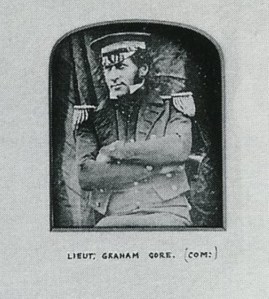
Graham Gore (1808-1847) was a third generation naval officer, who experienced the kind of colourful global career that seemed to be available to 18th century adventurers. He saw action at the Battle of Navarino, sailed on the Terror in its 1836 Arctic exploration, joined the Aden Expedition in 1839 and fought in the Opium Wars in China.
In 1840, he was supposed to join the HMS Herald in Sydney. However, he was unable to join that voyage, and instead travelled to the north of the continent with HMS Beagle. It was on that journey that he painted Burial Reach. He died, along with the rest of the Franklin Expedition in 1847-8.
Incredibly, a picture of him exists, from 1845, and he looks exactly like the kind of swashbuckling man who had fought in China and Greece, explored the Arctic and Yemen, while taking a little time to sail on board HMS Beagle.

This depiction looks like it was painted much earlier than Thomas Baines’s view of South Brisbane, but it was actually produced later. Baines sketched out his work in 1855, completing the painting in 1868, but there appear to be more buildings in 1855 than 1864. All in the interpretation I suppose. The buildings do look more substantial in Stanley’s watercolour, but the scenery is not as detailed in its execution.
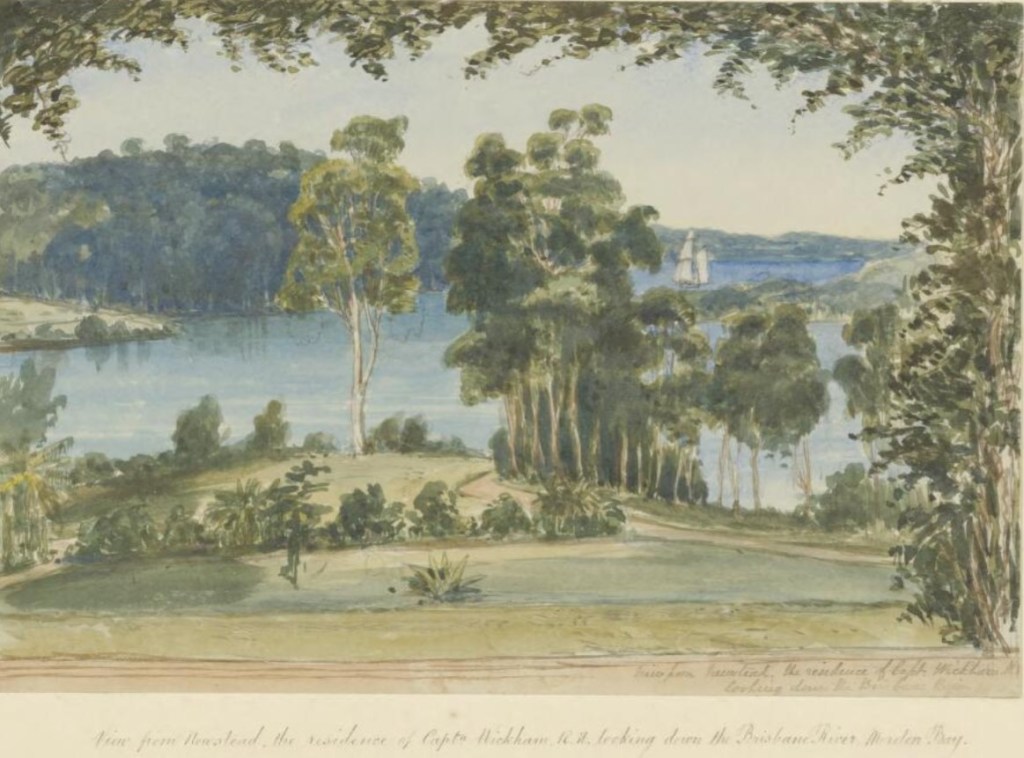
Henry John Douglas-Scott-Montagu, 1st Baron Montagu of Beaulieu (1832-1905) – what an exhausting name. He became a politician in his native England, but when he was a young man, afflicted with asthma, he travelled to warm British dependencies and sketched. On a visit to Moreton Bay, he – naturally – stayed with Captain John Wickham, RN, and sketched and painted his surroundings.
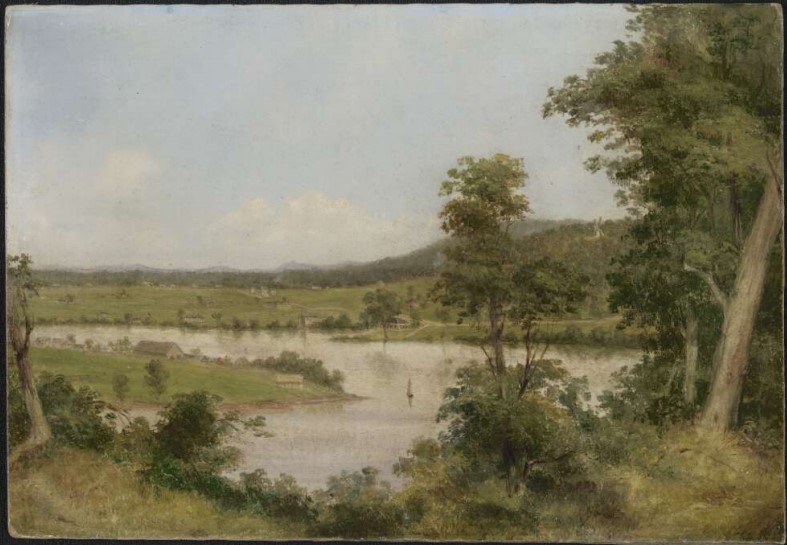
This artist has captured the grey-green hills, slowly flowing river and bushland perfectly.

There’s a lot to unpack in this painting. The ship docked at South Brisbane, and a steamer approaching. The early buildings on that side of the river. The cleared area at South Brisbane ends abruptly, reminding the viewer that colonial Brisbane was close to the bush.
A rowboat is crossing the river, which is glassy blue. In the foreground is the slope down to the Brisbane River on the north bank. A rough road, traversed by a bullock cart, pedestrians and horseback riders. Homes and buildings on the river bank. A spectacularly winding fence or two. Banana trees in the yards.
An indigenous man in the foreground, sitting alone. Two indigenous people behind him, one with spears resting on their shoulder. A couple of well-dressed white children calling at a gunyah.
In the early days of European habitation, there were parts of town where the indigenous people did live close by white areas, and not always in conflict. However, fundamental misunderstandings led to conflict. The Europeans never understood that they were in occupation of indigenous lands. The indigenous people had no interest in adopting ridiculous European ways, like clothing and office work. They were bound to clash.
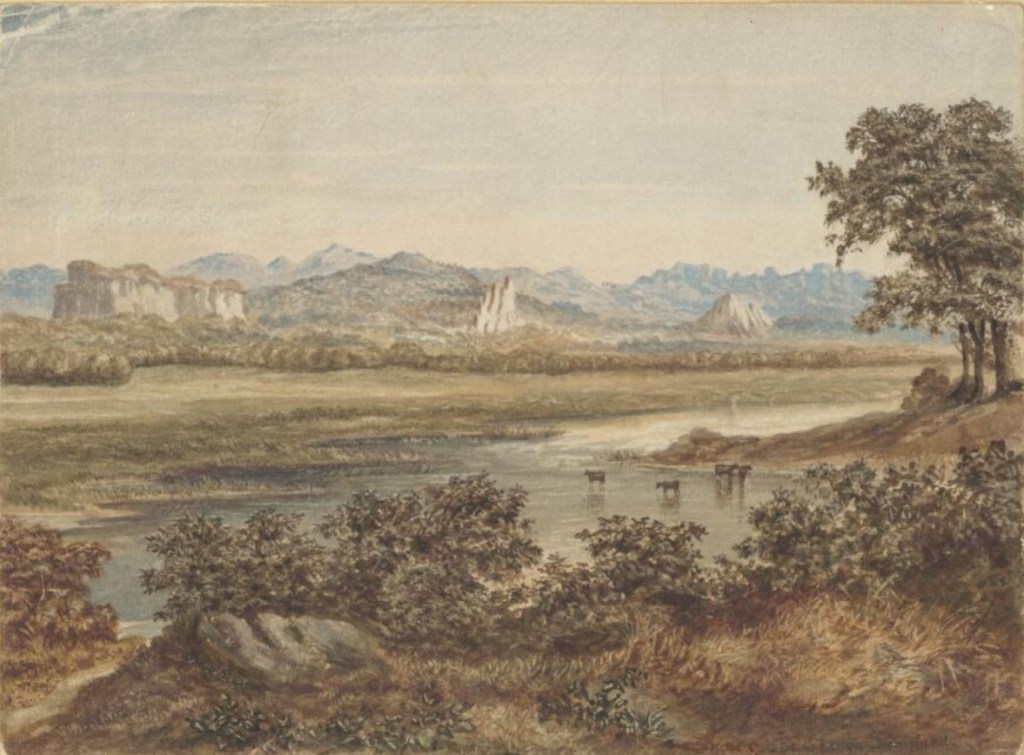
Distant ranges, a river, cattle wandering in the shallows. Not a building in sight. This was not going to last.
All works are in the collections of the Australian National Library and the State Library of Queensland.
 Moreton Bay and More