
A surprising discovery in Brisbane in the late 1840s.
The great Australian tradition of drinking one’s wages arrived at Moreton Bay with the Europeans in 1824. Soldiers and public servants at the settlement had cellars, and enterprising convicts could sometimes lay their hands on some of their contents. Free settlement meant liquor licenses, public drinking establishments and wages to spend on same.
Weary timber cutters and shearers could come into town, divest themselves of the fruits of their labours, and enjoy a quiet refreshment and exchange of philosophical views in the elegant surroundings of the Bush Commercial Inn and/or the Sawyer’s Arms.
Naturally some of these bons vivants occasionally encountered a hostile constabulary, and in one case, an incredulous Bench.
A teetotaler who drank nothing but ale
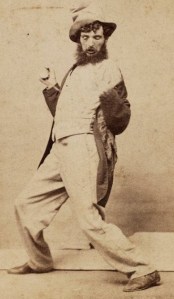
William Williams was brought up by Constable Conroy, on a charge of having been drunk and disorderly in the streets of Brisbane, at about eleven o’clock on the previous night. It appeared by the evidence of the constable that Williams took a fancy to amuse himself by hammering at the doors of Mr. Taggart’s’ establishment; and then, by way of a change, rushing across the street and repeating the operation at the expense of Mr. Poole’s quiet.
On being remonstrated with, the prisoner asserted that he was perfectly in order, and seemed highly indignant that he should be interfered with. When called upon for his defence, Williams denied that he had ever been drunk for the last sixteen years, having during the whole of that period drunk nothing but beer; and he seemed to be greatly astonished at the supposition that tipple of that description could make him drunk. The prisoner, it being his second appearance on this stage, was sentenced to pay a fine of ten shillings, or go to the lock-up for twenty-four-hours.
Suffering the liquid enemy to steal away his brains
Henry Owen was convicted, for the sixth time within as many months, of having suffered the liquid enemy to steal away his brains. The Bench, after a severe censure from the Police Magistrate, ordered the prisoner to pay 20s., with the costs of the information; but being unable to pay the money, Owen was sentenced to be confined in the cells, on bread and water, until eight ‘o’clock on Monday morning.
As the prisoner was under engagement to proceed to the interior, and the principal object of punishment is prevention, the Magistrates took a wise and merciful course- in not sending the besotted young man to the House of Correction, as they might have done.
How’s that non-drinking going, Mr Williams?

William Williams, the great ale-drinker who figured at this Court last week, was charged by Constable M’Guire with having, obstructed him in the execution of his duty on the previous evening, at South Brisbane. According to the evidence of the witness, corroborated by that of Constable Walker, it appeared that the prisoner had interfered to prevent the apprehension of Owen, and had protested against his incarceration as an infringement of the rights of a British subject. His conduct had been so troublesome that he was taken into custody.
On cross-examination, the Constables gave the prisoner an excellent character for general disorderly conduct; and insinuated that certain of the inhabitants of South Brisbane attributed the rapid disappearance of cabbages and other valuable esculents from their gardens to the activity of his agency. Williams, in defence, made light of the whole matter; declared that the evidence was not worth a fig in a legal point of view, and was fined forty shillings, to be levied by distress upon his goods and chattels. Having confessed his innocence of worldly clogs of that description, the prisoner was sentenced to one months’ imprisonment in Sydney Gaol.
Blame the drink
Inquest. – A coroner’s inquest was held at Ipswich on the 24th instant, on view of the body of James Welch, who had died on the day previous, from the effects of intemperance in the use of intoxicating liquors. The jury returned a verdict to the effect that the deceased’s death had been accelerated by drunkenness.
James Welch had been found dead in the Caledonian Hotel in Ipswich, after quite a lengthy drinking holiday, so the verdict was unsurprising. The publican, however, did not care for the verdict.
Don’t blame the publican
[ADVERTISEMENT.]
To the Editor of the Moreton Bay Courier.
SIR. – It is a duty which I consider due to a class of men, far more sinned against than sinning, I mean the licensed victuallers, to inform them of an opinion expressed by Dr. Ballow, the Coroner of this District, on the occasion of an inquest held here on the body of James Welch. The particulars of the case I need not recapitulate, as no doubt it will be given by your correspondent in this week’s report, although he declines taking notice of the subject of my present communication, that is, the severe reprimand which I received from the Coroner for not having sent sooner than I did for a “regular medical practitioner” for the deceased, the Doctor also stating that I was liable to lose my license for not having done so.
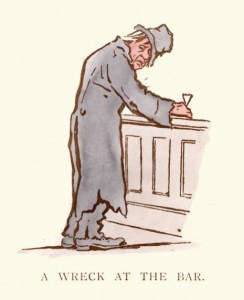
With all due deference to his Worship, I most decidedly dissent from this opinion, for the simple reason that not being a medical practitioner, either regular or irregular, it was impossible for me to judge from the man’s appearance that the state of his health was such as to cause his death so quickly; as it is well known that bushmen on first arrival in town generally drink to excess, the result of which is in many cases delirium tremens; now were I or any other publican to send for medical attendance in all cases of this kind, from what fund are we to be repaid? – or what clause in the Act do we commit a breach of in not doing so ?- at the same time I can firmly assert that not one of, us as a body but would, for the sake of humanity, readily pay out of our own pockets for professional advice whenever anything serious was apprehended.
It is well known that delirium seldom sets in until all the cash is spent, without any regard to the future; this was the fact in the case of Welch, commonly called “Foig-a-ballogh,” who, while on the “spree,” although only five days in my house, felling himself a little indisposed, was asked by a party, whose name if necessary I can mention, why he did not go to Dr. Dorsey, his reply that “the Doctor’s charge would be too much, and that he was sure he could do very well without him.’ As I had seen so many instances of illness of this kind in which the medical men invariably gave spirits in small quantities to the patient, I gave Welch for this simple reason half a glass the evening before he died; but this was when, unassisted, he walked into the bar, and had nothing whatever in his appearance to denote the near approach of death; besides which the evidence of Dr. Dorsey went to show that the disease had existed a length of time, and that Welch ought to have had medical treatment months past : why therefore, did not the Coroner pass a vote of censure on the parties whose employ the deceased had just left?
After this explanation, I feel confident that your readers will coincide with me in my view of the case; but if we poor devils of publicans are, after paying a heavy licence, high rent, and the keeping up of such an establishment as the Act requires, to have our conduct – which is guided by common sense and prudence, as well as humanity when required – animadverted upon publicly, and our licenses threatened by every official who chooses to form an erroneous opinion for want of local knowledge, the sooner we shut up our houses the better. Had I thought for a moment (even supposing me actuated by selfish motives) that by employing a medical man Welch’s life would have been saved, it would have been far better for my interest to do so rather than incur the expenses of his interment.
I am, Sir, Your obedient servant.
THOMAS MOORE, Caledonian Hotel Ipswich, 26th January 1849.
*Faugh a Ballagh (clear the way – battle cry of Irish origin) from the Gaelic Fág an Bealach or Fág a Bealach.
A puzzling question
In a case of drunkenness which was brought before the Police Bench last week, one of the Magistrates, addressing the Chief Constable, inquired with much simplicity-“Was the prisoner, ever drunk before? “The Chief looked at first puzzled, then doubtful, and finally, with a negatory shake of the head, “gave it up,” and reluctantly confessed his inability to answer the question.
I’m with the Chief Constable here. Was the prisoner ever drunk before? The Chief Constable hadn’t been in the defendant’s house, or known him all his life, so he couldn’t possibly answer that question. If, however, the Bench had asked whether the defendant had been arrested for being drunk, well, that he could answer with just a flick-through of his charge-books.
Moreton Bay Courier (Brisbane, Qld. : 1846 – 1861), Saturday 20 January 1849, page 2.
Moreton Bay Courier (Brisbane, Qld. : 1846 – 1861), Saturday 27 January 1849, page 3
 Moreton Bay and More