
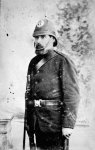
Policing in the early days at Moreton Bay had its challenges. There were hundreds of convicted criminals about – former convicts on tickets of leave and in indentured service. The free men and women of the town tried to foster a sort of civic pride and dignity, but their efforts were undermined by an itinerant population of sawyers, shepherds and bullock-drivers who tended to prefer the atmosphere of the Bush Commercial Hotel to that of Wesleyan Methodist meetings.
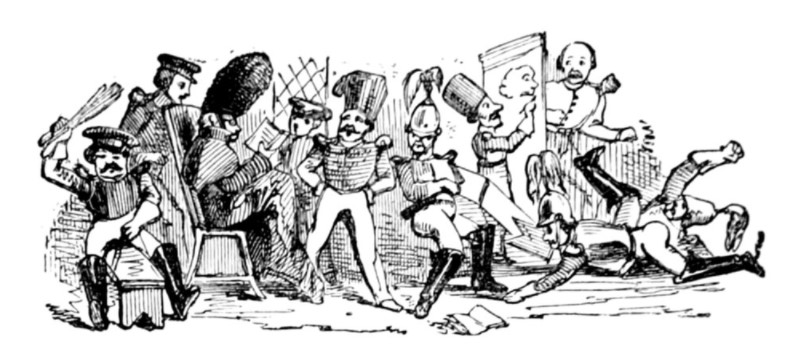
The 99th Regiment was still stationed in Brisbane, blurring the lines of authority. The few constables in town had a lock-up and lodgings, some very uncomfortable uniforms (designed, naturally, for the conditions in England), and what appears to have been little training or direction.
There were serious crimes to investigate (the Kangaroo Point murder, for one), but on the whole, it was hauling drunks to the lock-up, and separating squabbling neighbours. Although one suspects that it was the professionalism of Captain Wickham, Dr Ballow, Dr Simpson and others who made up for the shortcomings of the local plod when dealing with inquests and murder cases.
An early example of the talents of the force was this fearless bit of investigation:
ROBBERY.—On Thursday night, last week, an out-building adjoining the stores of Mr. Hampden in South Brisbane was entered by some dishonest person. Fortunately it was empty, and the fellow found nothing portable but the window sash, which he carried off. One of the aborigines was put on the track early in the following morning, but as the footsteps led to a cottage occupied by a person in a respectable station of life, no further attempt was made to recover the stolen property.
Moreton Bay Courier, 27 June 1846
If the footsteps had led to the door of a cottage occupied by someone of a less respectable nature, one presumes that the police would have felt empowered to continue their investigation.
Policing in Brisbane and Ipswich in the 1840s was marked by scandal, incompetence and constantly-changing personnel. In fact, Ipswich District Constables rarely had the chance to unpack.
The Revolving Door
First to go was the Ipswich District Constable Higgins. In September 1846, he was charged by Mr George Furber for assault and general misconduct. The Court found Higgins guilty, and that he had been drinking at a public house “at unseasonable hours.” Higgins was fined £2 and dismissed from the force.
The following month, Higgins’ replacement, District Constable McCrohon was dismissed in sensational, and highly disputed, circumstances.
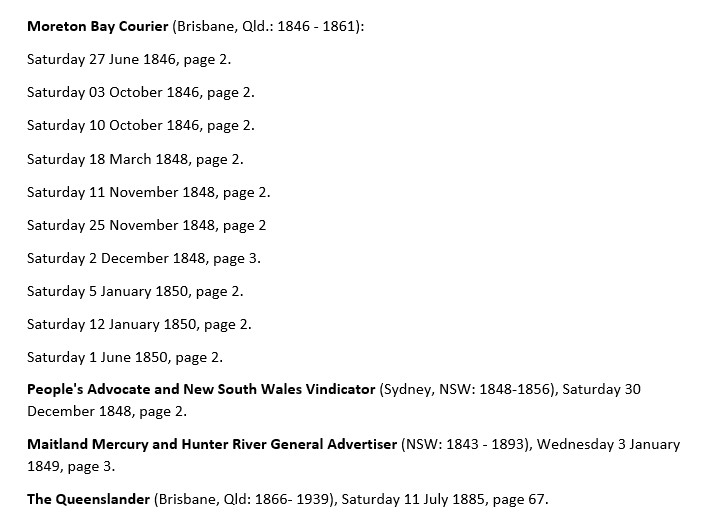
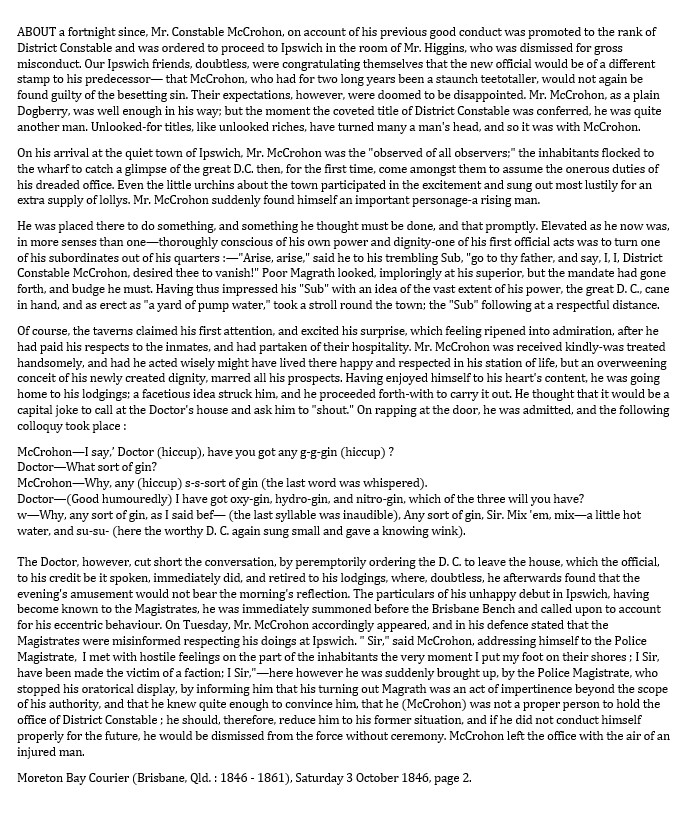
It seems that McCrohon, who had hitherto enjoyed an excellent reputation and was a teetotaler, arrived in Ipswich and met with hostility. He was accused of high-handedly turning one of his Constables out of his rooms, and of becoming drunk and pestering Dr Dorsey for a drink. This was reported to the Brisbane Magistrates, who ordered McCrohon to attend and answer to his behaviour. The Moreton Bay Courier reported all of this in exceedingly colourful prose. (Appendix 1)
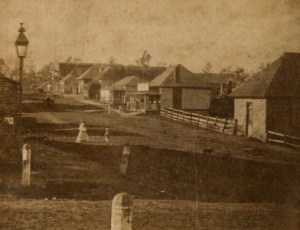
DC McCrohon attempted to explain himself by stating that he had been the victim of idle gossip and a faction that was set against him. The Bench rescinded his appointment as District Constable, and he was returned to ordinary police work.
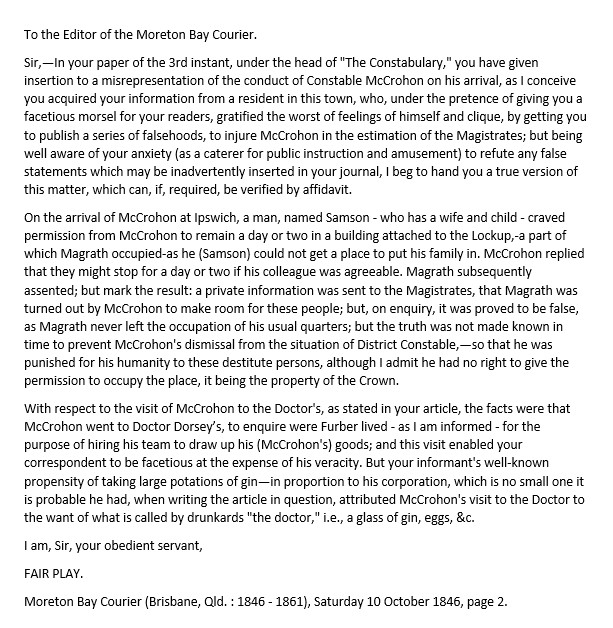
The following week, a different story was provided to the Courier. “Fair Play” wrote that McCrohon had indeed incurred the wrath of a local identity, one who had complained to the Bench, and maliciously briefed the Courier. (Appendix 2)
“Fair Play” wrote that McCrohon had allowed a man named Samson to stay a day or two in the part of the station occupied by Constable Magrath, provided Magrath was agreeable. He seemed to be, and indeed had not been turned out at all by the District Constable.
McCrohon’s visit to Dr Dorsey, “Fair Play” contended, was to ask for the address of Mr Furber, whom he intended to hire to cart his possessions to Ipswich. “Fair Play” was willing to verify these claims by affidavit for the Courier’s readers. However, DC McCrohon had already been demoted and removed from Ipswich, and the claim went no further.
In November 1848, the Ipswich police were in trouble on two fronts. The first involved the seemingly never-ending complaints about the Chief Constable, the second involved a profound lack of judgement on the part of his underlings.
The successor to Higgins and McCrohon was District Constable Moore. He had managed to stay employed in that position for two years before facing his first complaint. The complainant in this instance was Mr George Thorne, and his charges were abusive language towards his good lady wife, and laying a “malicious information” against his brother-in-law, a local publican.
The Magistrates heard the case in a closed court and dismissed both charges.
“The case excited considerable interest, and, on its result being made known, there was an evident manifestation of pleasure. A similar feeling – to his credit be it spoken-was evinced by the complainant.”
The Courier
Disgraceful Conduct
Barely a fortnight after retaining his job, Moore was tasked with investigating what on earth his constables, Connor and Foley, thought they were doing, getting drunk with three accused murderers in their custody. Furthermore, what said constables were doing spending money tendered as evidence in the case.
The murder charges resulted from a disagreement between two men at Canning Downs, which in turn resulted in a £5 per side fight, and the death of one John Doyle. William Hardcastle was charged with murder, and two men who had acted as seconds, William Kirby and James Short, with aiding and abetting. At Ipswich, they were committed to take their trial at Sydney for murder. But first they had to be brought to Brisbane, and then by steamer to Sydney.
Constables Connor and Foley were tasked with escorting the prisoners to Brisbane, together with a package containing £25, sealed by the District Constable.
On their arrival at the Brisbane watchhouse, all parties appeared to be drunk. So drunk, in fact, that the prisoner William Hardcastle could not stand. The package containing the £25 had been opened, and, on searching the prisoners, the amount remaining was £19 10s. Constable Connor then found it necessary to go out in the street and have a little sleep.
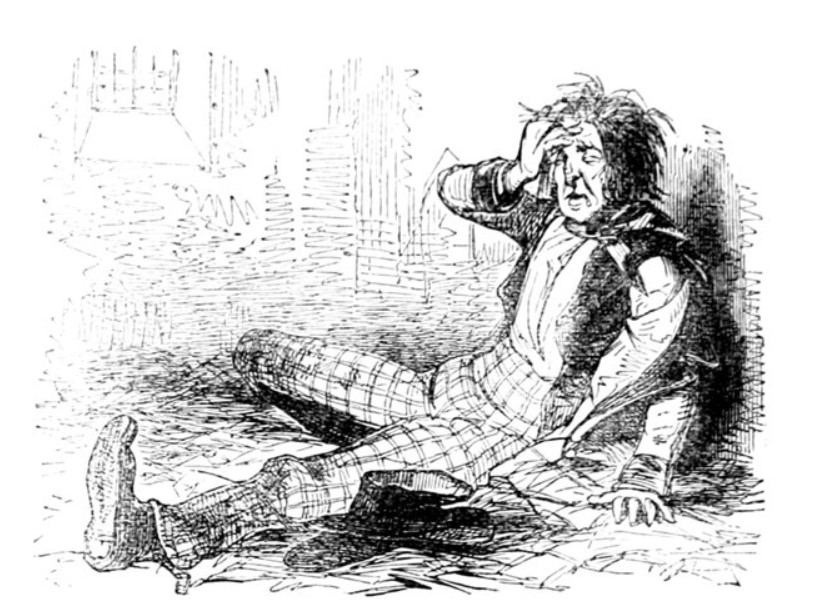
Captain Wickham examined the miserable creatures the following morning, and a sorry tale unraveled. Constable Foley claimed that the Ipswich Bench had permitted the prisoners to choose to take a steamer to Brisbane at their own expense, rather than walk the journey of 54 kilometres, which would have taken at least a day.
Wickham found the idea of prisoners being permitted to choose their mode of transport decidedly unlikely. Constable Conroy, of the Brisbane Police, gave evidence that he saw the two Ipswich officers and their prisoners entering a public house to drink prior to going to the watchhouse. Brisbane’s Chief Constable, William Fitzpatrick, opined that Foley and Connor had conducted themselves disgracefully.
Finding the whole situation deplorable, Wickham sent the constables back to Ipswich for examination, and wrote a letter “in terms of the strongest reprehension” to the Bench there.
Constable Foley, clearly an optimist, stated that they had delivered the prisoners safely to the Brisbane watchhouse, as instructed, and they had very responsibly and dutifully kept everyone’s travel expenses down by allowing the prisoners to dip into the £25. He felt that their hitherto unblemished records would encourage the Bench to be lenient with them. Unsurprisingly, the Bench did not agree, and sacked the pair immediately.
And the accused murderers? In December 1848, the three prisoners were tried in Sydney. The charges had been reduced to manslaughter, and evidence was given that Doyle had been unwell for some time prior to the fight, but had insisted that it take place. Hardcastle had been reluctant to take part. All three men were found not guilty.
The Brisbane police did not fare any better than their Ipswich brethren. In 1850, Acting Chief Constable Murphy reported two of his men to the Police Magistrate for neglect of duty and intoxication.
Unfortunately for Constables Hore and Sparkes, there were witnesses to their intemperance, including Dr Ballow and Tom Dowse. In fact, Sparkes had been drunker than the tosspot he had put in the cells. Both were dismissed.
Chief Constable Fitzpatrick and York’s Hollow
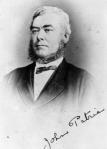
There was an Acting Chief Constable, because William Fitzpatrick had been dismissed after Captain Wickham investigated a shooting in York’s Hollow, involving the indigenous people of Brisbane.
On the night of Wednesday, 28 November 1849, John Petrie was advised that some of his bullocks had gone missing, and that the indigenous people of York’s Hollow were to blame. Petrie and his brothers went to search for the bullocks, while an indigenous friend, Humby, went into town to advise the police.
About 15 minutes into Petrie’s search, he heard shots, and returned to the camp at York’s Hollow to find armed soldiers, who stated that they had fired when on the receiving end of a boomerang. It was thought that no-one had been injured or killed, but several indigenous men attended the hospital in the next days.
Chief Constable Fitzpatrick had stayed at home on the night of the shooting, but had ordered his constables to go to the shooting, and to alert Dr Ballow as the Magistrate. Dr Ballow, when consulted, did not think much of that order.
Although it was a military shooting, and Fitzpatrick had been unwell, Captain Wickham did not think much of his actions either, and recommended that Fitzpatrick be dismissed for neglect of duty. The Colonial Secretary took Captain Wickham’s advice and Fitzgerald was sacked. A trip to Sydney and an appeal in person did not advance his cause.
End of an era
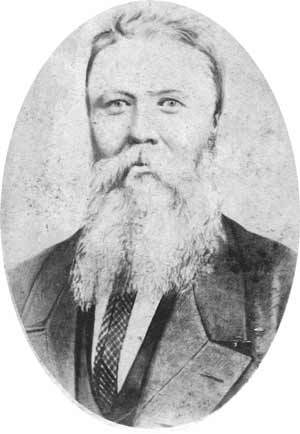
Samuel Sneyd was by this time installed as Chief Constable, and conducted his force with diligence throughout the 1850s, leaving the role to take over as superintendent of the gaol. Sneyd had years of experience, first as a member of the “4th of Kings” regiment in the 1830s, then as a mounted policeman in the Goulburn division, attaining the rank of sergeant-major. He brought that level of professionalism and experience to his work in Brisbane.
Sneyd still had some trouble with his underlings, though. In 1853, Constable James Tredennick was charged by him with neglect of duty for leaving Constable McGuire behind in the bush during a journey to Durandur to apprehend a felon. McGuire did not catch him up as planned, and was later found to have died in a bushfire. But the parade of drunken, inexperienced policemen passing through Brisbane seemed to end with his appointment.
Appendix 1.
Appendix 2.
 Moreton Bay and More
1 Comment