
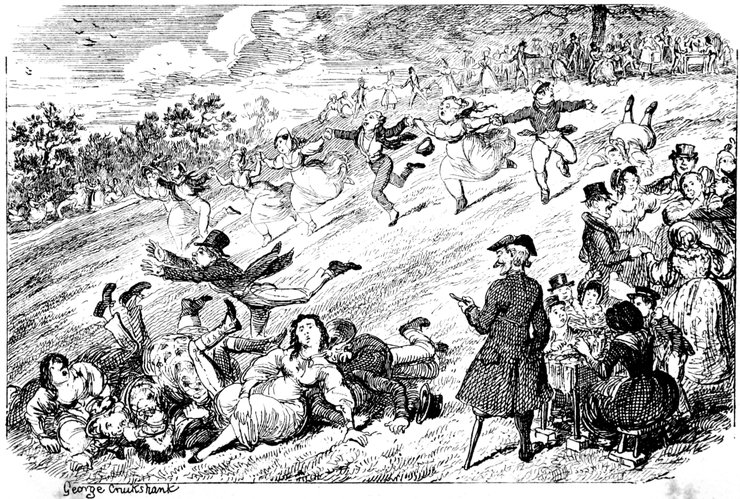
A correspondent in calling our attention to a desperate fight which took place in North Brisbane on Tuesday last, between a soldier and a sawyer, says:- “I counted no less than eight women who were present, looking on with great interest; and one disgrace to her sex was actually cheering and goading the men on by applause, oaths, and shouts! This virago was the wife of one of the combatants.” O tempora, O mores!
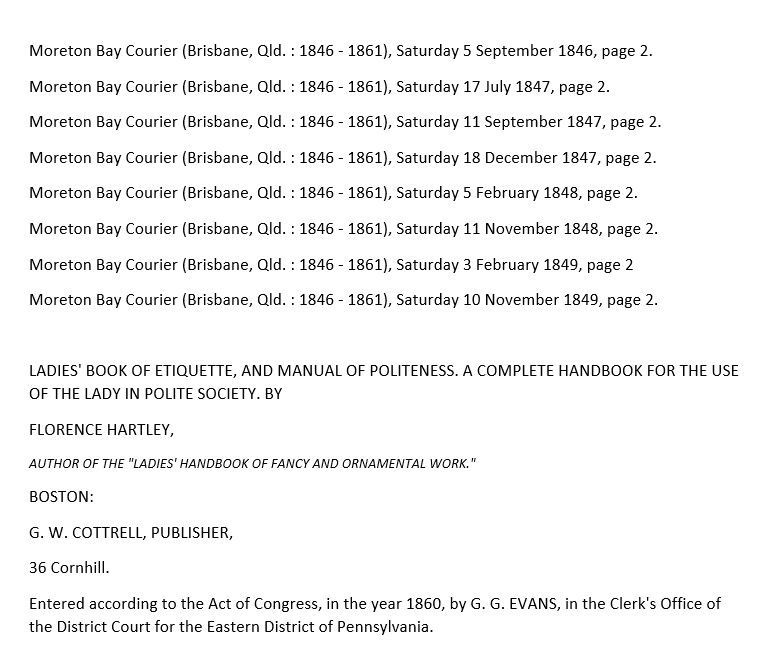
Moreton Bay Courier, 18 December 1847
When men behaved badly or made a drunken spectacle of themselves in public, they were generally an object of mild ridicule. If they assaulted someone, or worse, behaved insolently to their masters, they met with some conventionally-phrased condemnation. In general though, they were portrayed as amusement for the public – colourful Dickensian characters, essentially harmless.
Next appeared, for the same offence, and also drunkenness, a mate of the former defendant, named Thomas Milner, better known as McGouzlem’s fool, a regular Victor Hugo’s “Quasimodo” in ugliness, whose entree created much mirth. He was indeed as ugly as sin, with an obliquity of mug truly remarkable, and lips that would rival any Hottentot Venus, beard of at least a week’s growth, manured by a portion of some puddle which his phiz often appears to fondle, and hair of “mud coloured grey,” standing out like quills upon the fretful porcupine. Fancy all this, and you have my “Caliban.”
The subject matter in dispute will be seen by the following colloquy between Bench and defendant. Bench – Were you drunk? Defendant-Oh! yes. Bench-How much did you drink? Defendant (grinning most ominously) Until I got drunk. Bench-Had you no water to wash your face? Defendant (another grin) I forgot the water while I drank the rum. During this short confab the cachinnatory muscles of the auditors were exercised to an unusual degree; even the stern front of justice was compelled to relax, which was perhaps so much in favour of McGouzlem’s fool, that he was only admonished as to the present working of the Vagrant Act, and fined five bob.
In other words, the Magistrates were compelled to laugh and let the fool go with a slap on the (no doubt quite grubby) wrist.
Moreton Bay Courier,10 December 1849
When women drank to excess, raised their voices, or behaved in a disorderly way, their treatment by the Bench and the press was less indulgent. Even their descriptions of the women are pejorative. The standards of behaviour these settlers’ wives and immigrant servants were being held up to were quite exacting, as described in great seriousness by one Florence Hartley in “The Ladies’ Book of Etiquette, and Manual of Politeness.”
Here are some examples of how our Moreton Bay ladies failed to embody the ideals of feminine loveliness, together with Florence’s suggestions on conduct in similar situations.
Cases
Indecent Conduct:
Not named: “the filthy creature,” “this disgrace to her sex.” Admittedly it’s still illegal, and very much frowned upon, to get one’s freak on in a public place; however the man involved was described in infinitely more forgiving terms.
The difficulties and trials of life have only just begun when a young lady fancies herself to be of sufficient importance to become the theme of animadversion. She knows little of the true importance of self-control, until she experiences the first indications of preference shown her by the other sex.
Abusive Language:
Not named: “a vixenish-looking woman, with a child in her arms.”
Avoid exclamations; they are in excessively bad taste, and are apt to be vulgar words. A lady may express as much polite surprise or concern by a few simple, earnest words, or in her manner, as she can by exclaiming “Good gracious!” “Mercy!” or “Dear me!”
Ann McIntyre: “a woman of dissipated appearance” whose conduct was “disgraceful.”
Loud talking and laughing in the street are excessively vulgar. Not only this, but they expose a lady to the most severe misconstruction. Let your conduct be modest and quiet.
Mary Conlon: “annoying and disgusting,” she was sent to gaol in Sydney with Margaret Keys, “an animal of the same species.” “By the departure of these two graces, the district has experienced a loss which it is very well able to put up with.”
A lady’s conduct is never so entirely at the mercy of critics, because never so public, as when she is in the street. Her dress, carriage, walk, will all be exposed to notice; every passer-by will look at her, if it is only for one glance; every unladylike action will be marked; and in no position will a dignified, lady-like deportment be more certain to command respect.
Intoxication:
Katherine King: “found lying in the road in broad daylight, in a state of intoxication.”
Avoid lounging attitudes, they are indelicate, except in your own private apartment. Nothing but ill health will excuse them before company, and a lady had better keep her room if she is too feeble to sit up in the drawing-room.
Ann Simpson: “an abandoned woman” in “a beastly state of intoxication.”
No lady should drink wine at dinner. Even if her head is strong enough to bear it, she will find her cheeks, soon after the indulgence, flushed, hot, and uncomfortable; and if the room is warm, and the dinner a long one, she will probably pay the penalty of her folly, by having a headache all the evening.
Mary Ann Williams: “looking about as wholesome as a Tartar with the scurvy.”
You need not fear to offend by refusing to take wine with a gentleman, even your host. If you decline gracefully, he will appreciate the delicacy which makes you refuse. If, however, you have no conscientious scruples, and are invited to take wine, bow, and merely raise the glass to your lips, then set it down again. You may thus acknowledge the courtesy, and yet avoid actually drinking the wine.
Mary Broom: “a melancholy and disgusting example of habitual drunkenness.”
Be careful not to be alone in the streets after night fall. It exposes you to insult. If you are obliged to go out, have a servant, or another lady, if you cannot procure the escort of a gentleman, which is, of course, the best.
Florence Hartley had one golden rule to observe in the pursuit of good manners.
If you wish to be a well-bred lady, you must carry your good manners everywhere with you. It is not a thing that can be laid aside and put on at pleasure. True politeness is uniform disinterestedness in trifles, accompanied by the calm self-possession which belongs to a noble simplicity of purpose; and this must be the effect of a Christian spirit running through all you do, or say, or think; and, unless you cultivate it and exercise it, upon all occasions and towards all persons, it will never be a part of yourself.
Sound advice for any woman carving out a life in (at best) a rough-hewn settler’s hut in Brisbane in the 1840s on a diet of salt beef, with no form of entertainment beyond the Sunday sermon. How could one ever turn to drink, or use salty language as the fumes from the boiling-down works drifted through the humid air, and one’s husband trundled home from a day of manual labour, reeking of rum?
 Moreton Bay and More