
The Free Settlement Edition.
The Brisbane Riot. Kind of.
On the night of the 2nd October 1849, a riot took place in Queen Street in Brisbane. At least, it was kind of a riot. A group of a dozen rather drunk men assembled noisily in Queen Street at about 11 pm. The Chief Constable, with two ordinary constables as back-up, ordered the drunks to go home and sleep it off. They dispersed.
The minute the lamps were lowered in the Chief Constable’s office, six of the men armed themselves with bludgeons and re-grouped, ready for trouble. Their leader, a man named James Hudson, ordered them to march two deep, and prepare for trouble.

Normally, a group of men armed with bludgeons, walking two deep through town would be very alarming. What the rioting six proceeded to do was – wait for it – bang their bludgeons on a few householders’ doors. Having exhausted the supply of doors to knock on (Brisbane was a very small town, after all), the men went to the Government Garden road, and lit a bonfire.
The Police, their sleep murdered a second time, felt that six drunks lolling about a campfire was too much for just the North Brisbane law enforcement contingent, and a signal was sent to Kangaroo Point for more men.
Suitably reinforced, the Police gained control of the situation and arrested the three rioters who had bothered to hang about. Warrants were issued for James Hudson and one other man, who were apprehended the following morning.
The Bench, namely Captain Wickham, who had the good sense to reside far out of town in Newstead, and who’d thus avoided having his door knocked on by ruffians, gave the offenders good behaviour bonds.
A Wolf in Lamb’s Clothing.

This tale of historical cross-dressing is best told in the words of the reporter.
“On Saturday last a man named William Pittman thought fit to exhibit himself in female attire, in Queen Street. It was a singular fancy on his part, for he cut anything but a graceful figure.
“His proportions not being pleasant to the eye of the chief constable, who is a bit of a connoisseur in that way, William was lodged in the watch-house, on a charge of drunkenness. On being brought before the Bench on Monday, he was admonished and discharged.” Moreton Bay Courier, Saturday 26 May 1849.
The Queen’s Birthday, 1849-style.
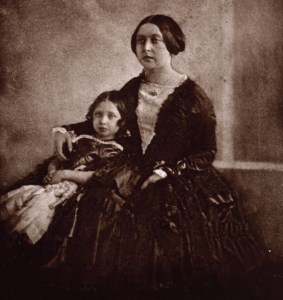
The Queen in question was Victoria Regina, then aged 30. She had packed a lot into her first 30 years – she had been Queen for 12 years, had six babies, and had survived an assassination attempt. It was only right that her birthday be celebrated in style by her loyal subjects in the far-flung dominion of Moreton Bay.
Rather than have a public holiday on a random date that was not her birthday (the modern custom), Brisbane celebrated with loyal displays. There were fireworks lit – causing three people to be fined 10s. each by a humourless and unpatriotic constabulary.
In the Bay, the ships the Chaseley and the Eleanor were decked out in fine patriotic bunting and fired a patriotic salute.
In South Brisbane, Hocking’s store was decked out with a crown, star, and VR “in variegated lamps” – something not seen in Moreton Bay before.
Then there was Her Majesty’s loyal 11th Regiment, which had a detachment stationed in Moreton Bay. Traditionally, a feu-de-joie would be fired in honour of the birthday of the beloved Sovereign. This consisted of officers firing blank rounds in rapid succession, creating a striking rat-tat-tat sound.
Except that at Brisbane they didn’t. They wanted to, but some dunderhead supplied them with ball cartridges, meaning that any firing would have been highly hazardous to onlookers, and ruining the rat-tat-tat effect entirely.
Happy birthday, Your Majesty. At least the lanterns and ships looked good.
Moreton Bay Courier (Brisbane, Qld. : 1846 – 1861),
Saturday 26 May 1849,
Saturday 6 October 1849.
 Moreton Bay and More