
George Jean de Winton had a long and distinguished career in Her Majesty’s 99th Regiment, and many years of it were spent in Australia and New Zealand. He was stationed in Van Diemen’s Land, Sydney, Port Macquarie, Norfolk Island and Moreton Bay. His memoirs (out of copyright and now online), show a man of good humour, intelligence and spirit. Where others might have written a long, self-pitying account of being posted to one-horse towns in brutal climates, de Winton finds friends and allies along his way, and greets every new adventure with curiosity and zest. Here is the Moreton Bay chapter, with illustrations, and biographical details of the characters he met along the way.

An officer of the 99th, 1850s 
CHAPTER XV. BRISBANE (MORETON BAY)
My next detachment was Brisbane, relieving Lieut. Blamire, who afterwards commanded the 99th. The command of the Brisbane detachment, the most distant from headquarters, was a post of considerable responsibility, the more as the officer in command was always nominated as a magistrate, there being in those days no residents on whom the office might well be conferred; the community, besides Government officers, consisting of storekeepers, publicans, and artisans. The date in this instance I am able to fix with exactitude, as I have fortunately preserved a copy of the Government Gazette of New South Wales, dated June 22, 1847, notifying my appointment as a magistrate of the territory and its dependencies.
Incidentally I may here mention that in January 1847 I was made a Mason, so that in this year of grace 1897 I may fairly claim to be one of the oldest of Australia’s magistrates and masons.
Brisbane Town
The only substantial buildings in Brisbane in my time there were the barracks, the officers, the courthouse, and gaol, the remainder being weatherboard structures. The town was a long straggling street, and the buildings jotted down apparently indiscriminately, or at the sweet will of the early settlers.

Brisbane was first occupied in 1824, the year of my birth, as a convict settlement, but had ceased to be so in 1843, and the only remnants of the convict regime were a few time-expired men who were employed about the barracks and the courthouse. As evidence of our primitive state, our water supply was from a waterhole[i] in which the blacks occasionally bathed. An ex-convict filled a cask with water, and this he carted around the settlement to supply our water-casks. We had no gas, there was no bank, the only coin was that sent me from time to time to pay my men, the currency being individual orders on the storekeepers or publicans.

We had a church memorable to me for the fact that I was there married. Some attempt had been made at a mission for the conversion of the natives, but the worthy pastor confessed that this had been a hopeless failure. The strength of the detachment was, I think, fifty rank and file, and the duties were light, there being nothing to keep guard over, save the barracks and the gaol, the last places to suffer attack. A year or so before my time, there was a sergeant’s guard at some twenty miles distance to protect the drays at a spot which was selected by the natives as a point of attack, but the scrub having been cleared away and some severe lessons imparted[ii], the guard was no longer deemed necessary.
Bench Duties

The magisterial duties devolving upon the officer were not onerous, as his services were only required in the temporary absence of the police magistrate, who dealt with minor offences. We had a useful little book called the “Australian Magistrate,” with the somewhat chaffy[iii] motto: Si quid novisti recitus istis, candidus imperti; si non, his utere mecum,[iv] which was my vade mecum.[v] Any deficiencies the police magistrate’s experience supplied. The police magistrate was Captain Wickham, RN, who had been a brother officer of Darwin in the “Beagle,” and it is something to recall having been associated so closely with one who shared the labours of Darwin, who revolutionised the theories of foregone centuries, and whose teachings now hold sway throughout the intellectual world. We had two lawyers in our little community, and each, it was said, made a good living, though it was facetiously asserted that before the second lawyer came, number one could not make a living. It often surprised me when one of the lawyers appeared in court to defend a client, in a case which admitted of no possible doubt, and the old Irish story would occur to me when the accused asked for a remand till the morrow as he had a lawyer coming. “But what can the lawyer say?” “Bedad, that’s just what I want to know.”
Occasions there were when some jolly squatters would visit the settlement, and after an evening at “Bows,” the principal inn, would sally forth for a spree and end by being brought before the bench in the morning. I well recollect such a case when I was alone on the bench, and had, of course, to express my regret at seeing gentlemen under such circumstances; but my duty being to administer justice to all alike, I imposed the usual penalty with the usual alternative. If archives of the time are preserved, a memorable case, in which, I regret to say, some of my men were concerned, will probably find therein a record. The incident was the old one, the teterrima causa belli,[vi] and the context between some squatters and men of the detachment.[vii] The local print gave it in Homeric verse. Here are the opening lines:
Bold Hawkins’ arm to Faulkner direful spring,
Of blows un-number’d Brisbane muses sing.
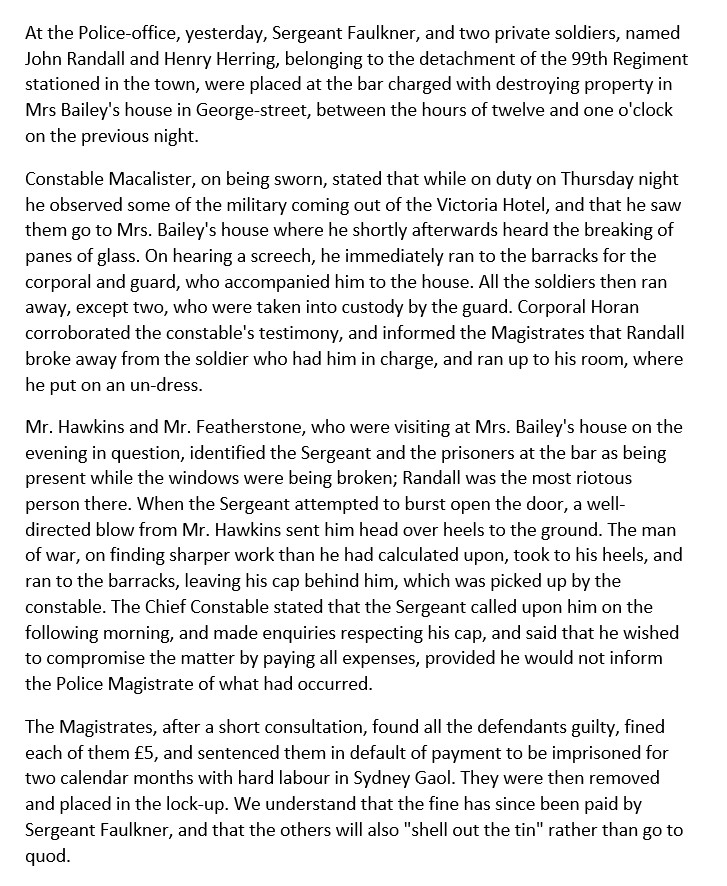
(The incident refers to the night some of his men visited a Mrs Bailey, who must have been something like a courtesan, given her gracious dwelling, silk crinolines and fabulously stocked cellar. Mr Bailey was conspicuously absent during her brief and eventful time in Brisbane Town. The following are two accounts of the evening’s high jinks.)

Economy and Business
It was in my time that the first boiling-down establishment was set up in Brisbane. The cattle were boiled down for tallow only, and the meat thrown away or put on the land for manure. Ox tongues and tails might be had for asking, and here I may mention that at the first boiling-down establishment set up on the Hunter river, the proprietor was quite satisfied with a return of £2 a head per beast, for tallow, hide, hoofs, and horns.
The contention of Malthus and his school that population tends to increase more rapidly than the means of subsistence could hardly find support in face of the state of things that existed in my time in Australia, nor, indeed, at the present time, when all efforts to keep down the increasing number of rabbits seem to prove futile. The fact is that the earth yields food greatly in excess of the requirements of its population, and to man’s intelligence it belongs to adjust excess in one quarter to deficiency in another. In the year 1875, invited to preside in London in connection with a project for the importation of cattle from Texas, I ventured to predict that in a few years inventive genius would enable us to bring the plenty of Australia to the hungry at home, a prediction amply verified today. About the same time, when the subject of importing mutton from New Zealand was mooted, I was assured by a then great authority that it would be impossible to conduct such a trade at a profit. The millions of carcasses of sheep yearly imported from New Zealand conclusively prove that the trade is not done at a loss. To the pioneer of Australian meat importation, Daniel Tallerman, history will do justice. An infinitesimal fraction of the savings of our butchers’ bills, presented to him, would make him a millionaire, but he shares the fate of many pioneers of great movements, and others reap where he has sown.
It was at the time of the Irish famine that I was at Moreton Bay and contrasting the state of the labouring classes in the two countries, I addressed a letter to the “London Morning Herald,” giving a table of the wages and rations then ruling in New South Wales. This letter, a copy of which is before me as I write, dated July 10, 1847, was published in the “Morning Herald” on December 22. This may serve to indicate how long it then took to communicate with England. I learned later that the letter was widely quoted and led many to try their fortunes in the land of promise. In 1848 a batch of assisted emigrants arrived at Brisbane, and at once found remunerative employment. On arrival they were housed in rooms over the courthouse, and I recollect visiting them in company with our colonial surgeon, a man of sporting tendencies. Inquiring if they had much shooting in Ireland, one of the emigrants said, “Oh yes, but it be mostly at night-time.” “But what game was it?” said the astonished doctor. “Shure, its agents, your honour,” came the ready reply. Such was the demand then for labour on the stations that shepherds got £1 a week and rations (12 lb. of meat and 10 lb of flour, with tea and sugar), and common day labourers 5 s. a day.

As showing the vicissitudes of fortune in Australia in those days, a gentleman who had a little steamer that used to ply between Brisbane and Ipswich, the head of navigation of the Brisbane river, lost all by the sinking of the little boat. Some three years afterwards I met him in Sydney, and he told me that he had, after losing his steamer, purchased a station with 10,000 sheep from one of the Sydney banks, paying for it in bills renewable, and that he had just taken up the last bill, and the station was his unencumbered.
In many cases stations were mortgaged to the banks for advances, and owing to the dearth of labour, consequent on the cessation of transportation, many stations could not be worked at a profit, and fell into the hands of banks, who were only too glad to place them with those in whom they had confidence. As the ruling rate of discount was ten per cent, these operations brought no small profits to the banks. Our only communication with Sydney was by a bi-monthly steamer. After sending off my returns I would occasionally pay a visit to settlers and squatters. On one occasion, when Wickham and I were on the way to the Darling Downs, we came near being roasted in a bush fire, and only escaped by taking a beeline to the river, and riding, as the French say, ventre a terre[viii].
Stations on the Darling Downs

Hospitality is, or was, the characteristic of the Australian settler and squatter, and pleasant are my reminiscences of visits to stations on the Darling Downs and the Logan. Some years back I met an old friend on the London press, who had paid a flying visit to the Darling Downs, and he told me, that on mentioning my name, that a toast to my health was drunk in remembrance of pleasant meetings in the long past. How early were those days in the settlement of that part may be gathered from the fact that Patrick Leslie, at whose station I have often stayed, was the earliest settler on the Darling Downs. Dotted over the vast expanse of land then taken up as sheep stations and cattle runs, and far beyond these in country then unexplored, are now towns and villages with thriving populations, one town in the Burnet district bearing my name. The discoverer of that district dined with me the day before he set forth on his expedition. Alas! he has passed away, as have all, save the present writer, of the little group who bid him and his party God speed as they left Brisbane on the morrow.
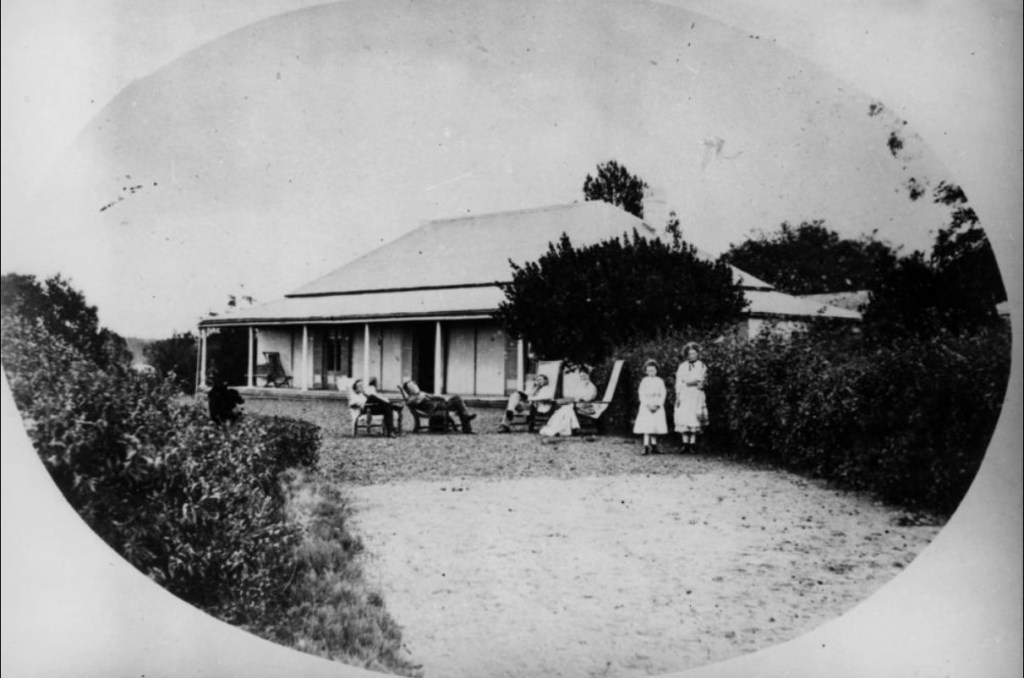
In the early settlement of Australia there existed a camaraderie, begotten of mutual dependence, which gave impetus to endeavour, as it imparted a certain sense of security that should one fall, a helping hand would be given to make a fresh start. How many have I known who in bad times went under, but who, by kindly aid given at the moment, again rose to fortune. In a new country a very small amount of capital timely advanced may lay the foundation of a competency, sometimes of a fortune. Here is an instance. Two or three of us were one day standing on the wharf at Newcastle when a barge laden with maize came alongside. We asked the man in charge the price of the maize; he said he would take 6 d. a bushel as he had to return for another load, and we agreed to take the lot. Just then a little sailing vessel came in from Sydney and made fast alongside the wharf. I asked the skipper the price of maize in Sydney; he said three shillings a bushel. We at once realised the seller from his bargain and counselled him to send all his maize to Sydney and take advantage of the price then ruling; and on his representation that he had not the money to pay for the loading and freight, we clubbed together and lent him the requisite sum. This little aid at the opportune moment was sufficient to lay the foundation of a substantial business. I need hardly say that not only did e repay the money, but insisted on our accepting a parcel of maize, which kept our horses for some months. I mention this incident, trifling though it be, to show that we, as temporary residents, identified ourselves with the growing fortunes of the colonists, and the popularity enjoyed by the regiment was in no small measure due to this feature which characterised all ranks of the “Nines.”
In the month of May 1848, the Moreton Bay detachment was withdrawn, the 99th being sent to Van Diemen’s Land to relieve the 11th Regiment, and to furnish a detachment at Norfolk Island. An extract from the Sydney Morning Herald of June 27, 1848, I find among my papers, in which regret at the withdrawal of the detachments is expressed, “as men of the detachment had gained the good wishes of all.” The reference to myself I refrain from transcribing, conscious that it exceeds my deserts. In the year 1859 the north-eastern portion of the Australian continent was constituted into a separate colony with Brisbane for its capital. On the side occupied in my time by the barracks are now splendid buildings, the principal Government offices occupying, as I can judge from the photographs in the galleries of the Imperial Institute, the site of my quarters, garden and paddock.
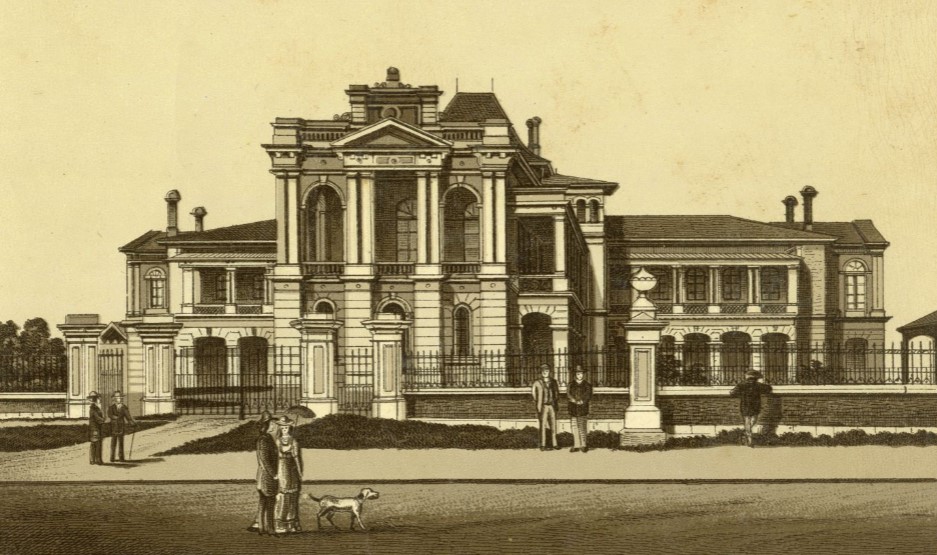
Law Courts 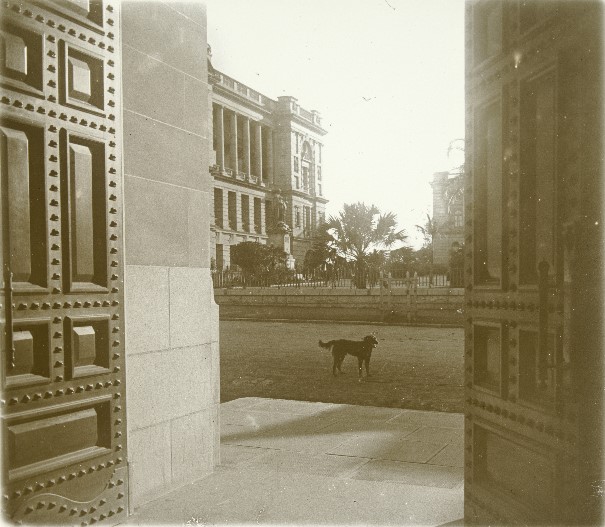
George Street 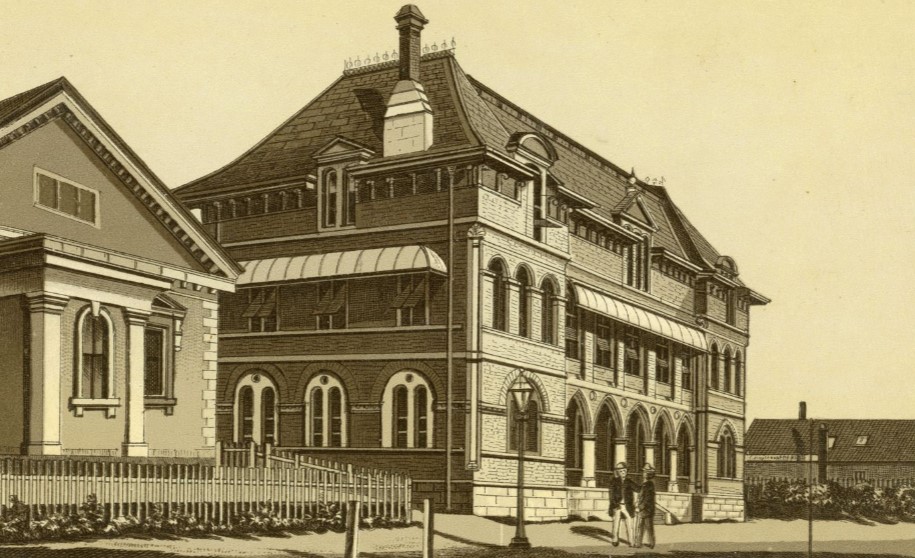
Government Printing Office
A Governor, legislative council, and assembly, a chief justice, and puisne[ix] judges, have taken the place of the two magistrates of 1848; 500,000 tonnage of shipping, that of our one small steamer; and a force of 3000 men, permanent and volunteers, the 50 rank and file of the “Nines.” There were banks with aggregate deposits of millions, some thousands of miles of railways are open, and as triumphant evidence of credit and respectability, the colony has a debt exceeding thirty million. There are handsome streets, a fine water supply, gas and electricity. One of the finest rows of buildings bears the name of Wickham Terrace, and I am told a street that of de Winton. And finally, the annual Queensland dinner, attended by the leading Queenslanders visiting the old country is one of the functions of the London season.
At a dinner given to Arthur Hodgson (now Sir Arthur) on his leaving for England, the speech he delivered on that occasion was rendered into verse by our Brisbane poet. The concluding lines are all of that epic I can recall:
And when I come home to claim again
The homage that was mine,
I hope to find you all
A-basking in the sunshine.
Which I believe he did – though not all, I fear; for the sun was strong in those days, and a too frequent basking in its rays, in a sense not contemplated by our poet, had on occasion disastrous results. I never meet my charming and genial friend, Sir Arthur, but I think of that duly famed Brisbane speech, and I am sure he will not take it ill that I give the incident a place in my “Reminiscences.”
Woe is me that I did not preserve copies of our little Brisbane paper, irreverently called “Tag Rag.” Besides our poet, the commissariat officer, John Kent, who had a facile pen, was more than suspected of occasional facetious contributions; and as we had no political and little local news to record, parts. were often personal, and these now would well weave into colonial history.

A great character in those days was Dr Simpson, a Commissioner of Crown Lands. When in Brisbane, he would occasionally lend us a hand on the Bench when we had a “Small Debts Court,” and the way he polished off the cases was a caution. He first swore the plaintiff, and if the defendant met the evidence with a direct negation, he swore him, and, on his oath confirming his statement, he dismissed both parties to the suit, and said to the clerk: “Now the next.”
Some friendly blacks were wont to camp near the settlement were wont to camp near the settlement and to pay us unceremonious visits, entering unannounced. Indeed, herein they followed the general custom, for I don’t think any house had a knocker or a bell, and the doors stood always open in the daytime, nor were they locked or barred at night. We were a friendly community, among whom the failing of acquisitiveness had not developed. Among the callers after my marriage to offer the customary congratulations was a blackfellow who somewhat startled my young wife[x] by his abrupt appearance, the more from the fact that he had ‘nodings on.’[xi] As the weather was warm, and at the time Pears’ soap was not in use among the natives, having appreciatively recognised the compliment of his call, I expedited his departure.
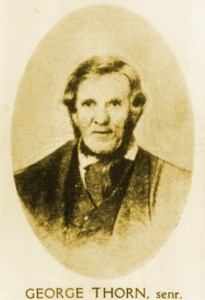
On leaving Brisbane, I disposed of my furniture to Mr George Thorne, a well-known character who had lived at Ipswich, and as illustrating the off-hand way in which business matters were conducted in those days, Thorne simply glanced at the articles for which I had named no price, and said “Shall we say fifty pounds?” and, on my saying “Yes,” at once wrote me a cheque for the amount on his bank in Sydney. A characteristic of the Australians in my time was the utter absence of haggling and of that distrust which is so prevalent in the Old Country. Thorne, I learnt, amassed a large fortune. He was one of the earliest to acquire town lots in Brisbane. Incidentally I may remark that these operations are not invariably successful; at any rate, I can vouch for an exception.

My old friend, Robert George Massie, the Commissioner of Crown Lands for the Macleay, was butting up some lots in Armidale and Bendemeer in 1852, and he suggested my buying a lot in each township. This I did at a total cost of about £9. A few years ago, I instituted inquiries concerning those lots, and the only information I was able to procure was that in one case my lot had been dug out by a gold seeker – with what result to him was not stated – but that if filled up, or a bridge constructed, it might be an eligible site for a church. In the case of the other lot, if I recollect right, the information was not more satisfactory. Peradventure, when these lines fall under the view of some old friend in Australia, he may help me to disposed of these ‘valuable building lots,’ always, be it understood, on terms of mutual advantage.
Having disposed of my furniture in Brisbane, I was necessitated to buy some to take to Norfolk Island, and a sale being announced at a house on the Parramatta river I attended it. Salamon was the auctioneer. Having effected the purchase of the articles I required, I was leaving with Mr Stuart A Donaldson, who had also attended the sale, when Salamon asked me to bid for the carriage which was then being put up; with a friendly nod I advanced £1 on the last bidder, when to my surprise the family chariot fell to me for £16. However, not much harm was done. I got a man to take the carriage to Sydney, and on calling on Sam Lyons, I explained the situation, and he put up the carriage at this next sale, and it fetched over £20. This carriage was the one, as Donaldson told me, in which one of our Australian belles had, but ‘a few months before, driven away from the paternal home in all the pride of youth and beauty.’ Many were the cases of sudden loss of fortune at that time, but happily in most instances the fortunes were retrieved by pluck, hard work, and friendly aid. In those days in Australia there was no keen competition in business, no struggle for existence, and each could help his brother without injury to himself – ay, and he did.
[i] The Reservoir
[ii] Probably a reference to frontier violence, with the indigenous people on the receiving end of the harshest lessons
[iii] Dry
[iv] If you have come to know any precept more correct than these, share it with me, brilliant one; if not, use these with me. (Horace, Epistle I.6.67)
[v] A guide for reference, handbook
[vi] ”Full many a war has been for woman waged” or “the most shameful cause of war.”
[vii] On Friday 9 July 1847, Sergeant Faulkner and Privates Henry Herring and John Randall were brought before the Brisbane Bench for breaking windows at the house of a lady named Mrs Bailey, who was entertaining two gentlemen at the time
[viii] Flat out – belly down
[ix] Judges of inferior rank
[x] Mrs de Winton was just 20 at the time of her marriage
[xi] The gentleman in question was in a state of nature
“Soldiering Fifty Years Ago: Australia in the Forties” by Major De Winton, Late 99th Regiment.
1898, Printed by Spottiswoode and Co, New-Street Square, London.
 Moreton Bay and More