
Memorable Characters from Old Tom’s Story of the Old Times
Some of Old Tom’s friends and acquaintances – Tom O’Neil and Johnny Hamilton – passed through the Colony without making much impact on the news of the day. No doubt they were great friends and unique characters, but their activities did not incur much public attention.
Others, however, made quite an impression on the township. Possibly not always for the right reasons.
The Genuine Philanthropist
Robert Little (of Little and Phelan, not the Robert Little who became Crown Solicitor) was a merchant at The Corner from about 1842-1846. He announced his departure from Moreton Bay the very month that the young lawyer came to town to set up practice. Robert Little the First, as it were, seems to have dealt in sly grog as well as more respectable merchant goods. He prided himself on being a man of faith and charity, and seems to have taken a very particular interest in the moral education of children. He acquired the title of a “Genuine Philanthropist.”
On his departure from Moreton Bay in December 1846, the Moreton Bay Courier ran the following flattering portrait:
A GENUINE PHILANTHROPIST. We learn with sincere regret that Mr. Robert Little, of the late firm of Little & Phelan, and one of the oldest commercial settlers in this district, is about to leave this place for Sydney. Mr. Little during his residence in Brisbane has gained the esteem and regard of everyone anxious for the moral well-doing of the rising generation, by his unceasing endeavours to promote education, and to propagate religious principles amongst the youth of both sexes.
It was during the second year of his residence in this town, that he determined upon erecting a suitable building, at his own expense, to be devoted to educational and religious purposes. He was urged to do this by observing the utter destitution of the children, who without supervision and control, and placed under no moral restraint, were permitted to rove about the town, and contract habits of the most immoral and irreligious kind, owing to their being no teachers at that time in the township. To the credit of the inhabitants be it recorded, Mr. Little’s endeavours were crowned with success, and he has the satisfaction of being the first individual who established a Sunday School in the district. We have the testimony of many of the parents of the children frequenting the school, that they have profited greatly by their attendance, and that the scholars are the best-behaved children in the town.
Mr. Little’s conduct is the more to be admired because it is disinterested. Unassuming and retired in his habits, with the one idea always uppermost in his mind-the moral welfare of his youthful pupils -he deserves all the praise that we have it in our power to bestow. The sceptic may perhaps smile, and the libertine laugh at this encomium; but those who are acquainted with the real worth, and Christian qualities of the man, will appreciate the justness of our remarks, and join with us in wishing him every success in whatever place he may hereafter take up his residence.
We are not in the habit of stepping out of our way to notice the acts of private individuals ; but in this instance we have been impelled by a sense of justice to record the meritorious conduct of Mr. Little, in the hope that many others will be induced to walk in his footsteps and follow his bright example. We understand that on Tuesday evening Mr. Little gave a juvenile tea party to his scholars at the Schoolhouse, and that upwards of sixty children, accompanied by many of their parents, were present on the occasion. After partaking of the hospitality of their entertainer, several valedictory speeches were delivered, to which Mr. Little gave suitable replies. The party then separated, impressed with a grateful sense of Mr. Little’s kindness, and unfeigned regret at his projected departure from the district.

A few years later, William Charles Wilkes, in the guise of Our Windmill Reporter, told a tale of a Genuine Philanthropist, who left Brisbane to improve the morals of Sydney, but who failed to make the impression he had hoped on that metropolis. Every use of the word “little” is deliberate.
THE GENUINE PHILANTHROPIST. [A NICE LITTLE TALE] In the days when Brisbane was in its infancy, a pious man became a dweller in the tents of the ungodly. Eschewing, after a brief and profitable season, the lucre, arising from the unauthorised vending of alcoholic fluids, he devoted himself largely to the promotion of amateur preaching, and occasionally distributed, to hungry souls and bodies, the crumbs of comfortable doctrine, yea, and of bread and butter also.
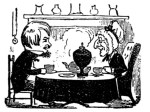
Verily, stimulating decoctions of the Chinese leaf were not wanting upon those, spirit-moving occasions, and it came to pass that the man of piety was known to the little children, and to women ancient of days, by a surname, even the surname of “Genuine Philanthropist.”
Now, in course of time, the philanthropist journeyed to Sydney, where he sojourned for a season; and when, the time was come for him again to depart from that city of sin, he lifted up his voice and said, “What do I here? Lo the children of Sydney are wise in their own conceit, and will not permit me to traffic after the manner of my desires. Behold, there is the town which has aptly been termed the capital of Greenland, even the town of Brisbane; thither will I return, and it shall come to pass that my horn shall be exalted, and my spirit refreshed in the meetings of the Elect. “
So he girded up his loins, and went down unto the wharf whence ships depart for Moreton Bay, and he took ship and put out to sea, and in due season the vessel arrived in safety at Brisbane, whereat the philanthropist rejoiced exceedingly. But it was soon made manifest that the ways of Brisbane were not as the old ways had been.
Another man ruled the Councils of the Elect, and the philanthropist was no longer called “Genuine.” So he called unto him a young man of his household, even John, and he said unto him, ” John, thou art a faithful servant, and I will reveal to thee the thoughts of my heart. The people of this place are changed, and I am about to incise my staff; but there is certain young man, comely and fair to look upon, and my heart yearneth towards the youth. Nevertheless his eyes are closed to the light, and it grieveth my spirit sore. I will commune with him, and peradventure it may be that through me his eyes may be opened.” Then the philanthropist sought out the youth of whom he had spoken, and he communed with him, and purchased his precious stuffs, his wines and his oils. Albeit the eyes of the young man were not yet opened unto the light.
Now, it came to pass in the second year of the Californian fever, that many men humped their drums and went off to the diggings; and about this time the people of Brisbane made merry, for behold, it was the time of the festival of horse-racing. And the philanthropist said unto himself, ” Now shall my staff be incised, and no soft feathers shall exist in the minds of the people. Is not California pleasant? Thither will I go, and my scrip shall be filled with shekels of gold and with shekels of silver. There was then lying in the river of Brisbane a ship, whose sign was the name of a woman, even the famous woman named in the song of Dibd En, and whose eyes were of the line of the Ethiopian; and behold the philanthropist made show as if he would view the racing sport, but he covertly embarked on board the vessel, and the sail having been loosed, the Captain put off for Sydney, fearing to lose the tide. But when it became known at Brisbane that the philanthropist had incised his staff, certain of the inhabitants waxed exceeding wroth, and they said, “Wherefore did he not first pay us ?” Nevertheless the “young man of his household pacified the people, saying, “Tarry yet a little, and he will come back again.”
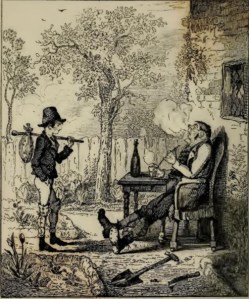
When, therefore, the days were passed when they should have heard further, they sought out the young man John again, but lo! it was found that he had now also incised for the diggings. Then each man looked upon his fellow, and said, ” Brethren, are we not done?” When all these things were told to the young man with whom the philanthropist had held communion aforetime, he was sore perplexed; but at length he found that both his eyes were now opened, yea, even unto an exceeding width. And there was a certain other young man, whose house the philanthropist had hired for a season, and he believed that his own eyes had long been opened, and that they were free from sand; but behold, he also was done to a dark colour; yea, even the colour of the walnut shell. And it came to pass that the philanthropist returned no more to those parts, but went on his way rejoicing.
And here’s what Old Tom thought of Robert Little the First:
“I won’t say Little made much money by selling bad grog or retailing questionable merchandise; but he and his partner made money, bought land, built a large (for the times) brick house, and finally, to crown his good works, built a chapel (by-the-bye, the first erected in Brisbane), and then, it is said, went off with another man’s wife, a sad Don Giovani.
“The Brisbane poet of that day I fear had this “Little” humbug in his mind’s eye when he concluded the following satire, in that well-known song “The Merry Boys of Brisbane :”
Some shake at us their pious bonds,
Go home and solemn tears they shed,
Then gloriously get drunk in bed-
Merry boys of Brisbane.“
Thomas Adams
Gossip about old times and forget Tommy Adams – never! Talk about Bob Little, Dan Roberts, Garrick, and others learned in the law, and leave out the name of Thomas Adams, Esq.
Tom Dowse
Before Robert Little (the Second) and John Ocock arrived in 1846, there was one solicitor in Brisbane, Thomas Adams. From Old Tom’s description, he was a cheerful, generous man with a shining bald dome. “Prodigal to excess when in funds and sharing his last shilling with a friend.”

Thomas Adams did well in his first few years, buying a riverside property at Kangaroo Point in 1843, and later having an enviable residence in the New Farm Estate. In June 1846, when competition arrived in the form of John Ocock (an upright character from a legal family), Adams removed his business to the premises between the post-office and the old Convict Barracks, close to The Corner. From there, he did a reasonable business, usually appearing before the Bench to represent parties in actions under the Masters and Servants Act. He was an elector of Stanley, and a member of the Committee of the Benevolent Society. His practice included young Richard Stubbs, described by Old Tom as “that laughing, rollicksome young limb of the law.” Apart from the theft of some of his pineapples in the night in 1847, times were good.
Then, in 1848, Adams’ troubles began. There was a professional falling-out with Richard Stubbs – for reasons not on the public record – Adams advertised the following notice: “Mr Richard Stubbs is not authorised to transact any business, or receive any moneys, on my account. THOMAS ADAMS, Brisbane Jan. 20, 1848, Attorney.”
More troubling was Adams’ involvement in hotelier David Bow’s insolvency proceedings. Adams was named as a co-defendant in a civil case arising from Bow’s insolvent estate.
In the estate of David Bow, a third meeting was held. The following claims were proved: (including) John McConnell £75 10 s 8 d. The Assignee was directed to convey to Mr John McConnell all his right, title and interest, whatever it might be, as official assignee, in and to that parcel of land over which the said John McConnell now holds an equitable mortgage, and respecting which land an equity suit is now pending, in which the said John McConnell is plaintiff and the insolvent David Bow and Thomas Adams are defendants. The expenses of conveyance to be paid by the solicitor for McConnell.
Sydney Morning Herald, 4 April 1848.
John McConnell was a determined litigant, and, with the judgment not satisfied, Adams’ property at New Farm was sold by the Sheriff in October 1848 to a Mr Clark Irving of Sydney. Not long after, Thomas Adams moved his practice from the Queen Street premises.
Adams continued to work in the Brisbane and Ipswich Courts of Petty Sessions, though more sporadically, as he became involved in another case, this time as the solicitor for the plaintiff. Mr Alexander MacPherson had been involved in a case with Patrick Nicol, in which a judgment was made to sell a property in Ipswich. An auction was announced for May 16, 1849.
On Saturday 5 May 1849, the Classified Advertisements of the Moreton Bay Courier lit up with Notices.
- The first was from John Connolly, Special Bailiff, advising that the Ipswich property was to be auctioned.
- The second was from Patrick Nicol, stating that he had made and executed an indenture in June 1848 between a William Henry Shetland Thomson and himself as trustee for John William Nicol, a minor, conveying the Ipswich property to himself to hold as trustee for the boy until his majority. He further claimed he had a signed discharge from the plaintiff in full of the judgment and gave notice not to sell the property.

- The third was from Thomas Adams, claiming that Thomson never had any right or title to the premises, and that neither the deed nor the receipt would prevent the sale. He added that he held an assignment of debt to him under the hand and seal of the plaintiff.
- The fourth was from Patrick Nicol, again, and refuted Adams’ claims, and stated that the deed between himself and Thomson was “Attested by John Ocock.” He added: “The receipt is, as usual, at the conclusion of the deed, and attested by a respectable attorney of South Brisbane.” Ouch.
- He added, “I have further to observe, with reference to his observations respecting dishonest plaintiffs and defendants, I think Mr Adams is also aware that there is a law to prevent pettifogging and dishonest attorneys urging on a case, whether just or unjust, to obtain costs. The plaintiff in this case never having given Mr Adams a single fee (unless a glass of grog); neither has he received any consideration for the alleged assignment of the debt, nor did he ever authorise the present proceedings; but, upon being applied to for a sum of money to carry on the case, politely told the applicant to go to the devil; he would have nothing to do with it.”
- Then Mr McPherson (apparently) got into it, as Notice number five. “The public are hereby cautioned from being misled by Mr Adams’ advertisement, as I never gave an assignment of “the debt;” and further, that I have given Mr Nicol a receipt in full of all demands. I have, therefore, no claim on him.” adding “if Mr Adams possesses any document pf assignment purporting to be signed by me, it was obtained surreptitiously when I was in a state of intoxication.”
This series of notices was damaging to all parties, not least Thomas Adams, whose professional reputation could suffer serious damage as a result of the last two notices. One week later, an advertisement appeared in the Courier, signed by McPherson, claiming that the previous week’s correspondence was a fraud, and giving Adams a hearty testimonial.

The damage was done. After appearing in Petty Sessions once more representing dissatisfied employees, Adams travelled on the Schooner Mary Stewart, 24 July 1849, destination – Sydney (along with the recently widowed David Bow and his children).
After that, unclaimed letters addressed to him at Brisbane were advertised in the Courier. His Kangaroo Point property was still listed as belonging to him in the 1855 map of Brisbane Town, but he never practiced law in Brisbane again.
John Canning Pearce
A plain, blunt-spoken, irrepressible Englishman, prone to a fault to join issues with his best friend upon the slightest provocation, yet, at the same time, overflowing with the milk of human kindness.
Tom Dowse on John Canning Pearce
Old Tom recalls John Canning Pearce as an indifferent merchant, but a man of warm, if at times uncertain, character. During Pearce’s Moreton Bay career, he was a shopkeeper at Brisbane, then manager of a station called “Perseverance,” then a humbled old man employed as a clerk at the Gaol in Queen Street.
It was during Pearce’s station-managing days, when he was flying high and entitled to call himself a gentleman, that he conducted a war of words with a country magistrate that ended in a sensational trial for slander.
In September 1853, two Chinese labourers petitioned the Bench at Drayton for unpaid wages owed by John Canning Pearce at “Perseverance.” Mr Pearce had been summoned, but did not attend the Court that day, and the bench awarded wages and costs against him.
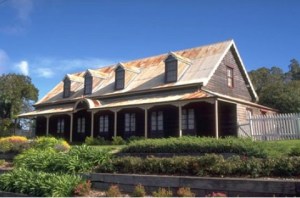
When Mr Pearce, who had not been inclined to attend court on the day appointed, found out about the award, he blustered straight into the Drayton courthouse and demanded the decision be reversed. This the justices refused to do. Mr Pearce was not pleased, and stewed upon the issue until meeting one of the magistrates, Mr Joshua Bell, out of hours on the verandah of the Royal Bull’s Head Inn at Drayton. Pearce gave Mr Bell an unabridged view of his character and lineage, and the police were called to remove Mr Pearce. The Chief Constable let Mr Pearce go, and Mr Bell contemplated civil action.
The matter came to a head in a civil case brought by Magistrate Bell for slander. The descriptions of the evidence given are so perfectly of a time and place, it seems wrong to paraphrase them. Here is the evidence of fellow-magistrate, Leonard Edward Lester:
On the 17th of September last I was standing on the verandah of Mr. Horton’s Inn at Drayton, in company with the plaintiff, and Mr. R. C. Bagot, when I saw the defendant Mr. Pearce coming over from Mr. Mehan’s inn, on the opposite side of the road. He came up to the plaintiff and said “I hope, Bell, you feel more independent today than you did yesterday when sitting on the Bench. You did not behave to me on that occasion like a friend. I suppose that you rejoice in being the first joint of Arthur Hodgson’s tail.” Mr. Bell said “Pearce, I beg you will not use that language.” Pearce immediately said “You a magistrate? You dirty, low scoundrel. You are a low paltry b-. You dirty low scoundrel.” [The witness was permitted to refer to a memorandum made half an hour after the transaction, and then continued. Pearce also said. “You are a b-scoundrel.” Plaintiff said, “Pearce, you old fool, I beg you will desist from using this kind of language to me.” Defendant repeated similar language for about a quarter of an hour. Constable Smith and Collins the waiter were in the verandah at the time. Horton’s inn is in the centre of Drayton.
Plaintiff conducted himself very quietly, continuing to tell Pearce to desist. Pearce put himself into a fighting attitude, and lightly tapped Mr. Bell three times on the nose, with his closed fist. Bell immediately caught Pearce round the waist, and said. “”You old fool, I cannot strike you, but I will put you out of the verandah.” He then attempted to put defendant over the railing of the verandah, but was prevented by witness. When plaintiff left the Inn, defendant attempted to follow him, but was warned by Mr. Manley, the Chief Constable, that he should put him in the watch-house if he did. [Cross-examined by Mr. Faucett.] Did not see Bell strike Pearce. Bell used no words of abuse but “you old fool.” Did not see Bell knock Pearce down, nor could he have done so without witness seeing it. Bell’s conduct was perfectly gentleman-like on the occasion.
Robert Cooper Bagot deposed:

That he was on Horton’s verandah at the time named, and saw the defendant come there from Mehan’s. Plaintiff said, “good morning, Pearce.” The latter did not reply to this but said “I hope you feel more independent than when you were deciding in my case yesterday.” To the best of witness’ belief plaintiff replied. “Now Pearce, the less said the better. The case is decided, and let it rest.” Pearce replied. “You have a good deal more to hear from me yet. In the decision you gave yesterday you did not behave to me like a friend.” Plaintiff made no reply, and defendant said, “It is all I could expect from a d- Paramatta Factory b-like you.”
Mr. Bell said “Now Pearce, you have most grossly insulted me. You had better leave off and let me alone.” Defendant then said, “Oh I’ve no doubt you pride yourself on being a joint in Arthur Hodgson’s tail.” Mr. Hodgson is a magistrate of the same Bench. Bell said, ‘I don’t want to have any row with you, Pearce, I wish you’d desist and let me alone!” Defendant did not desist. He called Bell a d-scoundrel several times, and said that, like all the b-magistrates on Drayton Bench, he sided with Hodgson. So far as witness could recollect, Bell said that the best way to prevent a row would be for him to go away, and was turning to go, when, after some further conversation, Mr. Pearce pushed him with his hand. Bell said “Now-Pearce, you are taking advantage of your age. You know I cannot strike you.”
Pearce then struck Bell in the face. Bell said. “Now you old fool, you will drive me to strike you if you don’t leave off.” He then walked to the end of the verandah, where Pearce followed and made some coarse remark about plaintiff’s father. He also pushed him, when Bell said “I can’t stand this. You have struck me three times.” He then struck Pearce, and they closed. Witness proceeded to detail the rest of the transaction, substantially the same as the preceding witness. He spoke of several offensive epithets used by defendant in reference to plaintiffs family. When Manley refused to put Mr. Pearce in the lock-up he said that Mr. Bell was the aggressor and had struck Pearce first. Mr. Faucett cross-examined the witness at considerable length.
By way of translation, Mr Pearce’s blustering “damned Parramatta Factory bastard” was his suggestion that Mr Bell had been born out of wedlock to an imprisoned female convict. John Canning Pearce clearly had a command of fire-breathing Victorian oaths, but the slander at the heart of the case was decided in Pearce’s favour. Why? Because his lawyer very cleverly put doubt in the court’s mind as to what might be construed when Pearce said that Bell had not acted like a friend the day before. Indeed, that could be seen as an endorsement of Bell’s impartiality as a magistrate! And all the swearing and yelling? “Mere abuse, used at a time of irritation, and not seriously intended to impute any offence.”
At length, Pearce’s lack of talent for business was his undoing, and, as Tom relates, he saw out his old age as a clerk at the Brisbane Gaol. In July 1859, the Brisbane correspondent of the North Australian noted, for the benefit of its Darling Downs readers, “Your former townsman, Mr JC Pearce, I am happy to inform you, has been appointed to the clerkship of the gaol.” The old man passed away in October 1859.
NB: There was another J C Pearce, James Canning Pearce, who at one point operated the Experiment steamer. They’re as hard to distinguish as the two Robert Littles.
Richard Stubbs
That laughing, rollicksome young limb of the law, as full of mischief as a pet monkey, and as ready to negotiate a loan for himself or any other man, if the security was forthcoming, as the smartest of my uncles.
Tom Dowse on Richard Stubbs
In Old Tom’s recollections, he compares Richard Stubbs, the junior partner of Thomas Young to the Dickens character Dick Swiveller, from The Old Curiosity Shop (Tom thinks the character was from The Pickwick Papers, but his literary recollections failed him on this occasion).

The character of Dick Swiveller was a cheerful young law clerk, prone to grandiose pronouncements, open to bad influence, and indebted to just about everyone – not that this troubles him greatly.
His character has an unusual subtlety as it progresses – people were either Very Good or Very Bad Indeed in early Dickens. Dick develops and matures as the story goes on.
No doubt The Old Curiosity Shop, published in 1841, was fresh in Young Tom’s mind when he met and befriended Tommy Adams and Richard Stubbs. The partnership disbanded in 1848, a year after Stubbs distinguished himself in the shipwreck of the Sovereign at Moreton Bay. He acted bravely in trying to save other passengers, using his strong swimming to good use. Just how disastrous the Sovereign wreck was, and how extraordinary Stubbs’ actions were, is borne out in the following contemporary report.
Messrs. Dennis, Berkeley, and Elliot, worked for some time at the pumps, which, however, soon got choked, and they then assisted in heaving overboard the remainder of the deck cargo. While they were thus employed, a heavy sea came, and washed Mr. Stubbs overboard; but he managed to get on deck again. He then went down to the ladies’ cabin, which he found half-full of water. Mrs. Gore and her child were lying down in one of the berths, quite exhausted, while large quantities of water poured over them through one of the dead lights, which had been stove in. He went to her, and taking the child away from her, deposited it in the arms of the servant girl, who was standing with the stewardess on the steps of the companion hatchway.
He then returned to the cabin, and conducted Mrs. Gore to the same spot, being the only place of safety at the time in the vessel. He then procured a small quantity of spirits from the stewards’ cabin, which he administered to the females. Mr. Gore shortly afterwards was heard to call out for his wife, when Mr. Stubbs informed him that she was in safety, and requested him to come down through the skylight, and assist him in blocking up the dead light. Mr. Gore accordingly went down, and both gentlemen endeavoured to thrust mattresses through the aperture; but all their efforts were unavailing, for the water still continued to pour in as each wave broke upon the ship. Mr. Gore and Mr. Stubbs then went on deck and assisted in heaving the wool overboard.

Whilst the latter was working at the wool bales, a billet struck him on the left aim, and disabled him. Just then Mr. Gore joined him, and they both went aft. Mr. Gore, addressing his wife, said, ” Mary, there is no hope for us now; we shall go to heaven together.” Mrs. Gore, turning to the stewardess, said, ” We can die but once. Jesus died for us. God keep us.” She repeated these short sentences several times, and seemed perfectly prepared to meet the inevitable fate which awaited her with calmness and Christian-like resignation.
Mr. Stubbs now told Mr. Gore that he thought the vessel was sinking, as the water was nearly level with the top stairs. The doors of the companions were then opened, and the females came on deck together. The dreadful moment which was to determine the fate of all who still remained on board now drew on; and everyone saw in the countenance of his companion the vivid expression of his own feelings. At this particular juncture, Mr. Dennis was observed standing near the poop with his head cut open and bleeding profusely. Mr. Elliot was close to him, and Berkeley a little below them.
Captain Cape, who had more than once been washed overboard, was holding on by the shrouds. Mr. Stubbs, who appears to have maintained his presence of mind throughout, now cried out, “avoid the suction,” and jumped overboard. One dreadful shriek was heard, proceeding from one of the females in the fore part of the ship, as she took one roll, heeled over, and sunk, and then all was still. The struggle for life then commenced; some of the passengers clung to the wool bales-some to portions of the wreck-while others, who had been disabled on board, soon sunk to rise no more alive.
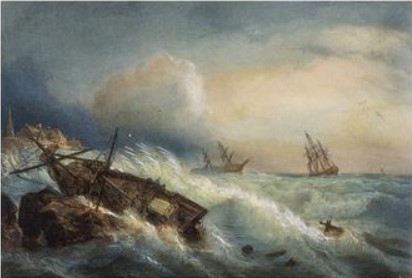
Mr. Stubbs states that the first thing he saw after he jumped overboard was the body of Mrs. Gore floating with the face upwards close alongside the vessel. The poor unfortunate lady had, doubtless, died in consequence of the fright she had undergone; her child was between the vessel and Mr. Stubbs; Mr. Gore was about thirty yards off; Mr. Dennis and Mr. Elliot were clinging to a wool bale, and Mr. Berkeley was swimming. Mr. Dennis called out to Mr. Stubbs, “for God’s sake save the child!” Mr. Gore also cried out, ‘for God’s sake bring me my child!” The appeal was not made in vain-Mr. Stubbs swam towards it, and catching hold of it by the hair of the head, conveyed it to its distracted parent. He nearly, however, lost his life in the attempt, by the child clinging convulsively to him, as it was in the arms, of Mr. Gore; and it was only by main force that the father obtained possession of the object of his strong affection.
Mr. Stubbs then struck out and reached a wool bale, when he saw Mrs. Gore’s servant girl, who implored him to have pity upon her and help her. He desired her to cling to the wool; and releasing himself from his superfluous clothing, tried to lash two bales of wool together with a strap which he carried about his person. He did not, however, succeed, in consequence of one of the bales sinking. He then told the girl to hold on until she could get some wood; for he did not think the wool would be of service to her much longer.
On reaching the breakers, supported by a plank, he observed. Mr, Gore with his child inside the skylight. Feeling very much exhausted, he swam towards them, and got into it; in about a minute afterwards a sea struck it and washed them all out. As Mr. Stubbs was swimming, he saw, for the last time, Mr. Gore clinging to the skylight, with the child in his arms. Shortly afterwards a man with a blue shirt and dark hair came close to him, supported by a long piece of wood, which hit him on the head in passing, and nearly rendered him senseless. Having escaped this danger, he had to encounter another still more formidable. He saw breakers ahead proceeding from the bar, which appeared coming towards him like a wall, upwards of fifteen feet in height, frothing and foaming, and enough to appall the stoutest heart. How he got through them he does not recollect, for he saw nothing more until he reached the shoal water on the beach, which was about four miles from the spot where he left the vessel. He had just vigour enough remaining to get out of the reach of the breakers, when a native belonging to the pilot’s crew seized him by the waist, and supported him until his strength returned.
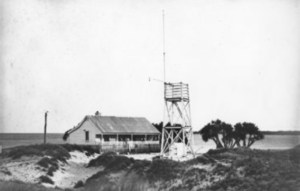
After the loss of so many lives, it became clear that there were two main causes of the wreck of the Sovereign – the vessel was not built for rough passage crossings, and the Amity Point crossing was unsafe. It was suggested by Wickham and others that the pilot station be relocated to the north entrance to the bay, where navigation was safer. His Excellency the Governor was pleased to approve of the relocation of the pilot station, and placing navigation buoys to mark dangerous shoals. His Excellency’s minions, however, took their time in calling for tenders, requisitioning materials and authorising expenditure. The endless delays that resulted led Old Tom and others to believe that little had been done, and to agitate for Separation.
Richard Stubbs, following the Sovereign ordeal and the end of his time working with Thomas Adams, left Brisbane in the same year as Adams. His name joined that of his former master in the Unclaimed Letters column.
 Moreton Bay and More
2 Comments