
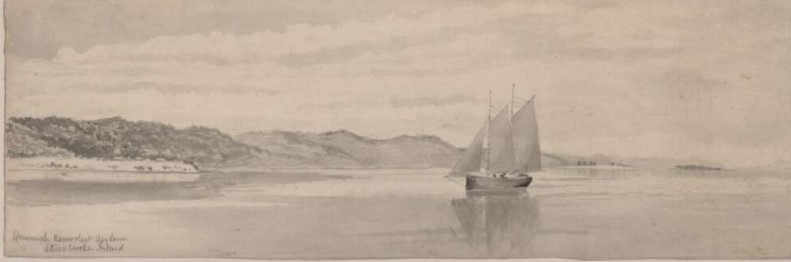
On June 4, 1878, a very old man passed away at Dunwich Benevolent Asylum at Stradbroke Island. He’d been there since 1869, when, aged 91, he could no longer take care of himself. That was a hard blow for a very independent man.
Abraham Brown had been a mariner since the turn of the 19th century, when, as he told the Dunwich staff, “I was pressed for service[i] in 1800 under Lord Nelson for the Copenhagen Expedition and was compelled to serve against my country.” He had not been back to Denmark since.

His father was a gamekeeper named Thomas Brown, and his mother was named Catherine. Despite their English names, they considered themselves Danes. Abraham had been raised in Copenhagen in the Lutheran faith.
At Dunwich, he was nicknamed “Old Trafalgar,” and was credited with fighting in that battle under Nelson in 1805. In 1822, he arrived in Australia as an able seaman in the brig Atalanta and obtained his discharge. After that, he told the Dunwich Admissions officer, he’d been in the coasting trade, then the Clarence River, more recently Richmond and the Tweed Rivers.
He said he’d been in all the colonies in Australia at one point or another. He’d never married and had no family in Australia. For a man in the 19th century to reach 100 years of age was very unusual, but for a man with his British military history, it was something to note.

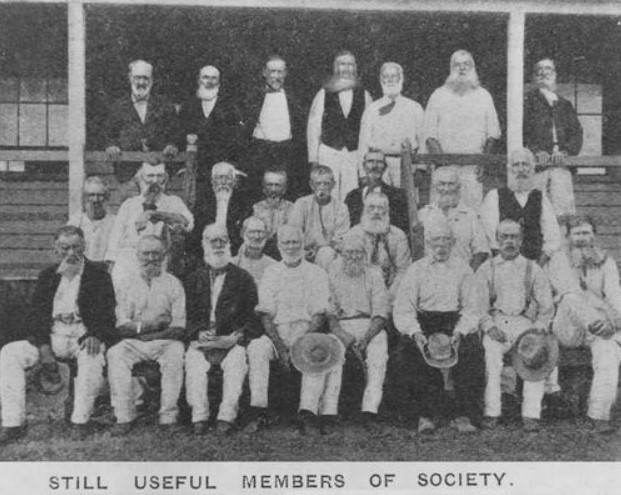

The Darling Downs Gazette, shuddering at the idea of a grand old British sailor living out his days on the Bay Islands in a Benevolent Home, declared that a quick death with Lord Nelson would have been a more fitting fate.
(The Darling Downs Gazette writer didn’t know that Brown was pressed into the service of Lord Nelson, but even if they had, I suspect they would have considered being pressed into fighting for Nelson a vastly better fate than being, well, a foreigner.)
It’s hard to verify Abraham’s tale. One fact I was able to find was that the brig Atalanta did not arrive in Australia until 1826, but that discrepancy could have been due to a very old man’s failing memory. A dozen or so Copenhagen-born men are confirmed to have fought at Trafalgar, but none of that name. That doesn’t necessarily mean that he wasn’t there – record-keeping in times of conflict could be fraught. One wonders what his long, hard, solitary life was really like.
[i] The website Napoleon.Org has an excellent piece on being “pressed” into the Navy:
“ The Impress Service or Pressgang.
“Founded long before the Napoleonic wars, the Impress service came into high profile during the wars with Revolutionary France. The word impress was derived from the old French word ‘prest’, modern ‘prêt’ or loan/advance, in other words, each man ‘impressed’ received the loan of a ‘shilling’ (that is he paid the ‘King’s shilling’ to enlist) and became a ‘(im)prest man’.
“The service was present in every major port in the kingdom. The service’s offices were called ‘Rendezvous’ with a Regulating Officer in charge, and he hired local hard men as ‘gangers’. These thugs would thus roam the countryside attempting to ‘encourage’ men aged between 18 and 55 to join the navy. No-one was safe from the gang, and often the only escape route when captured was to bribe the gang or to join it. A preferred target for the pressgang was the merchant navy, so it was not infrequent to find special hiding places on merchant vessels.”
 Moreton Bay and More
1 Comment