
The Commandants, Soldiers, and their Families.
In 1824, Moreton Bay was designated by the British Government as a place of secondary punishment. It was not quite as isolated as the Norfolk Island Penal Colony, but seemed that way, because there were no roads open from Sydney. It may as well have been a remote island.
The settlement was an insular place –commercial vessels and private individuals were not permitted to visit the district, although vessels in distress or the survivors of maritime accidents would be given every assistance.
Moreton Bay always had an uneasy relationship with the military. From 1824 to 1842, the settlement was under military command, with the various Regiments and Detachments rolling in and out of town, under the command of men of wildly varying temperaments.
The Commandants
Lieutenant Henry Miller
(1785-1866), 40th Regiment. Commandant: 1824-5.
Lieutenant Henry Miller of Londonderry was a veteran of the Peninsular Wars and Waterloo, and nearly forty when he arrived at Moreton Bay. He was tasked, alongside John Oxley, with setting up a convict settlement at the chosen site of Redcliffe. In September 1824 the brig Amity brought Oxley, Miller, and a detachment of soldiers, convicts, and provisions to Amity Point.

A family man, Henry Miller brought his wife and children with him on this new adventure. Miller’s children were born far apart due to his various campaigns and postings – Henry in 1809, Mars in 1817, Charles in 1824 and Henrietta in 1832. Charles was born in at the Redcliffe settlement in November 1824.[i]
Jane Morphett Miller was a military wife of many years’ experience, accustomed to dealing with difficult conditions, but camping out at a beach site with inadequate shelter and provisions whilst heavily pregnant would have been extraordinarily challenging. Not that we know anything about this – Jane Miller’s views were not recorded, but those of Henry Miller were. As they waited – months – for fresh provisions, Miller observed:
“I passed toilsome and miserable days, anxious and restless nights, and underwent privations, difficulties and hardships greater than any I had been called upon to sustain during years of actual service.”[ii]
Lt Henry Miller
So, tougher than Waterloo then. Miller kept his sense of humour, though. One old stager recalled Lt. Miller’s amusing way of getting the religious observances out of the way quickly (the settlement had no religious official and wouldn’t for some years):
The officer in command of the troops which first effected a settlement at Moreton Bay, had a very concise method of performing the duties of Chaplain; after he had mustered the troops and prisoners he would begin thus- “‘When the wicked man turneth away from his wickedness’–and all that-“, “’Dearly beloved brethren’, you know all that.” When he had got through the Church Service in this sort of abbreviated manner, which generally lasted about ten minutes, he would wind up with a parting benediction of “Soldiers! take a day’s leave!” [iii]
Having set up the Redcliffe settlement, he was then ordered to move the whole deal inland, to a spot that Governor Brisbane thought might be called Edenglassie.[iv] Miller’s successor, Captain Peter Bishop, arrived in October 1824.
Captain Peter Bishop
(1780? -1846). 40th Regiment. Commandant: 1825-6.
Captain Peter Bishop, of Bishop’s Court, Waterford, Ireland, joined the military in 1803 with the 5th Northumberland Regiment, and became a captain in 1812. He transferred to the 40th and served with distinction in the Peninsular Wars and at Waterloo. In 1815, he married Julia Talbot of Castle Talbot, Wexford. Place names like Bishop’s Court and Castle Talbot suggest that Peter and Julia were landed gentry, or at the very least landed gentry-adjacent.
Bishop’s regiment arrived in Australia in 1824, and he was assigned to relieve Lt Miller at Moreton Bay at the end of that year. Sadly, by this time he was a widower.
His time at the settlement was marked by the completion of the move to Brisbane, the commencement of the first Commissariat Store, and the unannounced departure of a group of convicts. They were the first runaways from Brisbane.
Bishop was then ordered to the Illawarra, then Van Diemen’s land. His regiment was kept busy putting down bush ranging activities, and those of indigenous groups who did not take kindly to the European presence. It’s unlikely that the soldiers were particularly merciful to either group.
Bishop was promoted to Major, then retired in 1829. His services at Waterloo were recognised, and he died in 1846.
Captain Patrick Logan
1796-1830, 57th Regiment. Commandant: 1826-1830.
The best-known of the Moreton Bay Commandants, Captain Patrick Logan’s name has become a byword for tyrannical and brutal treatment of convicts. His reputation has undergone some rehabilitation in the last few decades, as archival material from his time becomes more accessible. Logan certainly knew how to get the settlement built and running. In his spare time, he completed explorations of the south-east Queensland area.
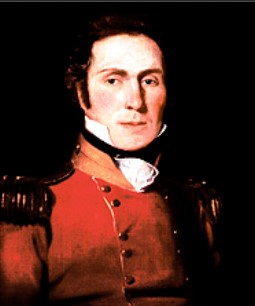
Logan was a veteran of the Peninsular Wars, who had left and then rejoined the service. In 1823 he bashfully sought the hand of one Letitia O’Byrne, and, after buttering up her uncle, he received it.
By the time the couple arrived at Moreton Bay in 1826, they had one child, Robert, and another on the way. Letitia Logan did not have the experience of Jane Morphett Miller to draw upon. It is unlikely that she had ever “roughed it” prior to becoming a military wife. Her home was the Commandant’s Cottage, a snug brick house, unlike the rough, prefabricated one at Redcliffe. Together with her wifely duties, she played hostess to shipwreck survivors and Government visitors, charming all of them with her solicitous manner. Her children were a particular delight.
I wish you to buy me a tea service similar to that you sent Janetta, which I intend for Letitia Logan, a sweet, pretty child of three years old, and if you can send some English papers or a late magazine, I will faithfully return them, and they will afford me the means of obliging Mrs Logan, who is so very attentive to me, or perhaps you can spare one of the late annuals, which the ladies here would consider a great treat.
Dr James Murray
Mrs Logan lived in fear of the danger of the unexplored lands beyond the settlement, troubled by a belief that her husband might die on one of his exploring jaunts, and that fear sadly came true. Letitia had suffered a miscarriage in April 1830 and her health and strength was badly affected. When her husband went missing in October 1830, she was fraught; when his body was returned to Brisbane, she was inconsolable. She knew that the convicts feared and despised her husband and informed James Clunie that Logan would not be buried at Moreton Bay under any circumstances. His grave could not be safe from convict depredations.
Her husband appears in the reminiscences of non-convicts who encountered him at Moreton Bay as energetic, gracious as a host, and a good companion at table. Allan Cunningham did not think Logan’s treatment of the convicts to be excessively harsh and said so at an inquiry following the Commandant’s death.
But by 1829, word of the punishments unleashed at Moreton Bay had found its way to Sydney, and to the willing ear of Edward Hall, editor of the Monitor. Hall began an aggressive campaign of sensational articles vilifying Logan, to the extent that there was a libel action on foot at the time of Logan’s death.
After Logan’s death, even the more respectful publications began to refer to the improved treatment and morale of convicts under successive Commandants. The tales of Logan’s brutality, though probably exaggerated, were consistent enough to suggest that there was a good deal of truth in them.
Letitia Logan returned to Sydney to endure her husband’s solemn military funeral, ensured that a fine monument was erected over him, and then took her young children with her back to Ireland. The poor woman spent many years beseeching the British government for pensions and considerations, without any success. She died on November 30, 1872, aged 73.
Captain James Oliphant Clunie
1795-1851. 17th Regiment. Commandant:1830-1835.
James Clunie came from a religious family with links to the poet Robert Burns. He signed up to the 17th in 1813, served in the American War, and was promoted to Captain in 1826. His regiment arrived in Australia in 1830 and Clunie was appointed to succeed Captain Patrick Logan at Brisbane.
Clunie and his men arrived at Moreton Bay in October 1830 to wait for the handover with Logan, who had chosen to take part in one last surveying expedition before sailing to Sydney.
Clunie had barely time to unpack his necessaries when word came that Logan had separated from his party and was missing. The new Commandant organised a search party to go into the wildly unfamiliar territory and seek out the missing man. Logan was found dead and had been partially buried. He had been brutally murdered, probably on the 17th, the day after he was last heard from.
Returning to the settlement with the remains of the previous Commandant, Clunie had to deal with many issues at once. There was the traumatised widow, Letitia Logan. The convicts were in a state of uproar, their wildest dreams having come true. There were arrangements to make for the removal to Sydney of (a) Logan, (b) his widow and young children, and (c) the soldiers of the 57th.
The settlement still had to be administered, and an inquiry had to take place as to what on earth had gone on to turn the expedition fatal. Captain Clunie proved his mettle in securing the settlement and establishing his authority. He punished severely when he thought it necessary, but at the same time improved the rations and working conditions of the convicts. The health of the inhabitants improved immeasurably, as did morale.
Leaving Moreton Bay five years after he arrived, Clunie was promoted to the rank of Major, and later Lt. Colonel. He served with distinction in India, before retiring to Scotland, where he died in 1851. He never married.
Captain Foster Fyans
1790-1870. 4th King’s Own Regiment. Commandant: 1835-1837.
Captain Foster Fyans was a puzzling figure. He was known to be ferocious with punishments, but kind and encouraging to convicts willing to mend their ways. He was capable of putting down a convict mutiny by making condemned convicts digging their own graves. He was also capable of being the kindest and most understanding host to the distressed Eliza Fraser, who had suffered a shipwreck, a stillbirth and widowhood in short order.

Fyans had given hard service in the Peninsular Wars, at Gibraltar, and in Burma, before becoming Commandant of Norfolk Island. He went to Moreton Bay after Norfolk Island until a suitable civil post could be found, and kept the settlement in good order during his tenure.
“Five hundred convicts on this establishment [Moreton Bay] were well and usefully employed; there was none of that lurking feeling in the men, and I may add that the settlement appeared to me not unlike a free overgrown establishment.”
Foster Fyans
During his Moreton Bay years, Fyans was a middle-aged bachelor, fond of making ornate chairs for his friends. He deplored the actions of Chief Constable Bottington in breaking into the Female Factory in Queen Street, and had all but the 14 oldest female convicts moved to Eagle Farm. In doing so, he put an end to the harassment the younger inmates at Queen Street received from soldiers and convicts alike. Eventually, the Factory was closed, and all the women relocated to Eagle Farm.
After Moreton Bay, Fyans was appointed to the Magistracy at Geelong, and there he seemed to undergo a rejuvenation. He was a passionate promoter of the Victorian city, and although considered “eccentric and harsh” in some of his judgments, Fyans went on to become a Founding Father of the area. He married in 1843, and became a family man and property holder, then dying at a grand old age in the community he loved.
Major Sydney Cotton
1792-1874. 28th Regiment. Commandant: 1837-1839.

Already a Major when he arrived at the settlement, he was the most distinguished Commandant Moreton Bay ever had and was also one of the quietest and least assuming.
His administration was marked by a significant decrease in the number of lashes given to convict offenders. He did not insist on his name and regiment being placed in the Trial Book, he simply had his clerk sign off “Commandant.”
Major Cotton was a much-appreciated host to, and tacit supporter of, the German Mission to Brisbane. He made sure that the missionaries were welcomed and had access to the few amenities the settlement had to offer.
Survivors of the wreck of the Whaler Duke of York, commented on Cotton’s command at Moreton Bay:
“Indeed, we could not have fallen into better hands than at Moreton Bay-Major Cotton, and the gentlemen there stationed are, and will be considered by the crew of the Duke of York, and the other ship-wrecked mariners, as perfect examples of British humanity.”[v]
Major Sydney Cotton had been born in Oxfordshire, and had an extensive career in India, before and after his time in Australia, rising to the rank of Lieutenant-General in 1841. He had four children with his wife Marianne Halkett Cotton, the youngest two – Maria and Lycah – would have been the right age to attend the little Public School at Moreton Bay.
Lieutenant George Gravatt
1815-1843. 28th Regiment. Commandant: 1839.
George Gravatt was the youngest Commandant of Moreton Bay, and his time there was the briefest. He was only 24 years old, a native of Woolwich, England. He was promoted to the rank of Lieutenant shortly after his appointment to Moreton Bay.
After leaving the settlement in July 1839, his Regiment went to India, where George Gravatt died in 1843, possibly during a cholera outbreak. He never married, and probably never had the chance.
Gravatt’s greatest legacy in Brisbane is Mount Gravatt – named in his honour in 1840 by Robert Dixon, the Surveyor. By this time Lt Gravatt was back in Sydney with his Regiment.
Mount Gravatt is, apparently, a fairly large hill, rather than a mountain, but its lookout provides superb views of Brisbane and its surrounds. The suburbs of Mount Gravatt and Upper Mount Gravatt, quite close to the CBD, also bear George Gravatt’s name. If you’re a local, you know to pronounce it “Mount Cravat.” I doubt that this is the pronunciation poor, short-lived George Gravatt would have used, but at least his name is honoured. Sort of.
Lieutenant Owen Gorman
1799-1862. 80th Leicestershire Regt. Commandant: 1838-1842.
Lieutenant Owen Gorman was the first Moreton Bay Commandant to have risen through the ranks to officer status. He was, in other words, not a gentleman. Gorman was a native of King’s County and had been married to Margaret Flanagan for over 20 years. The couple had four sons – John (born 1821), James (born 1823), William (born 1826) and Frederick (born 1828).
Lt Gorman was brought to Moreton Bay to be the final Commandant of the convict settlement. He would be tasked with dismantling the convict system and overseeing the gradual introduction of free settlers. There were 39 convicts left at Moreton Bay in 1839, working as indentured servants to the military and civil servants. The Survey Department was very much in evidence, exploring and charting the land that would soon be available to squatters, farmers and businesses. Groups of convicts were attached to survey parties under the commands of Assistant Surveyors Granville Stapylton, Robert Dixon and James Warner.
Surveying would be Gorman’s most notable achievements, but his interactions with one of the surveyors almost ended his career.
Gorman settled into his duties, which, with only 39 convicts to manage, were not very arduous. The military occupied itself with drilling and township security – as well as some dalliances with convict women.

Then the survey party under the command of a haughty, demanding aristocrat named Granville William Chetwynd Stapylton started to occupy Gorman’s time. Stapylton could not abide a shoddy or lazy convict, and when his 1839 surveying party returned to town, Gorman found himself dealing with a series of charges brought by Stapylton against the wretches of his surveying party. There weren’t many convicts left to choose a new survey party from, so Stapylton set out in 1840 with a few men in his charge who’d been recently gaoled by Gorman at the surveyor’s insistence.
With Stapylton out in the sticks, Gorman could concentrate on a growing feud with Assistant Surveyor Robert Dixon. It began with a lot of complaints from Dixon about conditions, supplies and forage and gradually developed into open hostility.
In April 1840, a young Irish convict servant to Robert Dixon had been sent to Sydney. Unusually, her fare and rations were paid for by Dixon himself, rather than the Government. Her name was Marcella Brown. Gorman would have been particularly sorry to see her go, as his conduct with her had been, at best, unguarded.
The departure of Marcella Brown, and any specific feelings it elicited in Gorman, was abruptly overshadowed by the arrival at Redbank Station of four exhausted, frightened men from the Stapylton party, with a tale of murder in the mountainous country they were exploring.
On 31 May 1840, the men had returned to their camp to find Granville Stapylton and convict William Tuck had been murdered, and another convict, Dunlop, on the brink of death. Dunlop managed to convey to them that a group of indigenous men and boys who had been travelling around with the party had run away, only to return to murder everyone they found at the camp.
The Redbank Station men made haste to Brisbane Town to alert the Commandant. Gorman, together with a party of his soldiers and Assistant Surgeon David Ballow, set out to the scene. At Redbank, the group was joined by the four witnesses, who returned to guide the party through the murder scene.
Gorman and party arrived to find the mutilated bodies of Stapylton and Tuck, and Dunlop miraculously still alive, days after the attack. The Commandant took depositions at the scene, then organized for Tuck to be buried where he died, and Stapylton’s remains to be brought to Brisbane for interment. Dunlop was carried to the Hospital at George Street, where he gradually recovered. Gorman occupied himself with inquests and committal proceedings on the accused killers until a convict runaway named James Sterry Baker arrived in Brisbane Town after 16 years with the indigenous people. Baker told Gorman of a route over the Great Dividing Range that could accommodate horse and cart traffic. Gorman set out with Baker in October 1840 in an “Irish Jaunting Car,” and marked the trail over the range. He thoughtfully named it “Gorman’s Gap,” as though he’d discovered it himself.
In April 1841, a convict named John Ford, who was attached to Robert Dixon’s survey party decided that it was time to deliver some home truths to Commandant Gorman.
“Lieutenant Gorman! Gorman, I will report you as soon as I reach Sydney for the carryings on that you had at Mr Dixon’s house with that infernal vagabond woman.”
John Ford
A scuffle ensued, followed by a scandal that left Dixon out of a job, and Gorman on thin ice with Governor George Gipps. The infernal vagabond of a woman had been Marcella Brown, who was taken to Sydney in an interesting condition the year before.
Surveyor Dixon made damning claims about Gorman’s behaviour with Marcella Brown, as well as the indigenous women at Moreton Bay. The Governor backed Gorman, although his investigation into Dixon’s claims led him to censure the Commandant and remove him from the Bench. Gorman’s tenure at Moreton Bay ended in May 1842, probably to the relief of all concerned.
Military families
Military men of the time travelled to some foreign regimental postings with their wives and children, and there was always a small, frequently changing, community of army children growing up at Moreton Bay.
Amity Moreton Thompson was the first child born in what would become Queensland, daughter of Sergeant Robert Thompson, a mere eight days after the Amity landed. Mary Cox was born at Redcliffe the following March. In 1826, Letitia Bingham Logan was born in Brisbane.
To cater for their educational needs, Mrs Esther Roberts was appointed Mistress of the Public School[vi] in January 1826. Later, Mr John Mill taught the boys, and then Mr Robert Maginnis was the head teacher. The pupils included the children of the military, government workers and the children of convicts. The schoolroom was kept busy – in 1833, 11 military children arrived, and 13 in 1835.
It must have been a strange upbringing, isolated from ordinary community life, and surrounded by convicts – some of whom were trusted indentured servants, while others were desperate characters on chain gangs.
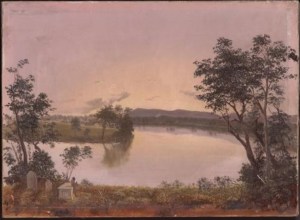
Sadly, some families lost children at Moreton Bay. John Wallace, aged four, died on 9 February 1834, followed by three-year-old Harriet Fry in May 1834. The graves of soldiers’ children were placed on the riverbank at North Quay, overlooking the Brisbane waters. The children were reinterred, with great respect and dignity, in Toowong Cemetery, when progress demanded that the riverside be developed.
Cranfield, Louis Radnor: Early Commandants of Moreton Bay. Journal of the Royal Historical Society of Queensland volume 7 issue 2: pp. 385-398.
Colonial Secretary’s letters received relating to Moreton Bay and Queensland 1822-1860.
Ryan, John Sprott: Captain Foster Fyans and Mrs. Eliza Fraser. Journal of the Royal Historical Society of Queensland volume 12 issue 2: pp. 260-263.
Brown, PL: ‘Fyans, Foster (1790–1870)’, Australian Dictionary of Biography, National Centre of Biography, Australian National University, 1966.
Cranfield, Louis Radnor: ‘Logan, Patrick (1791–1830)’, Australian Dictionary of Biography, National Centre of Biography, Australian National University, 1967.
The Brisbane Courier (Qld.: 1864 – 1933) Sat 28 Apr 1923, Page 19, THE FOUNDERS OF BRISBANE.
Cranfield, Louis Radnor: ‘Clunie, James Oliphant (1795–1851)’, Australian Dictionary of Biography, National Centre of Biography, Australian National University, 1966.
Jarrott, J. Keith (John Keith): Gorman’s Gap. Queensland Heritage volume 3 issue 4: pp. 24-38. Oxley Memorial Library Advisory Committee for the Library Board of Queensland, 1976
Hahn, Pamela: The marked tree line: the Gorman’s Gap walking trail. Journal of the Royal Historical Society of Queensland volume 15 issue 7: pp. 338-342. Royal Historical Society of Queensland, 1994.
Harrison, Jennifer: “The Moreton Bay Commandants and Their Families, 1824-1842.” Journal (Royal Historical Society of Queensland 2007).
[i] Charles Miller was not the first European infant born at Moreton Bay. The Amity had barely landed when Sergeant Robert Hay Thompson and his wife Mary welcomed a little girl, Amity Moreton Thompson. Despite her humble surroundings at birth, Amity lived until 1900. NSW Registry of Births, Deaths and Marriages.
[ii] Harrison, Jennifer. The Moreton Bay commandants and their families, 1824-1842 [Article presented at A History of Women in Queensland Seminar at the Commissariat Store on 13 August 2005.] [online]. Journal of the Royal Historical Society of Queensland, Vol. 20, No. 4, Nov 2007: 148-158.
[iii] Sydney Monitor (NSW : 1828 – 1838), Wednesday 17 February 1830, page 4
[iv] Governor Brisbane died not long after, and his successor kindly named the place of secondary punishment after him.
[v] Colonist (Sydney, NSW : 1835 – 1840), Thursday 7 September 1837, page 4.
[vi] Blue Books of the Colony
 Moreton Bay and More
1 Comment