
AN EARLY FASHION VICTIM
The first European women in Australia were of two distinct classes – Government/Military wives and poor convict women. The latter were largely immune to the variations in high style. The former were prey to the slings and arrows of outrageous fashion – foremost among these was Mary Bligh Putnam. Mary accompanied her volatile father to the Colonies to act as his first lady, her mother having flatly refused to make such a long sea voyage to such a primitive spot. Mary Bligh Putnam was only 22 when she arrived in Sydney, and set about charming the locals with her accomplishments and graceful fashions. Determined to be elegant in challenging circumstances, Mary kept up with the very latest fashions from London and Paris.
The styles of the time were classically inspired, loosely draped light materials (usually muslin), with low necklines and straight skirts[i]. These dresses were diaphanous tending towards the transparent, as poor Mary found to her cost at a church service at the Orphan School. Entering the building on her irascible father’s arm, the strong light behind her revealed Mary’s figure to all present, to the audible glee of the congregation. [ii] The only ladylike thing to do was to faint, which Mary promptly did. The only fatherly thing to do was bluster and rant, which Governor Bligh promptly did.
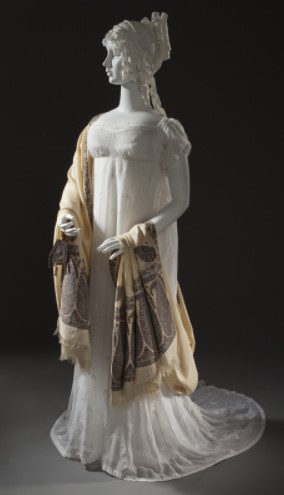
Mary Bligh Putnam thus became the first fashion victim in the Colonies. In the decades that followed, Queensland ladies ignored the climate and their general surroundings and followed the styles of dress and conduct that prevailed “at home.” A quick tour through the ensuing decades shows the sheer fortitude it took just to get dressed.
MORETON BAY 1842 – 1855 – MAKE IT YOURSELF OR BUY IT FROM OLD TOM
In the first years of the Moreton Bay settlement, a woman in need of a new outfit had few options. If she was handy with a needle, she could purchase some material from Skyring’s Beehive or Richardson’s store, where she could pick past the moleskins, boots and ironmongery to obtain her laces and trimmings. Until 1848, when the population increased enough to support a drapery store, a lady had to resort to consignments auctioned by Tom Dowse for new ready-made dresses (advertised invitingly next to fish-hooks).

A glance at an 1848 draper’s advertisement from the Moreton Bay Courier shows a bewildering list of unheard-of items available to make up a wardrobe – worked collars, mourning collars, and dunstable garden bonnets.
Underneath one’s muslin, tweed or silk garments, lay a complex system of unmentionable garments, including drawers, chemises, corsets, stockings and petticoats. Drawers were long underpants that ended at the knee, while a chemise was a loose under-dress[iii]. Corsetry was generally meant to provide back and chest support, in the days before the invention of the brassiere.
When waist measurements became more exacting in the 1850s, the corset went from providing support to threatening suffocation. The effect of all this layering in the sub-tropical heat would have been paralysing, but at the time, wearing cotton garments under one’s outer garments was seen as practical – a way to absorb perspiration and avoid having to launder complex and expensive gowns too often.

In this early daguerreotype, the Clark sisters wear the styles of the late 1840s. But that’s not the only reason they’re looking so glum. Photos took nearly 10 minutes to produce. (Library of Congress collection.)
To dress in fashion called for a corseted waist, contrasted by skirts made to look fuller with additional petticoats. Ears, for some mysterious reason, were kept hidden by the hair, which itself was bonneted whenever a woman of any class ventured out of doors.
If a lady was able to travel to Sydney, a new store called Messrs David Jones and Company offered a retail experience to make a strong woman swoon:
“THE SILK, SHAWL, AND MANTLE ROOM Presents attractions to Ladies which must be seen to be appreciated. Here are displayed, in great profusion, the most recherche SILKS and SHAWLS ever produced, from the looms of the most eminent English and Foreign Manufacturers, together with an endless stock of CLOAKS, VISITES, SCARFS, and DRESSES, in every fabric now in vogue. In the Room adjoining this Department (Presided over by Ladies of acknowledged taste and judgment), Ladies can enjoy the strictest privacy in trying on Bonnets, Cloaks, Shoes, &c. In this latter Department, Messrs. D. Jones & Co can exhibit the most tasteful display of BONNETS, CAPS, HEAD-DRESS FLOWERS & C., ever offered to the Public of Australia.”[iv]
THE CRINOLINE DIVIDES THE COLONY 1855-1869
By the mid-1850s, a strange new object appeared on the horizon. It was destined to be more controversial, and also more deadly, than any other fashion. It was the crinoline. What began as a slightly wider skirt bolstered by petticoats became a floating hooped edifice that made most of the unremarkable aspects of life (sitting down, walking indoors) remarkably difficult. Yet, by the late 1850s, every woman wore some form of this skirt (one suspects that was because the crinoline skirt was all that stores sold and patternmakers produced). The caged crinoline – a series of steel hoops – provided some relief for women hitherto suffocating under endless petticoat layers to achieve the desired width. It allowed for some freedom of movement in the legs, but made a bizarre swooping action if the wearer actually used those legs.
Satirists tittered, editorials railed, churchmen thundered from their pulpits. Women, particularly younger women, wore them regardless. A mock Act of Parliament was published.
PROHIBITION OF CRINOLINE.
ANNO VICESIMO SECUNDO AND VICESIMO TERTIO VICTORIAE REGINÆ CAP. CCXXXVIII.
AN Act for the Reform and Regulation of Female Apparel, and to Amend and Refrenate the customs relating to crinoline and other artificial superfluities and the profusion thereof, with the powers, provisions, clauses, regulations and directions, fines forfeitures and penalties, to be observed, applied, practised and put in execution for securing the proper observances of the same.
(Session, 1859.)
Whereas it has become necessary and expedient for divers cogent reasons, hereinafter set forth and fully shown, that certain customs relating to crinoline and other articles of female dress should be regulated and reformed by special Act, be it therefore enacted by and with the approbation of the Lords Spiritual and Temporal and Commons in this present parliament assembled, and by authority of the same, as follows—
1. From and after the respective times hereinafter appointed, the certain potential rights, powers, claims, &c., held by the female sex, by virtue of which they have chosen the pattern and configuration, and determined the shape and dimensions of their exterior habiliments, shall respectively cease and determine, and shall be, and the same are hereby repealed.
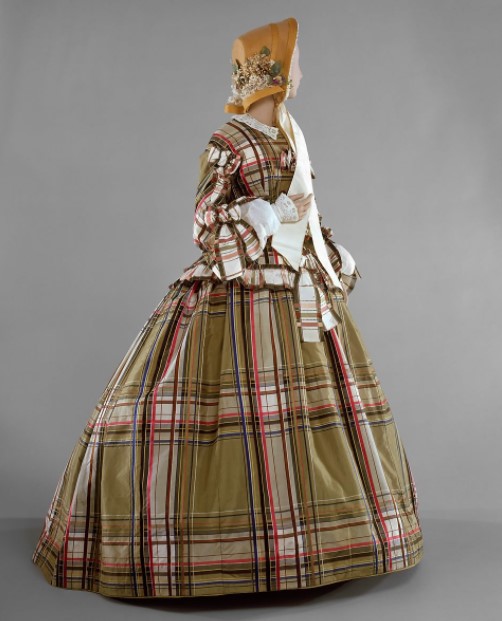
2. That from and after the passing of this act no female shall, under any pretense whatever, wear or immerse herself in a certain protruding skeleton, grating or gridiron pattern under skirt, nor any other anatomically formed framework, which shall be in diameter more than two yards, whether the same be made or fashioned out of steel, whalebone, cane, cord, wicker-work, cat gut India-rubber, gutta-percha, wood or any other material, fabric, or substance, whether screwed together, or fitted with hinges for the purpose of folding or decreasing the dimensions thereof, nor shall the same be contractible or collapsible in any manner of form, whether the same shall be made after the pattern of an umbrella or with radiating spikes, leaders, ribs, connections, strings, or framing whatsoever, or any other complex machinery, by means of which the same may be drawn together, for the purpose of making way or facilitating the transit or passage room for any. person or persons in the public streets, parks, bridges, churches, theatres, doorways, public vehicles, steam vessels, or private apartments heretofore incommoded by reason of the collisions and casualties caused thereby, under a penalty of twenty shillings for each time of offence, such sum to be earned by the offender, either at plain needlework, or shirt-making, at the usual slop charges, at the discretion of any sitting magistrate.[v]
Gentlemen bristled at the lack of space afforded them on the omnibus and train carriage when accompanied by fair “Crinolines,” a term in vogue to describe the younger wearers of the garment. It was all harmlessly amusing at first.
And then women started dying, horribly. The sweeping skirts caught at fireplaces and stoves,[vi] the sheer width of the garments often leaving the victim unaware that they had caught fire until it was too late.[vii] In 1863, a Coroner at Essex reported 91 deaths caused by the wearing of the crinoline.[viii]
Perhaps the most terrible death by crinoline was that of Mrs Baxter at Highfields, near Toowoomba in 1865.
A very sad accident happened on the 24th instant at the Victoria Sawmills, the property of Messrs. Deegan and Co. Mrs Baxter, the wife of James Baxter, a carrier, who is very well known in Toowoomba, where Mrs. Baxter was living some time, had settled at the Sawmills with her husband and their son, a little boy nine years of age. She was living with her mother not far from the mill, and was in the habit of going down there with buckets every morning to bring up a supply of water for household purposes. On that day, Friday, 24th instant, she went down with her buckets as usual at 7 o’clock in the morning. The water supply for the people living at the village is taken out of a water cask in the vicinity . of the well where it is supplied by pumps worked by the engine. This cask is in a very safe place, about fifteen feet distant from the revolving wheels – these wheels being four in number, are driven by an enormous revolving shaft, 30 feet in length and six inches in thickness. Close behind the revolving shaft is a large water, tank, from which the engine is supplied with water.
When Mrs Baxter walked up to the water cask first described she saw a German of the name of Ritmüller standing behind the revolving shaft, close to the larger water tank, where he was filling a keg with water. It appears that in order to save herself the trouble of filling her buckets out of the smaller cask, she walked up in front of the revolving shaft and requested Ritmüller to fill the buckets for her out of the large water tank. Ritmüller, before complying with her request, went on filling his own little keg.
Mrs. Baxter went close up to the revolving shaft, which was then going at a speed of about eighty revolutions per minute, when a most frightful accident happened. Mrs. Baxter had on a very large crinoline, made of steel hoops; it appears she slipped down, and her crinoline was caught by the revolving shaft in front of her stomach, the hoops all collected round her waist in one mass, and when Ritmüller turned round he saw her body revolve from sixteen to twenty times, being carried round by the shaft which had caught the hoops in front of her person. The revolving shaft is about two feet six inches high from the ground, and aa this turned, her head was struck against the boards during every revolution.
On being caught she uttered a faint cry, and stretched out her left arm, which struck against a post and was instantly smashed to pieces. Mr. Perkins, the manager of the establishment, was sitting in his little office on the opposite side of the establishment, but under the same roof, when he heard a faint cry, and noticed some unusual noise made by the machinery, which works very smoothly and noiselessly. He instantly ran out, and stopped the engine, and went to the place from whence he noticed the noise to proceed, and there he found Mrs. Baxter’s body so tightly fixed on the revolving shaft by the steel hoops, that the hoops had to be cut with an axe in order to release the body. The pressure had been so immense as to leave the impression of the hoops on the revolving shaft.
Mrs Baxter, on being released, was taken up to her house in an insensible state, where she died about half-an-hour afterwards. All intestines lying within the circumference of her waist were thoroughly smashed, the bones of her head were entirely bare, the flesh being taken completely from the forehead, and her left arm, as before stated, broken to pieces.[ix]
That would be enough to make any reasonable person feel tempted to defy the edicts of fashion, and dress to suit her health and comfort. It did not. It was a change in fashion, already beginning to take place in the Northern Hemisphere that finally freed Victorians of the hooped crinoline.
THE BUSTLE BUSTLES IN – 1870 ONWARDS
“WHO KILLED CRINOLINE? Most people would say Punch. But the wit and sarcasm of Punch’s pen and pencil were levelled against crinoline for eight or nine years without abating one jot of its inflated self-importance; and when, all at once, with scarcely a note of warning, the bell-shaped form of crinoline disappeared.”[x]
The crinoline gradually decreased in circumference, then largely disappeared by the end of the 1860s. It was replaced by another style requiring care to maneuver through daily life- the bustle. Initially, a smallish swept-up gathering of petticoats under the back of a dress in the early 1870s, it disappeared for a few years, and then returned twice as large (and risible-looking) at the end of the decade.
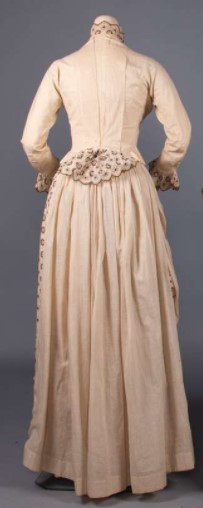
After the crinoline, this bustled dress of the 1870s seemed reasonable.
Unforgiving corsets were required to create the slimmer silhouette, and very straight skirts restricted movement in a wholly different way to crinolines. Small steps had to be taken in order not to expose (shock, horror) the feet.
This fashion would prevail for over a decade, and did not affect seating in railway carriages or walking on the footpath. There were few, if any, reports of bustle-related injuries, although how one sat down on ordinarily-proportioned chairs is not clear.
Having exhausted their outrage on the crinoline, preachers and letter-writers chose to view the bustle as just another form of feminine folly. “What game does a lady’s bustle resemble? Back gammon.”[xi]
By 1884, the tea-tray bustle had come into vogue as far north as Rockhampton, where a lady advised her readers, cryptically, of the new trends. (Mull ties are revived?)
Ladies’ Column.
NOTES.
Chalk-white lace is again in vogue. White embroidered mull ties are revived. Sleeves grow fuller and higher in the armhole. Skirts grow fuller and bustles more bouffant. White and black lace scarfs are revived for neckwear. The horse-hair cushion is the latest form of the bustle.[xii]
It would be another 40 years before the corset and other complex underpinnings left women’s clothing, and a liberated young woman of the 1920s could only gaze upon her grandmother and shudder at the sartorial horrors she must have undergone.
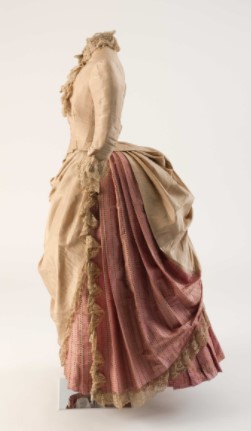
“I like big bustles, and I cannot lie.”
[i] Fashion History Timeline 1800-1809 https://fashionhistory.fitnyc.edu/1800-1809/
[ii] (Friends of the First Government House Site Inc) www.ffghs.org.au
[iii] Hudsonvalley.org – article Women’s Fashion in the 19th Century.
[iv] The Moreton Bay Courier (Brisbane, Qld.: 1846-1861), Sat 27 Dec 1851.
[v] Moreton Bay Courier (Brisbane, Qld. : 1846 – 1861), Wednesday 8 June 1859.
[vi] The Moreton Bay Courier (Brisbane, Qld.: 1846-1861), Thu 29 Nov 1860.
[vii] Maryborough Chronicle, Wide Bay and Burnett Advertiser (Qld. : 1860 – 1947), Thursday 7 August 1862.
[viii] Toowoomba Chronicle and Queensland Advertiser (Qld. : 1861 – 1875), Thursday 30 March 1865.
[ix] Toowoomba Chronicle and Queensland Advertiser (Qld. : 1861 – 1875), Thursday 30 March 1865.
[x] Queensland Times, Ipswich Herald and General Advertiser (Qld. : 1861 – 1908), Thursday 30 September 1869.
[xi] Gympie Times and Mary River Mining Gazette (Qld. : 1868 – 1919), Wednesday 6 December 1871.
[xii] Capricornian (Rockhampton, Qld. : 1875 – 1929), Saturday 11 October 1884.
 Moreton Bay and More