
NOTABLE BRISBANE PIONEERS
Henry William Shepperson was a well-known and respectable book-seller and stationer in Brisbane in the 1860s and 1870s. He produced beautiful calendars and religious pamphlets for St John’s Anglican Cathedral. Harry was active in the Masons, and was married with children, two of whom sadly died in infancy. He was an enthusiastic supporter of music and the theatre, perhaps rather too enthusiastic, because he lost his marriage and career to the arts.
The Bookseller
Harry Shepperson set up his bookselling and stationers’ business in Queen Street, Brisbane in the mid-1860s. His first claim to fame was as part of the patriotic display to greet the Duke of Edinburgh in 1868. The fledgling city glowed at night with brightly coloured illuminations in homes and businesses, and Shepperson produced a particularly English one – “A transparency representing St George and the Dragon, and containing the words “British Triumph”.[i]
The same year, Harry Shepperson offered his expertise to the Church of England, creating and printing the Brisbane insert of the Diocesan Magazine.[ii] The woodcuts were deemed to be excellent, and the reader’s attention was drawn to an article seeking the establishment of a book depot for the promotion of Christian literature. Perhaps Mr Shepperson’s fine establishment might do?
In January 1869, he suffered losses that he estimated at £150 after a flash flood in Queen Street, but he may have overestimated just a tad. “It is some satisfaction to have one’s misery brought before a sympathising public; but, as Mr. Shepperson puts it on rather heavy, I believe he jumped my claim to it.” Otto Hagen, Bookbinder.[iii]
Barely a week later, Harry was one of three men injured when a wheel of the buggy they were travelling in came loose on Sandgate Road. The men were thrown from the buggy, and Shepperson sustained serious back injuries.[iv]
Recovering, he took to exhibiting (and selling of course) oleographic reproductions of Old Masters and chromolithographs and that drew the avid praise of the Courier.[v] Later that year, he was touting a religious pamphlet called “The Church’s Creed and the Crown’s Creed.[vi]” Presumably he was still hoping for a chance to run the Christian book depot.
Harry’s wife Mary gave birth to their first child, Harry Dobbin Shepperson in December, 1868. He died of bronchitis, aged 1 year and 9 months. Another two boys followed – Leonard in September 1870, and Frederick, who lived one day after his birth in April 1872. Married life can’t have been easy with Harry’s absorbing business life, and the painful loss of two of children.
In January 1872, a charge was laid before the Magistrates at Brisbane. “That Henry Shepperson, of Brisbane, in the colony of Queensland, on the 11th day of November 1871, certain goods – to wit, 15 brooches, 12 pairs earrings, 12 sets shirt studs, 6 suites studs, 6 matchboxes, 6 solitaires, 12 lockets, 20 chains, and 6 dozen pairs pins-being goods liable to duty on importation, and then arrived at the port of Brisbane by a certain ship from ports beyond the seas, to wit, from Sydney, in the colony of New South Wales, such goods before then having been illegally unshipped without the duties on said goods having been paid, at Brisbane aforesaid, unlawfully and knowingly did harbour, keep, and conceal against the form of the statute in such case made and provided.[vii]“
The Customs procedure at Brisbane Town seemed to be a rather loose and understaffed affair, and the goods and invoices had passed through a number of hands. The wonderfully-named Ratcliffe Pring, who defended Henry Shepperson, poked a lot of holes in the prosecution case. In spite of this, Harry was found guilty and fined £50, quite a large sum in those days. The case would come back to haunt Harry many years later, but in the meantime, he directed his energies to promoting live theatre and concerts to Brisbane.
Madame Goddard
In June 1873, Madame Arabella Goddard, the celebrated concert pianist was contemplating a visit to the region, and Mr Henry Shepperson told the Telegraph that it would be a lasting shame if she could not secure a suitable venue for same[viii]. The Telegraph told its readers, who concurred, and Mr Shepperson became a part-time promoter, persuading the School of Arts to stage Madame’s concerts. Understandably, Madame brought her own piano on tour with her, sparing her any encounters with haphazardly tuned instruments that had lurked under doilies in Colonial parlours.
Madame’s short season at the School of Arts was a triumph, and Henry Shepperson, Promoter of the Arts was born. Madame was as plucky as she was talented, surviving a shipwreck off Townsville in 1874, and being obliged to spend a night in an open boat with the tight-rope walker, Blondin. Importantly, however, all the mails on board were saved.[ix] Without the mails, it would have been a catastrophe.
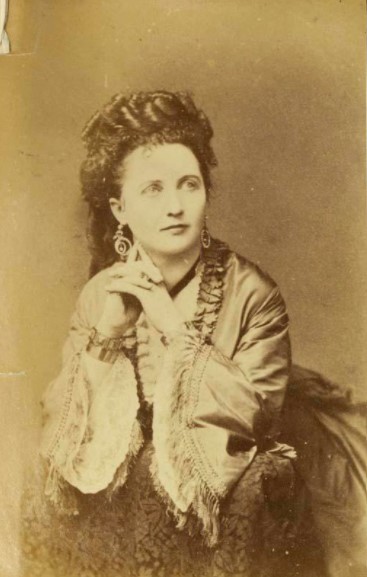
Madame Arabella Goddard (Canterbury Museum).
At the same time as he was bringing the fickle and litigious Madame to Brisbane for her triumph, Henry Shepperson was showing his charitable side. He loaned a series of lantern slides to the Lunatic Asylum for one of their evening entertainments, receiving special thanks from the Superintendent of that place.[x]
Harry’s position in Brisbane society had recovered from that little misunderstanding with the Customs – as well as Madame and the Asylum, in 1873 he became a Mason, and promoted and exhibited the Colonial landscape paintings of FL Montague to great acclaim.
In May 1874, Harry arranged for a concert by Miss Christian, Mr Farley and the Mdlles Nevaro (from France – one was a soprano, the other a forceful contralto). Then in August 1874, he had his greatest triumph – he became part of the act of the celebrated Charles Blondin,[xi] the world-famous tightrope walker who had conquered Niagara Falls with the rope and pole. Despite high winds, and a group of spectators watching his feats for free from the other side of the river, Blondin prevailed.
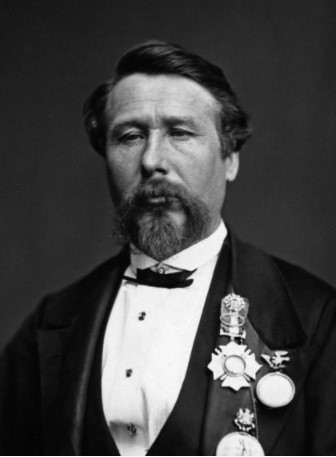
M. Blondin, nevertheless, went through his programme of dangers in the most praiseworthy manner. One of the most remarkable feats performed by him was that of partaking of a fruit and wine dessert on the rope. He carried his chair and table, the former in front, on which his pole was balanced, and the chair slung across his shoulders. Having placed them in position, a bottle of champagne and plate of fruit were pulleyed up to him, and these he partook of with evident enjoyment. The cork of the bottle not yielding readily to the corkscrew, he coolly knocked the neck off with a knife, leaning over the rope at an acute angle to do so. Instead of carrying over his secretary on his shoulders, he performed that office for Mr. Shepperson, the bookseller, who weighs over eleven stone. Blondin’s live burden seemed as unconcerned as himself, bowing to the spectators in the most nonchalant manner at several points on his aerial journey. On his descent Mr. Shepperson received quite an ovation. The feat must be admitted to be a most plucky one, however great the confidence Mr. Shepperson may have felt in Blondin’s powers. It may not be amiss to mention that the public have been greatly indebted to this gentleman, lately for affording opportunities of amusement and enjoyment they would not otherwise have had. It has chiefly been through his instrumentality that we have been favoured with visits from the leading stars in the musical world, and it was owing to him M. Blondin decided to perform in Brisbane.[xii]
Although he could not have anticipated it, that would be the summit of Harry’s success in Queensland. He continued to bring artists – of various levels of brow – to Brisbane throughout 1874 and until August 1875, when he found it necessary to leave town. And so, the curious tale of the stationer who “ran off with an actress” was born.
Constance Campbell Petrie, responding to the Bygone Brisbane tales in the Truth in January 1908, recalled:
“I often saw her and Shepperson out boating and fishing in the river, during her season here. Shepperson was a fine looking, man, always well groomed, affected frock coats and bell topper, and very much resembled Ned Hanlan, the late champion sculler, in appearance.”[xiii]
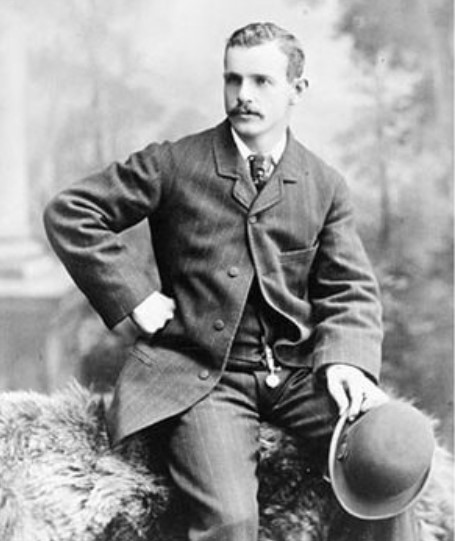
Ned Hanlan, who was said to closely resemble Harry. Or vice versa.
Miss Petrie’s recollection of the actress was that she was named Lydia Howard and was of the “leg show” type.
The Actress
Lydia Howarde was at that time the principal of the Lydia Howarde Company, an “opéra-bouffe and burlesque prima donna” of considerable note. Burlesque in those days being more about comic opera turns than removing one’s garments.
Born Annie Day in Shoreditch in 1837, she first married a gentleman who insisted on being called Signor Vitelli (despite hailing from Wandsworth), who promoted his young wife to near-stardom as Madame Vitelli before he dropped dead in the street. A widowed Annie married a Mr Charles Thatcher, who left for England in the 1870s, and Annie decided to soothe the pain of her husband’s absence by a return to the boards as Lydia Howarde. (Source – article: Australia’s Emily Soldene at Theatreheritage.org.au/on-stage-magazine).
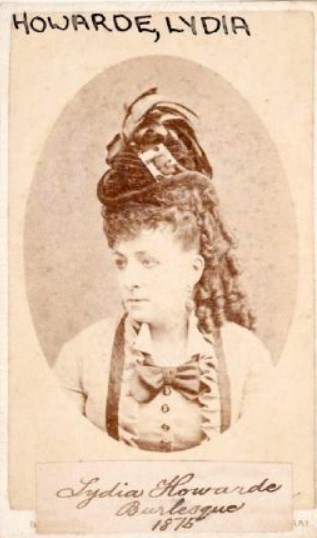
The indefatigable Harry Shepperson brought Miss Howarde and company to Brisbane in July 1875, where they performed “Chilperic,” with Miss Howarde in the leading role singing “with a vivacity that carried all before it.” It was not, the Courier[xiv] was at pains to point out, “actual opera bouffe” but rose “considerably above burlesque level,” due to the acting and singing.
Perhaps it was her vivacity that enraptured Henry Shepperson. She was in her late-thirties at the time of the running-off, and the one surviving photograph of her, taken that year, shows a lady rather too mature and serious-looking to be the “leg-show” type.
The Assault
At any event, the advent of Miss Howarde and the boating and fishing expeditions, proved too much for Henry Shepperson’s marriage. After high words with Mary Shepperson, he left her, but not after delivering her a terrible beating with a blackthorn stick. He had earlier threatened to cut both their throats.
Clearly, the church pamphlet days were over. The evidence given at the assault hearing was shocking, as was the fact that Mrs Shepperson mentioned the name of her rival in Court.
‘Defendant told her that “He had not done with her,” and that he was coming back again with a woman with whom he intended to go away on the Monday.”‘ Just who that woman was became clear in the next paragraph:
‘Complainant had said that if she were to meet him with Lydia Howarde in the street, she would horsewhip both of them. Defendant had often threatened to leave complainant.’[xv]
Henry Shepperson was fined £10 pounds, with the alternative of three months’ imprisonment. He left town. Miss Howarde left town. Mrs Shepperson, and two children, left town for a few months.
In the ensuing years, Harry Shepperson pursued a career in theatrical promotion in New South Wales and Victoria, returning to Brisbane to propose a new theatre in 1879. His bid was rejected on the basis that the City Council intended to use the site for a market hall. If they could ever stir themselves to actually erect a market hall.
“We would not like to encourage rash speculations but will venture to assert that any man among us who insures his life, pays his premiums regularly, and lives to see that market hall completed, will be a fortune to the insurance office who secures his business.”[xvi]
Miss Howarde continued to tour extensively, but her association with Harry ended. It was not until 1880 that she felt confident enough to venture back to Brisbane, where memories of that mention in the Telegraph had faded. She was, as usual a triumph, although she had to pull “The Beggar’s Opera” after one night, due to a violently miscast non-opera singer as MacHeath.[xvii]
The End
Harry Shepperson found himself spending the early 1880s in Victoria, where he did not experience the success he’d known in the north. Well and truly on his uppers, he took to collecting the mail for another Mr Shepperson (William) and trying to collect money from parties that owed the other Mr Shepperson money. He was arrested in 1885, and upon a search in the Watchhouse, found to be in possession of a number of items from a hitherto unsolved robbery at a Masonic emblem exhibition. [xviii]
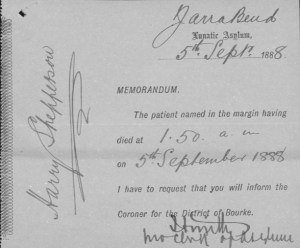
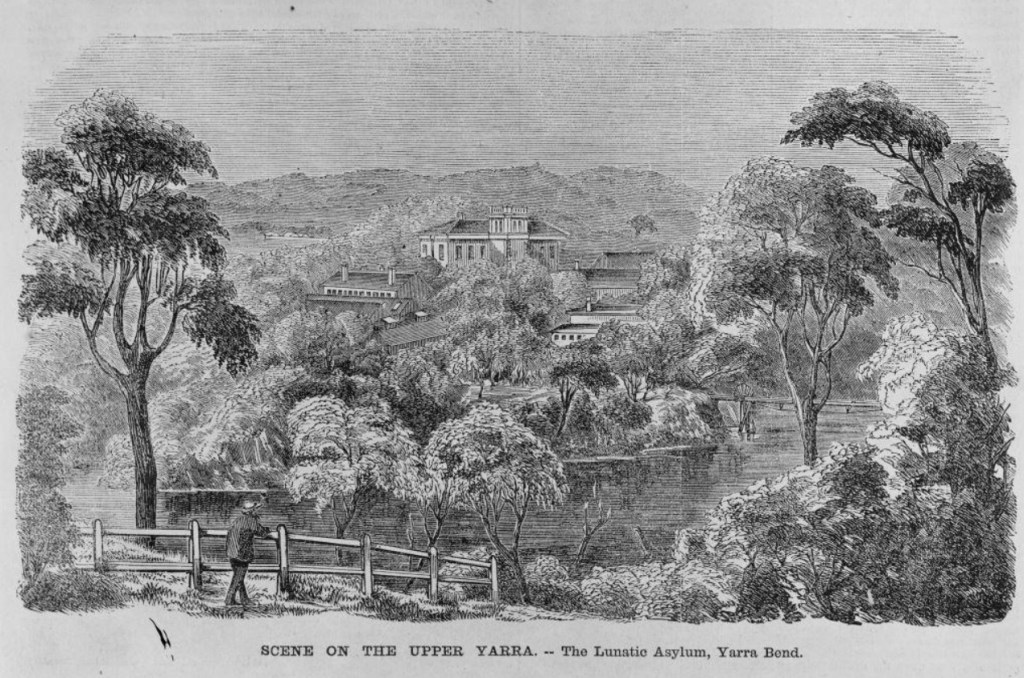
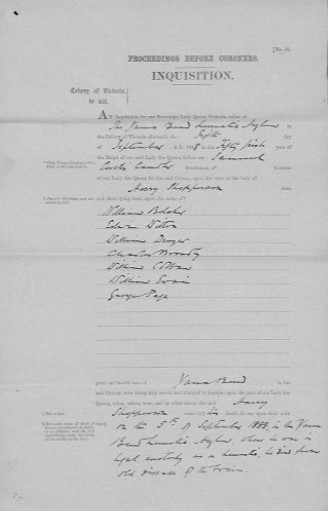
Harry was committed to take his trial in Melbourne, but, within days of entering prison, showed signs of insanity. His state of mind was confirmed by a number of doctors, and he was committed to the Yarra Bend Insane Asylum, where he died in 1888, emaciated and forgotten. It was a terrible end to the life of a man who once had a career, family, and the esteem of art and music lovers in Brisbane.

[i] The Queenslander (Brisbane, Qld; 1866-1939) Saturday 29 Feb 1868
[ii] Queensland Times, Ipswich Herald and General Advertiser(Qld 1861-1908), Thursday 17 Sep 1868
[iii] The Brisbane Courier (Qld: 1864-1933) Monday 25 Jan 1869
[iv] The Brisbane Courier (Qld: 1864-1933) Monday 8 Feb 1869
[v] Brisbane Courier (Qld. : 1864 – 1933), Friday 30 April 1869
[vi] Brisbane Courier (Qld. : 1864 – 1933), Tuesday 22 June 1869
[vii] Brisbane Courier (Qld. : 1864 – 1933), Friday 5 January 1872
[viii] The Telegraph (Brisbane, Qld: 1872-1947), Thursday 12 June 1873
[ix] Rockhampton Bulletin (Qld: 1871 – 1878), Wednesday 24 June 1874
[x] The Telegraph (Brisbane, Qld: 1872-1947), Tuesday 15 July 1873
[xi] Jean François Gravelet (1824-1897)
[xii] Brisbane Courier (Qld. : 1864 – 1933), Monday 3 August 1874
[xiii] Truth (Brisbane, Qld. : 1900 – 1954), Sunday 19 January 1908
[xiv] Brisbane Courier (Qld. : 1864 – 1933), Tuesday 13 July 1875
[xv] The Telegraph (Brisbane, Qld: 1872-1847) Tuesday 24 August 1875
[xvi] The Week (Brisbane, Qld: 1876-1934), Saturday 13 December 1879.
[xvii] Evening News (Sydney, NSW : 1869 – 1931), Saturday 29 February 1896
[xviii] The Telegraph (Brisbane, Qld. : 1872 – 1947), Friday 29 May 1885. An Accomplished Swindler.
The detective police yesterday afternoon (says the Age of May 19) effected what is considered an important arrest in the person of an alleged impostor named Harry William Shepperson, who is charged with stealing or obtaining by fraud letters from the General Post Office, the property of the Postmaster-General. Shepperson some years ago kept a large book seller’s and stationer’s shop in Queen street, Brisbane, and resided at Kangaroo Point, near that city. On one occasion he got into serious trouble with the Customs authorities, the result of which was the imposition of a very heavy fine. He soon afterwards sold his business and went to New South Wales, from which colony he recently came to Victoria. It is alleged that about a month ago he obtained at the General Post Office several letters which were addressed to and intended for a commercial traveller bearing the same name. The latter, Mr. William Shepperson, represented several influential firms in this city, and transacted a large business. In some of these letters, which Shepperson, of Brisbane, is said to have fraudulently obtained, were invoices of goods valued at between £2,000 and £3,000, and the alleged impostor, by representing himself as the owner of the goods — who at the time was in Sydney — endeavoured unsuccessfully to raise a considerable sum of money on these invoices. The firms on whom he called, however, not being perfectly satisfied of the genuineness of his representations, declined purchasing, and the real owner being informed of the matter placed the case in the hands of Inspector Kennedy. The last two firms Shepperson interviewed with the object of doing a peculiar business with these surreptitiously obtained invoices were Messrs. William Crosby and Co., merchants and shipping agents, 14 Queen street, and Messrs Felton, Grimwade and Co, wholesale druggists, Little Flinders Street West, and the latter at once communicated with Mr: William Shepperson in Sydney. When the officers called yesterday on Harry Shepperson he professed to be much too busy to see them, and affected intense surprise and indignation at the accusation preferred against him, but the proofs were too clear to admit of a doubt, and he was placed in the city lock-up. On his being searched an extraordinary discovery was made in there being found on him pawn tickets relating to a quantity of valuable Masonic jewellery stolen some time ago from a case belonging to Messrs Armfield Brothers, of Collingwood, which was in the Exhibition. One of these articles was a solid gold cross, worth about £40, on which a pawnbroker had advanced £10 10s. By the unexpected finding of these pawn tickets, what was considered a mysterious robbery will be cleared up, as several of the articles stolen from Messrs. Armfield have now been recovered.
 Moreton Bay and More