

The Moreton Bay Courier was published every Saturday in the 1840s, and on Saturday 17 March 1849, the edition gave readers all of the latest news (only three months late for overseas news!), letters and advertisements.
As was the custom at the time, the first page was devoted to classified advertising. Readers were informed that the Tamar would be steaming to Sydney on 27 March, and on every alternate Tuesday as formerly. The Crows’ Nest – equal to any run in the whole of the Moreton Bay district – was advertised for auction on 7 May at 12 o’clock precisely.
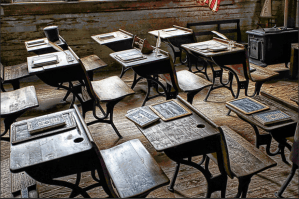
S.P. Welsby respectfully advised that the new boarding quarter at his Ipswich school would commence on Monday 26th March. “The premises are very commodious and healthily situated.” At Kangaroo Point, the wife of the Rev T.W. Bodenham was prepared to receive a few young ladies for the “usual branches of plain and ornamental education.” I have always wished that my education had been a little more on the ornamental side. “Little Boys will also be received, provided they are not above the age at which it is customary to admit them to Ladies’ Schools.” No distracting, rough teenage boys getting in the way of the young ladies’ instruction, please.
Mrs J. Rope, Junior (Milliner and Dressmaker) offered to execute orders quickly and dispatch them punctually, in the newest London and Paris fashions. For the gentlemen, Henry Neustadt (from London) advertised the same efficient service.
Saddlery and coach-making businesses promoted their wares, and Thomas Towell, Analytical Chemist (per the Fortitude) advised his readiness to receive Minerals, Ores, and other substances for analysis. Quality livestock was advertised, as was an offer to would-be cotton cultivators to try out the market. “Salary is of no consideration.” Which I think means “don’t ask for one.”
F.C. Carwithen would hear of something to his advantage if he called at the Courier office, and Tristram Baxter advised the public against giving credit to his wife “lately known as Mrs. England, the Dressmaker” as he would not be responsible for her debts. So there.
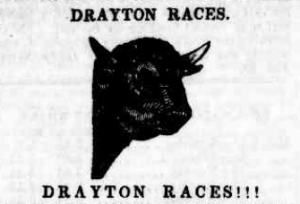
The Annual Drayton Races were advertised for early May, with a curt reminder that all dogs found on the course would be destroyed.
People were losing things. Hired servants disappeared from what was undoubtedly harsh manual labour, cattle strayed from a station at “Old Man’s Water Hole,” and Robert Graham & Co lost a cashbox from alongside the Tamar, with a veritable who’s who of Moreton Bay having their money orders stopped as a result. Tsk-tsk. And in the adjoining column, it appeared that Robert Graham & Co were going out of business.
Page 2 commenced with the shipping intelligence, including worrying signs of a wreck out at sea being washed up in the bay, that indicated “the effects of some most violent concussion.”
Then, having regaled its readers with lists of passengers and goods arriving and departing, the Courier got to the leader. They had a couple of the biggest stories of the day to unpack – Earl Grey’s proposal to resume transportation, and the confirmation of the death of the explorer Edmund Kennedy on an expedition to Cape York.

Earl Grey’s dozy aspect hid a tenacious zeal to send more scoundrels to the Colonies.
The idea that boatloads of convicts might again be infesting Moreton Bay’s fair shores was too much for the Courier, although it had previously tinkered with the idea as a way of solving the labour shortage. The evils attendant on transportation were too great, particularly after Dr Lang had sent so many useful Protestants on the Fortitude.
Disposing of the Editorial, Domestic Intelligence recorded the death of Charles Sidney Porter from a violent fall from a horse in the growing area of Maryborough. Indeed, Maryborough was growing so quickly that settlers had written to the Governor, requesting immigrants be sent there directly. And while the Governor was at it, perhaps a mail route directly from Brisbane to Maryborough, rather than passing through Ipswich on its way.
Then, a “Singular (Reported) Cure” for snakebite was described. A Chinese labourer working for Richard Jones at New Farm saw a black snake and decided to kill it, receiving a snake bite on his foot for his pains. The Courier admitted that it had been to some pains to verify what happened next – the Chinaman pulled up some couch grass, chewed it and placed it on the bite. “He afterwards procured a green frog, and placing it on the wounds, bandaged up the foot. Not the slightest ill-effect has since been perceptible!” Except possibly to the poor green frog, who no doubt died an unpleasant death surrounded by couch grass, foot odour and bandages.
Poor Mr William Mason at Pine River was adjusting his saddle prior to mounting his horse, when the gun he had slung on the saddle went off, and a ball passed through his hip, thigh and leg. Doctors Cannan and Ballow were summoned (from 25 miles away), and ordered Mr Mason to Brisbane Hospital, where he was reportedly doing well. The ball had very narrowly avoided the femoral artery.
A tea-party was held to celebrate the new Wesleyan church, with Dr Challinor doing the Master of Ceremonies honours. The Courier was gratified that so many attended, and that the gentlemen from the bush were well-behaved and partook of the non-alcoholic beverages with uncharacteristic zeal. Meanwhile, in Ipswich, the Rev Mr Stewart performed a divine service at the Courthouse, to overflow crowds.
The Government was still unwilling to decide what to do with the new immigrants, and the Courier reported with some sadness that vacant Crown lands were not to be used, even temporarily, for their housing. Perhaps the Government was in a pecuniary fix because it was intending to sell off the Government Buildings erected in the convict era.
Then to Edmund Kennedy on Page 3. The Courier extracted a long report from the Sydney Morning Herald. It was a terrible tale of ill-prepared, starving white men dying in a remote place.
After that harrowing read, the Courier reported on wool prices in Tasmania, and the impending failure of the wheat crops at Port Fairy for want of reapers. Those reapers who could be found were paid handsomely, and got very, very drunk. The reporter seemed to find this surprising.
In a sign of things to come, Victorians were searching for, and finding, gold. Hot words were uttered by “An Irish Felon” in the letters page of the South Australian Register, and the Adelaide postmaster stole money from a letter. There had been rain in Maitland. The King of Denmark was proposing a new constitution, giving greater power to the electors (probably in response to the unease felt by monarchs generally after 1848).
Then the Public Notices. Mr Thomas Dowse was instructed to sell a number of strong, serviceable horses. Rev Charles Stewart would preach in the Courthouse at Brisbane on Sunday 18 March. William Pickering was looking for a drayman who could also make himself generally useful. A Fortitude immigrant offered himself to prospective employers as a station manager, along with his two strapping sons, if required. Mr Black of Kangaroo Point was a teacher and was happy to measure land in any location.
The final page, Page 4, was largely devoted to extensive to-and-fro correspondence on the resumption of Transportation. Mr Porter wrote on the Proposed Cotton Colony, there was discussion on compensation for those who settled remote districts as squatters (also involving “Grey” as he signed himself).
The question of squatters occupying and cultivating land that they might never have the opportunity of actually owning would vex Colonials for years. Transportation was resumed, and indeed to Moreton Bay, later in 1849. The first ship to arrive was the Mountstuart Elphinstone, whose passengers kept the Police Magistrates of Moreton Bay and surrounding districts in a state of exhaustion for months afterwards.

The Mountstuart Elphinstone, ready to deliver scoundrels to Moreton Bay.
 Moreton Bay and More