
April 19, 1879. Maryborough, Queensland.
Robert Aitken’s disappearance continued to vex the Maryborough police. The river had been dragged, indigenous divers had been sent in to explore its murky depths, and no trace of the man had been found. Aitken’s personal life had been examined, and although there were some questions about the sequence of events on the night of his disappearance, nothing had really been found wanting.
On Saturday 19 April, the news that a woman’s body had been found floating in the river that morning galvanised the police and public. Perhaps she was the woman who had screamed out on the night of Robert Aitken’s disappearance?
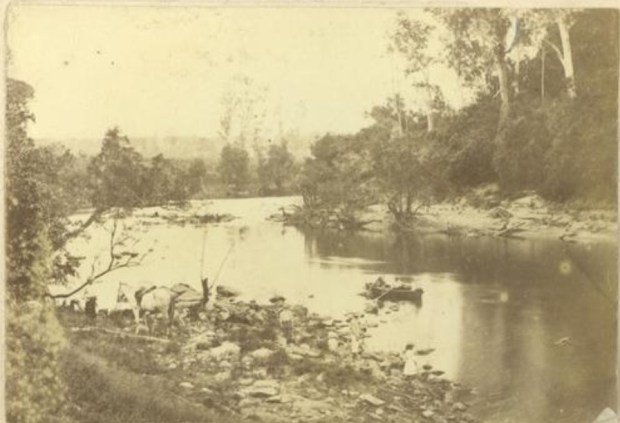
The Mary River, 1860s.
When the body was retrieved, however, it was clear that this woman had been dead only about one day, and was that of a very young woman, about 18 years old. She had drowned, and there was no sign of violence upon her. It appeared that she had fallen in, either deliberately to drown herself, or by accident. Several hours later, the body of a little boy, about 8 months old, was also found in the river.
Maryborough was a relatively small place, and police had an idea who the young woman and the baby might be. A girl named Elizabeth Sargeant gave birth out of wedlock to a son, William Michael Sargent, on 17 August 1878. She took a young local man named Michael Kennedy to court to pay maintenance. She obtained an order, which Kennedy had disobeyed. An inquest was ordered.
Elizabeth’s troubles were well-known in Maryborough, as was her large, blended family. Elizabeth was one of five children born to John Sargeant and his first wife, Rebecca Cleary. Rebecca died in 1866, and four years later John married Mary Pye, a widow with four children of her own. The family emigrated to Maryborough from Suffolk in October 1874, taking the seven youngest.
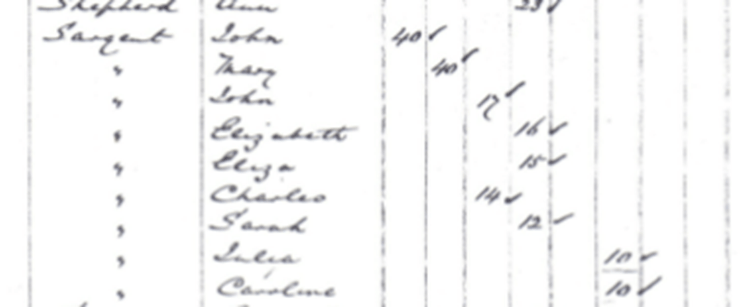
The log of the Great Queensland, showing the Sergeant-Pye family arriving in 1874.
Life cannot have been easy for the children, or their parents – a long voyage to a new, strange country. All of the stepchildren living together in one house. John Sargeant’s daughters by his first wife that suffered under his second.

Maryborough, 1874
Elizabeth’s little sister Julia rebelled first. She was interrupted in the act of trying to drown herself on 2 January 1877 and gave evidence of such an unhappy home life under her stepmother that she was taken into care. It was observed that she was so small and frail-looking that she appeared to be eight or nine, not her actual age of thirteen. The Maryborough Chronicle remarked that “If one hundredth part of the stories which she tells of the inhumanities practised towards her by Mrs. Sargeant be true, then it would indeed be profanity to call such a woman by the sacred name of ‘mother.’”
Elizabeth also chafed under her stepmother’s care and when she fell in love with young Michael Kennedy, he became the answer to her prayers – someone who cared for her, and if he would only marry her, she would be free. She went out to work for Mrs Ward as a servant and had her baby while there. Her passion for Michael Kennedy did not wane, and Mrs Ward found her going out late at night to see him. She reproved the girl and threatened to sack her but couldn’t bring herself to do so because no-one would take a servant with an illegitimate baby.
Mrs Ward asked Elizabeth why she wouldn’t return home – she replied that her parents “are good to me so long as I have money.” Elizabeth would throw herself on the floor and weep if the subject came up. Shortly before her suicide, Elizabeth quit abruptly.
Elizabeth took a little cottage with her severance pay. She saw Michael Kennedy a last time on the Tuesday night before she died. She desperately wanted him to marry her, or at the very least, provide for her baby. They made a date for the following night, but Kennedy did not keep it. He told the Coroner’s Inquest that Elizabeth had seemed “quite content” when he last saw her, at the gate of her cottage. They had not, he asserted, discussed marriage or maintenance.

Maryborough c 1879
On Thursday evening, Sarah Rutherford saw her friend Elizabeth in Lennox Street. She told the inquest that the young woman was desperate. She was worried that baby William was ill, but Sarah tried to assure her that the infant was just teething. Then Elizabeth made her intentions clear – she said that she could not expect any more support from Michael Kennedy, and that she “would do some great wrong,” and the baby would not live to see another six months. Sarah begged her not to do anything foolish and suggested that Elizabeth seek help from her family. The girl replied bitterly, “My mother is no more to me than a stranger; if I get anything from her, I must pay for it.”
When called to give evidence at the inquest, Mary Sargeant was perfunctory. She had last seen her stepdaughter alive on the Tuesday. Elizabeth had failed to come and help her with her washing on Thursday. The girl had a baby by Michael Kennedy and had left Mrs Ward and taken a cottage in the belief that he would marry her shortly. About five months earlier, Elizabeth had told her that if Kennedy did not marry her, she would do away with herself, “as she did not want any other man to be in the place of father to her child.” The body in the morgue was dressed in the same gown that Elizabeth had worn on Tuesday.
John Sargeant gave similar evidence but mentioned seeing his daughter on Wednesday at a store, and worried that the baby was too lightly dressed, and would catch cold. He said that his daughter was not in want as far as he knew, and that she could have come home to get food if she wanted it, in fact, he would have welcomed her at any time. The offer to come home and be welcome at any time had not been extended by Elizabeth’s stepmother.

It’s probable that Mary Sargeant preferred to look after her own children and found John Sargeant’s children an added burden. They in turn probably resented her presence in their family life, and the result of this resentment was unkindness and misunderstanding. Family life must have been harsh indeed, if two of the girls thought that the only solution was to go into the river.
Julia Sargeant, the younger sister who had been saved from the fate Elizabeth chose, proved to be a resilient woman. Julia went on to marry twice and had twelve children. She died in 1938. John Sargeant passed away in Maryborough in 1894, and Mary Sargeant died in 1910.
SOURCES
Maryborough Chronicle, Wide Bay and Burnett Advertiser (Qld. : 1860 – 1947), Tuesday 2 January 1877 Maryborough Chronicle, Wide Bay and Burnett Advertiser (Qld. : 1860 – 1947), Thursday 4 January 1877 Maryborough Chronicle, Wide Bay and Burnett Advertiser (Qld. : 1860 – 1947), Saturday 6 January 1877 Maryborough Chronicle, Wide Bay and Burnett Advertiser (Qld. : 1860 – 1947), Saturday 5 October 1878 Maryborough Chronicle, Wide Bay and Burnett Advertiser (Qld. : 1860 – 1947), Thursday 24 April 1879 Telegraph (Brisbane, Qld. : 1872 – 1947), Monday 28 April 1879. Registry of Births, Deaths and Marriages Queensland.
 Moreton Bay and More